

Online shopping asks customers to make real financial decisions without touching, smelling, or trying a single product. That sensory gap is where sales are won or lost, and it explains precisely why e-commerce needs visual content more than any other channel. Adding product video alone can increase conversions by up to 86%, which signals that visuals are not a cosmetic add-on. They are the primary mechanism through which browsers become buyers. This article breaks down the types, tactics, and technical realities behind building a visual strategy that genuinely performs.
Table of Contents
- Key takeaways
- Why e-commerce needs visual content: the sensory gap
- The visual formats that actually convert
- Technical and strategic optimization
- The measurable business impact of strong visuals
- My take on what brands keep getting wrong
- Take your product visuals further
- FAQ
Key takeaways
| Point | Details |
|---|---|
| Visuals replace physical touch | High-quality images and video act as a digital substitute for the in-store sensory experience shoppers expect. |
| Video content converts | Product videos can increase conversion rates by up to 86% and reduce return rates by up to 35%. |
| 3D and AR raise purchase intent | Interactive visualization tools can lift purchase intent by up to 64% and conversion rates by up to 94%. |
| Technical quality matters equally | Unoptimized image files slow pages down, and a 100ms delay alone can drop conversions by 7%. |
| Consistency builds trust | A uniform visual style across product pages signals professionalism and directly supports willingness to pay. |
Why e-commerce needs visual content: the sensory gap
Walk into a physical store and you instinctively reach for the product. You feel the weight, assess the texture, read the label up close. That tactile reassurance is deeply wired into how humans make purchase decisions, and online retail simply cannot replicate it the way a showroom does. What it can do is build confidence through visuals that anticipate every question a shopper's hands would have answered.
"Visual content bridges the sensory gap in online shopping by acting as a digital handshake that converts uncertainty into confidence."
The consequences of neglecting this are measurable. One-third of shoppers abandon a purchase outright when images are missing or clearly low quality. Nearly half have returned products because online visuals turned out to be misleading. Those are not edge cases. They are structural revenue leaks that good visual content can seal.
Consumer anxiety in online shopping centers on a few predictable fears: Will it fit? Does it actually look like that in person? Is the quality real? Each of these concerns maps directly to a specific type of visual content you can deploy. Size-in-context shots using a model or everyday object answer the fit question. Multiple angles with high-resolution zoom address the quality question. Lifestyle photography answers the "does it feel right for me" question. Think of each image as one still frame standing in for a physical experience, and the business case for investing in quality becomes self-evident.
The role of visual content in ecommerce extends beyond the product page too. Category banners, social ads, email headers, and marketplace thumbnails all compete for attention in milliseconds. When every touchpoint carries the same visual authority, you build the kind of brand recognition that makes a repeat purchase feel automatic.
The visual formats that actually convert
Not all visual content performs equally, and understanding which formats earn their production cost is where strategy separates from guesswork. Here is how the main content types stack up against the metrics that matter in e-commerce.
Product photography
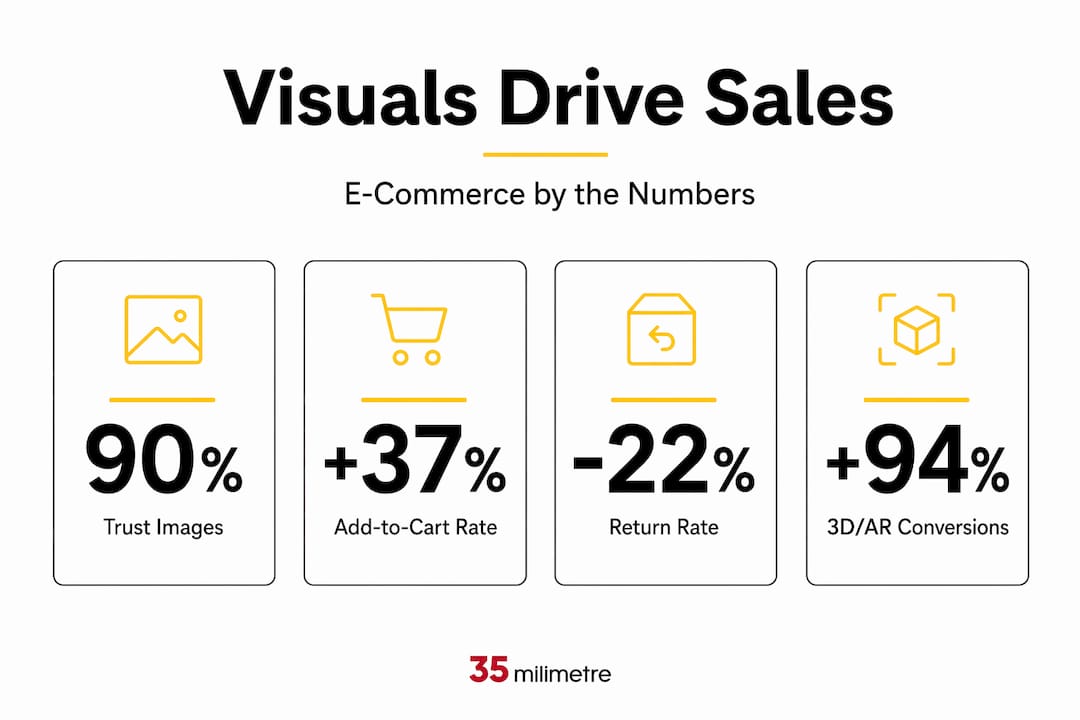
Still the backbone of any product page. 90% of online consumers say product images are the most important factor in their buying decision, and high-quality imagery can increase revenue by over 9%. The research consistently shows that simpler, distraction-free photos with clean backgrounds, multiple angles, and zoom capability convert better and reduce returns. The goal is not stylistic minimalism for its own sake. It is giving the shopper's eye exactly the information it needs without friction.
Video content
The numbers here are difficult to ignore. Product videos increase add-to-cart conversions by 37%, and shoppers who watch a product demo are 1.81 times more likely to complete a purchase. Short-form demos, 360-degree view videos, and unboxing-style content each serve a different phase of the consideration journey. Demos answer "how does it work." 360-degree views answer "what does it actually look like." Unboxing content answers "what am I really getting." Matching the video format to the question being asked is what separates high-converting video production from expensive content that gets skipped.
Pro Tip: Keep product demo videos under 90 seconds. Engagement data consistently shows drop-off accelerates past that point for e-commerce, where shoppers are in decision mode, not entertainment mode.
3D renders and AR previews
This is where the benefits of visuals in e-commerce are advancing fastest. Interactive 3D commerce tools can increase purchase intent by up to 64% and conversion rates by up to 94%. Augmented reality previews that let customers place a sofa in their living room or try on a watch virtually are no longer experimental features reserved for enterprise brands. They are becoming table stakes for furniture, apparel, accessories, and home goods.
The table below summarizes how each format contributes across four key performance areas.
| Visual format | Conversion lift | Return reduction | Production cost | Best use case |
|---|---|---|---|---|
| Product photography | Up to 9% revenue gain | Moderate | Low to medium | All categories, marketplace listings |
| Product video | Up to 86% conversion increase | Up to 35% | Medium to high | Electronics, apparel, complex products |
| 3D renders / CGI | Up to 94% conversion increase | High | Medium (scales well) | Furniture, tech, customizable products |
| AR previews | Up to 64% purchase intent lift | Very high | High | Home goods, eyewear, accessories |
| User-generated content | Up to 161% conversion increase | Moderate | Very low | Fashion, lifestyle, social commerce |
Technical and strategic optimization
Great visuals that load slowly are a liability. Every 100ms delay in page load can cause a 7% drop in conversion rates, and unoptimized image files are one of the most common culprits. The tension between image quality and file size is real, but it is solvable with a disciplined technical approach.
A few principles that the best-performing e-commerce teams apply consistently:
- Use next-generation image formats like WebP or AVIF instead of JPEG for product photos. They deliver comparable visual quality at significantly smaller file sizes.
- Implement lazy loading so only images in the user's current viewport load immediately. This prevents the full product gallery from blocking first-contentful paint.
- Separate your hero image (which must load fast) from secondary gallery images (which can load progressively).
- Maintain a consistent color grading and compositing style across all product imagery. When product pages look like they belong to the same brand, trust accumulates.
Pro Tip: Successful brands combine AI-powered image processing for speed and scale with human editing to retain fine detail and brand-specific style. Pure automation produces generic results. Human oversight is what keeps the output on-brand.
Mobile optimization deserves its own emphasis. Poor image quality on mobile actively drives shoppers away, and with mobile commerce now representing the majority of online sessions for many categories, this is not a secondary consideration. Images need to look sharp on a 390-pixel screen, not just a desktop monitor. That means testing renders and photos at mobile resolution before they go live, not as an afterthought.
User-generated content rounds out a strong visual strategy. Real customers photographing your product in real environments provide the authenticity that polished studio shots cannot replicate. The trust signals UGC carries are why it drives conversions up 161% when integrated effectively into product pages and social proof modules.
The measurable business impact of strong visuals
The case for investing in visual content is not philosophical. It shows up directly in the metrics that determine whether an e-commerce business grows or stagnates.

Conversion rates are the most immediate signal. Video content alone, placed on a product page, can push conversion rates up to 80 to 86% higher. That is not a marginal lift. That is the difference between a product that sells and one that sits.
Returns are the less-discussed but equally consequential metric. In online fashion, return rates can reach 64.3%, and poor or misleading visuals are a primary driver. When you invest in accurate color grading, realistic texture rendering, and scale-in-context photography, you give customers enough information to make the right decision the first time. That directly reduces the reverse logistics cost that erodes margins.
"When shoppers can see a product clearly from every relevant angle, the post-purchase regret that drives returns drops substantially."
Customer trust and willingness to pay are harder to quantify but very real. A product presented with professional photography, clean compositing, and consistent visual style signals that the brand behind it takes quality seriously. That inference carries through to pricing tolerance. Shoppers will pay more for a product that looks like it belongs in a premium catalog, even when the underlying product is identical to a cheaper competitor's offering. This is one of the most underutilized levers in visual marketing strategies for e-commerce.
SEO performance also benefits. High-quality images with proper alt text, structured data markup, and fast load times contribute to both organic search rankings and Google Shopping visibility. Time on page increases when visual content is engaging, and that behavioral signal feeds back into search ranking algorithms.
My take on what brands keep getting wrong
I've worked with enough e-commerce brands over the years to recognize a pattern that shows up repeatedly. The conversation usually starts with "our conversion rate is underperforming" and ends with a discovery that the product imagery hasn't been updated since the catalog was first built. The visual content gets treated as a launch cost rather than an ongoing investment.
What I've found is that brands often underestimate the cumulative damage of inconsistency. It's not one bad photo that kills trust. It's eight product pages where the lighting shifts, the background tone changes, and the crop ratios don't match. That visual noise reads as amateurism, even when the product itself is excellent.
The other misconception I see frequently is the belief that AI image generation can fully replace the production pipeline. AI is genuinely useful for scaling repetitive tasks like background removal, resizing, and basic color correction. But the brands that lean entirely on automation for their flagship product imagery end up with content that looks synthesized rather than considered. The details that build premium perception, specifically the specular highlights on packaging, the fabric texture in a close-up, the spatial accuracy in a lifestyle composite, still require human judgment to get right.
My practical advice: treat visual content the way you treat paid media. Give it a budget line, a production calendar, and a quality review process. The brands that do this consistently outperform those that treat visuals as a one-time checkbox.
— 35mm
Take your product visuals further
If you've read this far, you already understand that product imagery is doing more work than most people give it credit for. At 35milimetre, we've spent over two decades helping brands in technology, automotive, and consumer goods produce visual content that holds up under scrutiny. Whether you need high-end commercial retouching and post-production for a full product catalog, 3D renders for a product that doesn't exist yet, or compositing that puts your product in any environment imaginable, we build imagery that performs. Explore what a professional visual production partnership looks like for your brand.
FAQ
Why do product images matter more than product descriptions?
90% of online consumers say images are the single most important factor in their purchase decision, because visuals communicate product quality, scale, and context faster than text can.
How much can video increase e-commerce conversions?
Product videos can boost conversion rates by up to 86% and increase add-to-cart actions by 37%, making them one of the highest-ROI visual content investments for product pages.
What is the impact of 3D and AR visuals on purchase intent?
Interactive 3D tools and AR previews can increase purchase intent by 64% and conversion rates by up to 94%, particularly for categories like furniture, apparel, and accessories where fit and appearance are critical.
Can image quality affect page speed and conversions at the same time?
Yes. Unoptimized images cause load delays, and a 100ms page delay can reduce conversions by 7%. A balanced approach using compressed formats like WebP and lazy loading lets you maintain visual quality without sacrificing performance.
How does visual content help reduce product returns?
Realistic visuals that show accurate color, texture, scale, and multiple angles give shoppers the information they need to make confident decisions. Videos on product pages alone can reduce returns by up to 35%, cutting reverse logistics costs directly.