
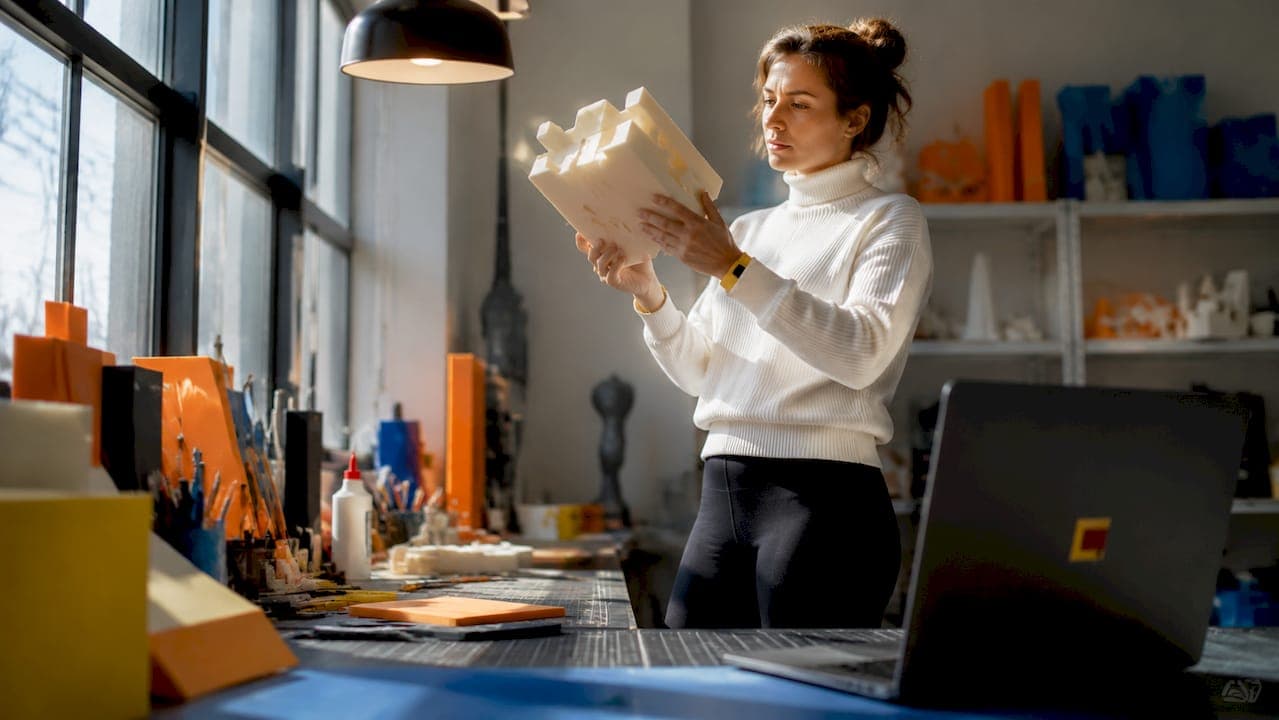
3D design is defined as the creation of digital models that represent objects, spaces, or concepts with accurate geometry, depth, and spatial relationships. For businesses and individuals who need to communicate complex ideas visually, it is the most precise and flexible tool available. Platforms like SOLIDWORKS and Autodesk have made this capability accessible across industries, from product development to advertising. Understanding why choose 3D design means understanding how it changes the quality of decisions, the speed of approvals, and the clarity of communication at every stage of a project.
Why choose 3D design over traditional methods?
The most direct answer is precision. 3D design software enables sub-millimeter precision, catching interference and assembly conflicts before a single physical part is manufactured. That kind of early error detection is not just convenient. It prevents the kind of costly production delays that derail timelines and inflate budgets.
Beyond accuracy, the benefits of 3D design extend into workflow efficiency. When a team works from a single digital model, changes propagate across every view and output automatically. There is no need to redraw elevations, update separate diagrams, or reconcile conflicting versions. This alone reduces development time significantly, particularly in product-heavy industries like consumer electronics and automotive manufacturing.

Stakeholder communication is another area where 3D design delivers measurable value. 3D models provide spatially accurate views that help both technical and non-technical audiences understand a product or space without needing to interpret abstract symbols or flat projections. A marketing director and a mechanical engineer can look at the same model and reach the same conclusions, which reduces the back-and-forth that typically slows approvals.
Cost savings follow naturally from all of the above. Fewer physical prototypes, faster iterations, and reduced miscommunication mean lower overall project costs. Digital 3D models enable quick color or fabric changes with one click, which makes them especially powerful for marketing teams that need multiple product variations without scheduling additional photo shoots.
Pro Tip: Build your 3D model with downstream uses in mind from day one. A model created for engineering review can also serve as the source for marketing renders, packaging mockups, and e-commerce imagery, but only if it is structured cleanly from the start.
How does 3D design compare to 2D design?
The core limitation of 2D design is that it asks the viewer to mentally reconstruct depth, scale, and spatial relationships from flat information. For simple shapes, that works. For complex products, architectural spaces, or multi-component assemblies, it introduces interpretation gaps that lead to misunderstandings and costly revisions.
3D design removes that interpretive burden entirely. A product rendered from multiple angles, under different lighting conditions, with accurate material textures communicates far more than a technical drawing ever could. This is why industries like architecture, automotive, and consumer packaged goods have shifted toward 3D visualization as their primary communication format.
| Dimension | 2D design | 3D design |
|---|---|---|
| Depth and spatial clarity | Requires interpretation | Immediately visible |
| Stakeholder alignment | Often requires explanation | Self-evident from the model |
| Iteration speed | Redraw required per change | Updates propagate automatically |
| Error detection | Often found in prototyping | Caught during modeling |
| Marketing flexibility | Limited to drawn views | Unlimited angles and variations |
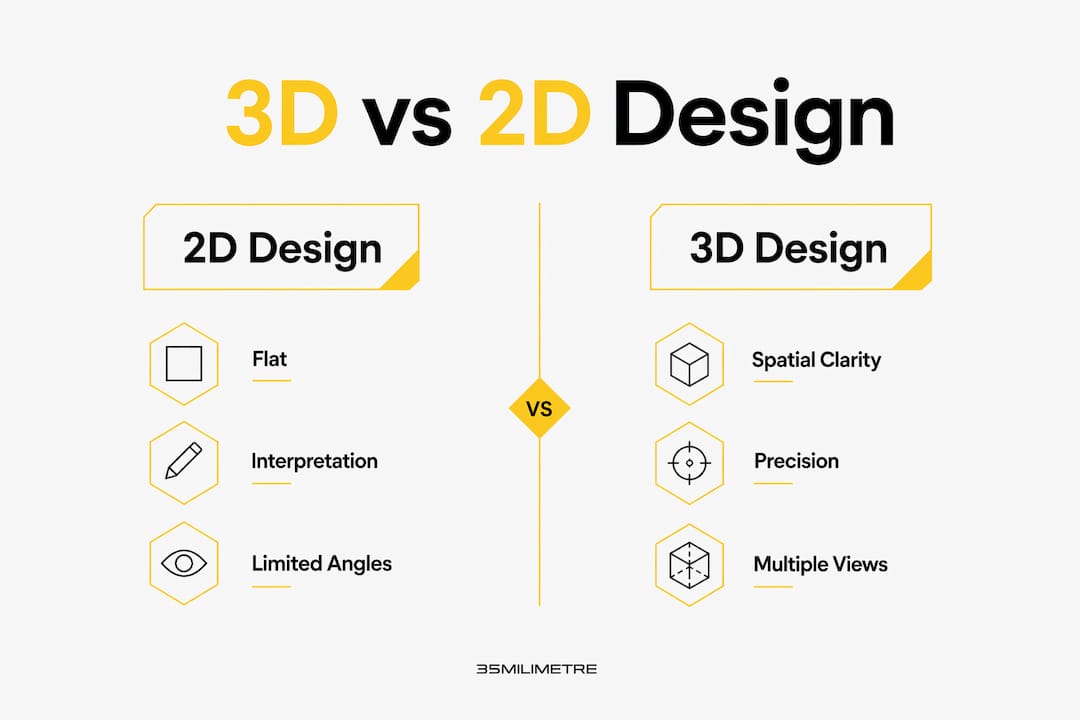
The table above makes the practical difference clear. In product development, errors caught during 3D modeling cost a fraction of what they cost when discovered during physical prototyping. In marketing, the advantages of 3D models are equally concrete: one master file can generate dozens of campaign images across different backgrounds, colorways, and contexts.
3D design acts as a conceptual space where designers assess form, proportion, and emotional tone in ways that flat sketches simply cannot support. That spatial truth accelerates creative decisions and produces work that connects more effectively with audiences.
What are the practical applications of 3D design?
The applications of 3D design span nearly every industry that relies on visual communication, and the range is wider than most people initially expect.
Product visualization and rapid prototyping represent the most established use case. Brands like Apple, Nike, and IKEA use 3D product renders to finalize designs before manufacturing begins, reducing the number of physical samples required and compressing time to market. For smaller businesses and startups, this same capability is now accessible through cloud-based tools and professional studios.
Architectural visualization allows architects and developers to walk clients through buildings that do not yet exist. Photorealistic 3D walkthroughs replace static floor plans and give decision-makers the spatial confidence to approve designs and investments. Real estate developers use these renders to sell units before construction is complete, which directly impacts revenue timing.
3D design for marketing and advertising has become a standard practice among major brands. A single 3D model of a product can generate hero images, lifestyle composites, social media assets, and video content, all from one source file. This is the digital twin concept in practice: maintaining a single master model that serves engineering, marketing, and sales simultaneously eliminates duplication and keeps every asset consistent. Studios working in AI-driven visual production are now extending this further, generating contextual scenes around 3D models at a fraction of traditional production costs.
Entertainment and gaming rely on 3D character modeling and environment design as foundational disciplines. Studios like Pixar and game developers like CD Projekt Red build entire worlds from 3D assets, but the same modeling principles apply to brand mascots, product animations, and interactive experiences for commercial clients.
Packaging design is another area where 3D design delivers immediate value. Seeing a package in three dimensions, on a shelf, next to competing products, reveals proportion and visual weight issues that a flat dieline never would. For e-commerce brands, this means fewer packaging revisions and stronger shelf presence from launch.
You can see how these principles translate into real brand outcomes by exploring inspiring 3D design examples across different sectors.
What to consider when choosing 3D design services or software
Selecting the right tool or partner is where many businesses make avoidable mistakes. The decision is not simply about which software has the most features. It is about what your assets need to do after they are built.
-
Prioritize clean topology from the start. Poorly structured 3D models often require complete rebuilding when adapted for rendering, animation, or game integration. Ask any studio or freelancer you consider how they approach model structure and whether their files are built for reuse.
-
Evaluate software for your specific workflow. SOLIDWORKS suits mechanical engineering and product development. Autodesk Maya and Cinema 4D are preferred for animation and visual effects. Blender offers a capable open-source option for studios with tighter budgets. The right choice depends on whether your priority is engineering precision, artistic output, or both.
-
Consider cloud-based collaboration tools. Cloud-based 3D CAD tools enable real-time collaboration and version control across distributed teams. For agencies and companies with remote workflows, this is not a luxury. It is a practical requirement that prevents version conflicts and keeps projects moving.
-
Weigh professional services against in-house modeling. Building an in-house 3D capability requires significant investment in software licenses, hardware, and talent. For most businesses, outsourcing to a specialized studio delivers higher quality output at lower total cost, particularly for campaign-specific work where the volume does not justify a full-time hire.
-
Plan for scalability. A 3D asset built today should still be usable two years from now. Ask whether the files will be delivered in formats compatible with future rendering engines, AR platforms, or product configurators. Future-proofing your 3D library is a strategic decision, not a technical afterthought.
Pro Tip: When briefing a 3D studio, specify every downstream use for the model upfront. A model built for a single hero render and one built for animation, AR, and e-commerce imagery require different construction approaches. Knowing this at the start saves significant rework costs later.
Understanding how to communicate your needs clearly to a creative partner is covered in depth in this guide on briefing a creative studio for high-impact visuals.
Key takeaways
3D design delivers precision, communication clarity, and cost efficiency that 2D methods cannot match, making it the standard for serious product visualization and marketing.
| Point | Details |
|---|---|
| Precision prevents costly errors | Sub-millimeter accuracy catches manufacturing conflicts before physical production begins. |
| One model, many outputs | A single master 3D file serves engineering, marketing, and sales without duplication. |
| 3D outperforms 2D for complex work | Depth, scale, and spatial relationships are immediately visible, reducing misinterpretation. |
| Clean topology protects your investment | Poorly built models require rebuilding; structured files survive revisions and format changes. |
| Outsourcing often beats in-house | Professional studios deliver higher quality at lower total cost for campaign-specific 3D work. |
What two decades of 3D work actually taught us
The most persistent myth about 3D design is that it slows projects down. The argument goes that building a model takes longer than sketching a concept, so it adds time to the front end of a project. In practice, the opposite is true. 3D design reduces guesswork and decision fatigue by giving everyone on the team immediate, clear spatial information. Approvals that used to take three rounds of revisions often close in one.
What we have seen consistently at 35milimetre is that 3D models function as a shared language. When a client from the automotive sector and a creative director from an ad agency can both look at the same render and understand it without translation, the project moves faster and the final output is stronger. 3D models become a common language that reduces costly misunderstandings between technical and non-technical stakeholders. That is not a soft benefit. It has a direct impact on project timelines and revision costs.
The other thing worth saying plainly: not all 3D work is equal. A model built quickly for a single deliverable and a model built with clean topology and future use in mind are fundamentally different assets. We have rebuilt enough poorly structured files from other sources to know that the difference in upfront investment is always smaller than the cost of fixing it later. Build it right the first time, or work with someone who will.
— 35milimetre
Take your project visuals further with 35milimetre
At 35milimetre, we have spent over two decades building the kind of 3D assets and post-production work that perform across every channel, from campaign hero images to marketplace-ready product renders. Our team handles the full pipeline: modeling, compositing, color grading, and retouching, so your visuals arrive ready to use without the back-and-forth. Whether you are a brand launching a new product, an agency managing a high-volume campaign, or a photographer who needs CGI to complete a shot, we know how to deliver. Explore our visual post-production services and see what a properly built 3D workflow can do for your next project.
FAQ
What is the main reason to choose 3D design?
3D design provides sub-millimeter precision and spatially accurate visualization that prevents manufacturing errors and accelerates stakeholder approvals. It replaces interpretation with clarity, which reduces revision cycles and total project costs.
How does 3D design improve marketing results?
A single 3D model generates unlimited product images across different angles, backgrounds, and colorways without additional photo shoots. This makes campaign production faster and more cost-efficient than traditional photography for most product categories.
Is 3D design worth it for small businesses?
Yes, particularly when outsourced to a professional studio. The cost of building and maintaining in-house 3D capability is high, but accessing studio-quality renders through a specialist delivers strong ROI through reduced sampling costs and stronger visual assets.
What makes a 3D model high quality?
Clean topology is the defining factor. A well-structured model survives repeated revisions and can be adapted for rendering, animation, AR, and e-commerce without rebuilding. Poorly built models look fine initially but become expensive liabilities as project needs evolve.
How does 3D design compare to photography for product visuals?
3D product renders offer greater flexibility than photography because color, material, lighting, and background can all be changed from a single file. For products with many variants or those not yet manufactured, 3D renders are the only practical option.