

What is hands-on design experience?
Hands-on design experience is active, personal participation in the creation of design work. You are doing the work directly, not theorizing about it, delegating it, or observing someone else execute it. In practical terms, that means building prototypes, handling materials, testing functional mockups, and iterating based on real feedback from physical objects rather than from a screen.
The industry term for this broader category of learning is experiential learning, a framework that distinguishes direct, reflective engagement from passive or purely academic study. What separates hands-on design experience from general design knowledge is the physical and procedural involvement: you are not just understanding a concept, you are testing it against real-world constraints.
The core elements that define this kind of experience include:
- Direct prototyping: Moving from sketch or digital concept to a physical or interactive model you can hold, test, and modify.
- Material exploration: Handling actual materials to understand their structural limits, tactile qualities, and behavior under production conditions.
- Manufacturability awareness: Knowing whether a design can actually be built, assembled, and produced at scale.
- Iterative refinement: Treating each version of a prototype as a learning event, not just a step toward a final product.
- Cross-functional collaboration: Working directly with engineers, fabricators, or manufacturing teams to ground creative decisions in production reality.
This is what separates a designer who has worked in a studio or fabrication environment from one who has only operated inside design software.
Why hands-on learning makes you a stronger designer
Experiential learning theory holds that genuine knowledge comes from reflection on direct experience, not from doing alone. According to Kolb's framework, a learner must actively participate, reflect on what happened, apply analytical thinking to conceptualize the experience, and then use that understanding to solve new problems. Hands-on design work naturally triggers all four of these stages in a way that reading a brief or watching a tutorial simply cannot.
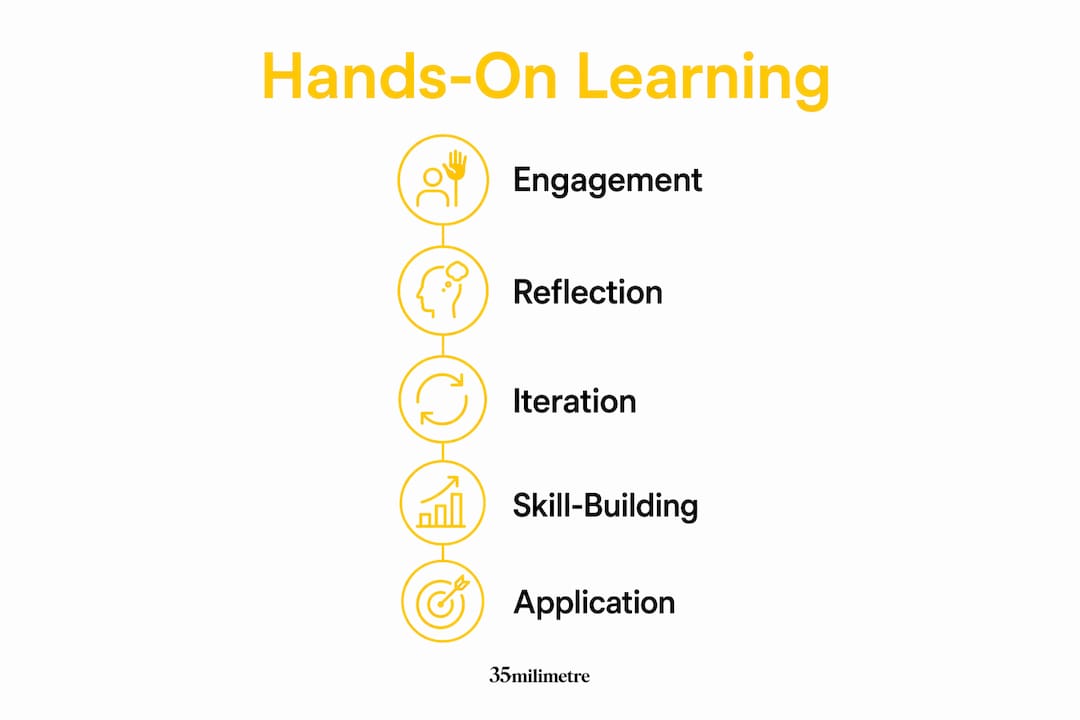
The benefits of hands-on design go beyond retention. When you physically interact with a material or prototype, you encounter constraints that no digital file will reveal: the way a surface warps under heat, the way a joint fails under load, the way a user actually holds a product. Material interaction is one of the primary mechanisms driving innovation in physical design, precisely because those discoveries cannot be simulated in advance.
Hands-on learning also improves retention and critical thinking across ages and industries. The reason is structural: when you make a decision with your hands, you own the outcome in a way that passive study does not produce. Failure becomes instructive rather than abstract.
- Deeper material knowledge through touch, testing, and physical manipulation.
- Faster problem identification because real constraints surface earlier in the process.
- Stronger creative confidence built through repeated cycles of making and adjusting.
- Better collaboration instincts developed by working alongside engineers and fabricators.
Pro Tip: After each prototyping session, spend ten minutes writing down what surprised you. The gap between what you expected and what actually happened is where your most durable design knowledge lives.
How to gain hands-on design experience in practice
The most direct path is prototyping, and you can start at any fidelity level. A paper sketch folded into a rough 3D form teaches you about proportion and assembly in ways a digital render cannot. From there, foam models, cardboard mockups, and eventually functional prototypes with real materials each add a new layer of constraint knowledge. The goal is not perfection at each stage. It is learning what breaks and why.
Physical tinkering, meaning testing ideas with actual materials before committing to digital modeling, gives you structural and material knowledge that screen-based design consistently misses. A textile designer who has spent years handling different weaves understands fabric behavior in a way that no specification sheet can convey. The same principle applies across product design, packaging, furniture, and visual production.
Practical methods for building this experience include:
- Sketch-to-prototype cycles: Start with rough sketches, build a physical version at low cost, and test it before refining digitally.
- Material sample libraries: Collect and handle physical samples of materials relevant to your field, noting how they respond to cutting, bending, heat, or pressure.
- Manufacturing floor visits: Spend time with fabricators or production teams to see how your designs translate into real processes. This is where tolerance errors and assembly problems become visible.
- Collaborative critique sessions: Present physical prototypes to engineers or end users and document their reactions, not just their words.
- Iterative build logs: Keep a record of each prototype version, what changed, and why. This turns iteration into a structured learning method rather than trial and error.
For designers working in digital and visual production, the same logic applies. Engaging directly with 3D design workflows and understanding how a render translates to a physical print or a packaged product is its own form of hands-on practice. The experiential dimension of interior and experiential space design follows the same principle: direct involvement in how a space feels and functions produces knowledge that no floor plan captures.
Challenges you will face and skills you will build
Real-world constraints are the defining feature of hands-on design work, and they are also its most demanding teacher. Material limits, production tolerances, and assembly complexity all push back against creative intent in ways that are genuinely difficult to anticipate without direct experience. Practical design in engineering contexts emphasizes cost-effective, flexible solutions over theoretical ideals precisely because real projects encounter these constraints constantly.
The skills that develop through this friction are not soft skills. They are technical and analytical:
- Manufacturability judgment: Recognizing early whether a design can be produced efficiently, before investment in tooling or production runs.
- Material fluency: Understanding how specific materials behave under real conditions, not just their listed specifications.
- Iterative problem-solving: Treating each failed prototype as data rather than a setback, and adjusting systematically.
- Cost-feasibility thinking: Balancing creative ambition against production costs and timeline realities.
- Cross-disciplinary communication: Translating design intent into language that engineers, fabricators, and clients can act on.
Designers with hands-on engineering backgrounds avoid costly production issues by recognizing manufacturing bottlenecks early, before those problems become expensive to fix. That early-warning instinct is not innate. It develops through repeated cycles of building, testing, and adjusting under real conditions.
How hands-on experience connects concept to finished product
The gap between a design file and a manufacturable product is where most costly mistakes happen. Building functional prototypes reveals manufacturing and user flow constraints that are completely invisible in static design files. A tolerance that looks fine in a CAD model may be impossible to hold in a production run. A visual composition that reads well on screen may lose critical detail in print or packaging. These are not theoretical risks. They are the daily reality of professional design practice.
Hands-on experience closes this gap in several ways:
- Early constraint discovery: Physical prototypes surface problems at the sketch or mockup stage, when changes are cheap, rather than at the production stage, when they are not.
- Bridge-building roles: Designers who translate vision directly into code or prototypes reduce friction in development handoffs, acting as a connective layer between creative intent and technical execution.
- AI-augmented craft: Building AI tools to automate manual tasks while maintaining direct creative control is an emerging form of hands-on practice, one that expands what "making" means without removing the designer from the process.
- Design for manufacturability: Understanding production realities from the outset means fewer last-minute redesigns and more efficient production runs.
The creativity that drives new design solutions consistently emerges from direct experimentation, not from planning alone. At 35milimetre, over two decades of working directly in image manipulation, compositing, and visual production has reinforced exactly this: the most reliable path from a strong concept to a finished visual is direct, iterative involvement in the making process. You can read about developing high-end visuals all day, but the judgment that separates a good result from a great one comes from having made hundreds of them yourself.
Ready to put your design skills to work?
At 35milimetre, we bring more than two decades of direct, hands-on production experience to every project, from CGI and compositing to AI-enhanced imagery and packaging visuals. If you are working on a project that needs that level of craft and involvement, explore our services and see what direct creative engagement actually looks like in practice.
Key Takeaways
Hands-on design experience builds the practical judgment, material knowledge, and production instincts that no amount of theoretical study can replicate on its own.
| Point | Details |
|---|---|
| Active participation defines it | Hands-on design means doing the work directly: prototyping, material testing, and iterating on physical objects. |
| Experiential learning requires reflection | Doing alone is not enough; genuine skill develops when you analyze what happened and why after each build cycle. |
| Physical tinkering reveals hidden limits | Testing ideas with real materials before digital modeling uncovers structural and material constraints that screens miss. |
| Early prototyping prevents costly redesigns | Designers with hands-on experience identify manufacturing bottlenecks before production investment, saving time and money. |
| Bridge roles are expanding the definition | Designers who translate concepts directly into code or prototypes reduce handoff friction and accelerate product development. |