
Custom illustration is defined as bespoke, original artwork created specifically for a brand to solve communication problems and establish a proprietary visual identity. Unlike licensed stock media, custom artwork grants full intellectual property ownership, meaning no other brand can legally use the same image. The industry term for this practice is "commissioned illustration," though "custom illustration" is now the standard phrase across branding, UX, and marketing circles. At 35milimetre, we work with agencies, startups, and marketing teams who need visuals that do more than fill space. They need artwork that communicates, differentiates, and holds up across every touchpoint.
What is custom illustration and how does it differ from stock?
Custom illustration is original artwork built from scratch for a specific brand, campaign, or product. Stock imagery, by contrast, is pre-made and licensed to multiple buyers simultaneously. That distinction matters more than most designers initially realize.

When you license a stock image, you pay for access, not ownership. Another brand in your category can buy the same license and run the same visual in their ads. Custom illustration beats stock imagery precisely because it delivers warmth, personality, and narrative that generic photos cannot replicate. A fintech startup using a custom character to explain a complex fee structure communicates trust and clarity in a way a stock photo of a handshake never will.
The cognitive advantage is also significant. The human brain processes images up to 60,000 times faster than text, making well-crafted illustration a high-return asset for brand recall and user comprehension. That speed advantage only pays off when the image is specific and intentional, which stock rarely is.
| Criteria | Custom illustration | Stock imagery |
|---|---|---|
| IP ownership | Full, exclusive | Licensed, shared |
| Brand uniqueness | Guaranteed | Not guaranteed |
| Emotional resonance | High, tailored | Generic |
| Flexibility for animation | Built in by design | Rarely possible |
| Long-term brand equity | Builds over time | Minimal |
The table above shows why brands with serious visual identity goals choose commissioned artwork over off-the-shelf options. Stock has its place for speed and budget, but it cannot build a recognizable visual language.
How to build a consistent custom illustration system
A single illustration is a tactic. An illustration system is a strategy. A consistent illustration system defines rules for shapes, stroke thickness, color palette, and proportions so that every asset looks unified, regardless of who creates it or at what scale.
The core components of a well-built system include:
- Shape language: Rounded corners signal friendliness; sharp angles signal precision or urgency. Pick one direction and apply it consistently.
- Stroke weight: A uniform line thickness across all illustrations ties them together visually. Mixing thick and thin strokes across assets breaks cohesion.
- Color palette: Limit the illustration palette to your brand's primary and secondary colors, plus one or two neutral tones. Expansion should be deliberate, not accidental.
- Perspective and proportion: Decide whether your system uses flat, isometric, or slight 3D perspective. Mixing perspectives within a system creates visual noise.
- Reusable components: Build modular elements like hands, icons, and backgrounds that can be recombined across projects without starting from scratch.
Developing a flexible yet cohesive visual rule set is what separates a one-off illustration from a scalable brand asset library. The rules do not restrict creativity. They protect consistency while giving designers a clear framework to work within.
Pro Tip: Document your illustration system in a style guide that includes do's and don'ts with visual examples. A written rule like "use 2pt stroke weight" is far less useful than showing a correct and incorrect example side by side.
For startups building their first visual language, the illustration styles for startups guide from 35milimetre covers how to choose a style direction that scales with your brand.
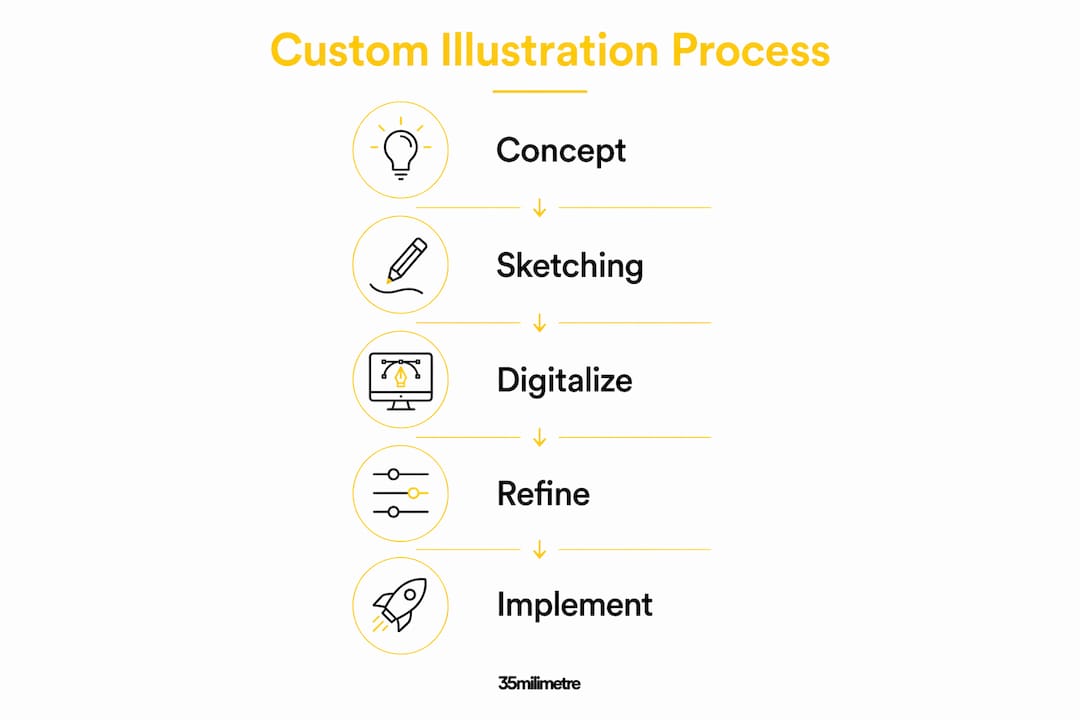
How to design custom illustrations: a step-by-step process
Knowing the theory is one thing. Executing a custom illustration project without costly rework requires a structured process from brief to final file.
-
Write a detailed brief. Define the brand voice, target audience, intended use cases, and any visual references. A vague brief produces vague artwork. Specify whether the illustration will appear on a website, in print, or in motion.
-
Establish style direction. Before any drawing begins, align on a visual style. Share mood boards, reference illustrations, and color direction. This step prevents the most expensive kind of rework: a completed illustration in the wrong style.
-
Sketch and iterate. Start with rough pencil or digital sketches. Share these early. Feedback on a sketch costs nothing. Feedback on a finished vector file costs hours.
-
Build in digital layers. When moving to digital production, organize artwork into clearly labeled layers. Layering elements like limbs on separate layers is critical for animation readiness and avoids costly re-rigging later. Even if animation is not the immediate goal, layered files give you flexibility.
-
Integrate feedback systematically. Limit revision rounds to two or three structured sessions. Open-ended feedback loops are the primary cause of timeline overruns on illustration projects.
-
Deliver in multiple formats. Final files should include vector formats like SVG and AI for scalability, plus PNG exports at multiple resolutions. Always deliver layered source files alongside flattened exports.
Small custom illustration projects for individual branding elements can be completed within 1–2 days. Complex illustration systems require significantly longer lead times. Plan accordingly and build buffer time into any project that involves client approvals.
Pro Tip: Before starting any illustration intended for digital use, confirm the final output formats with the developer or platform team. An SVG that works perfectly in a web browser may behave differently inside a mobile app or email template.
The visual assets development guide from 35milimetre walks through the broader asset creation process for marketing teams who need to coordinate illustration alongside photography and motion.
Why custom illustrations matter for branding and marketing
Illustration has evolved from decorative to a strategic element integral to UX and brand storytelling. The clearest proof of this shift is how SaaS and fintech companies now use illustration as a primary communication tool, not a visual garnish.
The most common and effective applications include:
- Website UX and onboarding: Custom spot illustrations guide users through unfamiliar interfaces. An illustration showing an empty state, a loading screen, or a success confirmation reduces user anxiety and reinforces brand personality at the same time.
- Product launches: A custom illustration system gives a product launch visual cohesion across social media, landing pages, and press materials without relying on inconsistent photography.
- Editorial and content marketing: Illustrated headers and inline graphics increase time on page and make complex topics more approachable. This is especially true for abstract concepts in fintech and SaaS interfaces, where visual metaphors replace jargon.
- Packaging and print: Custom illustration on packaging signals craft and intentionality. It tells the buyer that the brand invested in its presentation, which builds perceived value before the product is even opened.
Treating illustration as a core UX asset reduces user error and support costs while increasing engagement and brand loyalty. That is not a soft benefit. It is a measurable return on a creative investment.
Custom illustration also protects brand equity by providing authentic, proprietary artwork that competitors cannot access. As AI-generated visuals flood digital channels, the signal value of hand-crafted, commissioned artwork increases. Brands that invest now build a visual moat that generic imagery cannot replicate. For agencies looking to apply this across client work, the illustration styles for agencies resource covers how to build unified visual narratives at scale.
Understanding visual storytelling as a brand tool is the foundation that makes custom illustration investments pay off across every channel.
Key Takeaways
Custom illustration is the most direct way to build a proprietary visual identity that stock imagery, AI-generated graphics, and generic design templates cannot replicate or dilute.
| Point | Details |
|---|---|
| Full IP ownership | Commissioned artwork belongs exclusively to your brand, unlike licensed stock images. |
| Cognitive impact | The brain processes images 60,000 times faster than text, making illustration a high-return brand asset. |
| System over single assets | Define shape language, stroke weight, and color rules to keep all illustrations cohesive at scale. |
| Layer for flexibility | Build digital files with separate layers to enable animation and future edits without costly rework. |
| Strategic UX tool | Custom illustration reduces user confusion, lowers support costs, and increases brand engagement. |
Why we think custom illustration is undervalued as a brand investment
We have worked on visual projects across technology, automotive, and consumer brands for over two decades. The pattern we see most often is this: brands treat illustration as a finishing touch rather than a foundational decision. They commission one or two pieces, use them inconsistently, and then wonder why their visual identity feels fragmented.
The brands that get the most out of custom illustration treat it the way they treat typography or color. They define rules, build systems, and apply those systems with discipline. The artwork itself matters less than the framework around it. A mediocre illustration used consistently outperforms a brilliant one used once.
The rise of generative AI imagery has made this more urgent, not less. When every brand can produce a passable AI image in seconds, the brands with genuine commissioned artwork stand apart immediately. Craft signals investment. Investment signals confidence. Audiences read those signals, even when they cannot articulate why one brand feels more trustworthy than another.
For designers and marketing professionals, the practical takeaway is straightforward. Build the system before you build the assets. Document the rules before you commission the work. And treat every illustration brief as a brand decision, not just a creative task.
— 35mm
How professional post production elevates your illustration work
Custom illustration is the foundation. What happens after the artwork is finished often determines whether it performs at the level the brief demanded.
At 35milimetre, our post-production and retouching services are built to complement original illustration work across commercial campaigns, product launches, and digital platforms. We composite illustrations into photographic environments, apply color grading to align artwork with campaign visuals, and prepare assets for print, motion, and digital delivery. If you have commissioned illustration assets that need professional finishing before they go live, we handle that final stage with the same attention to detail we bring to CGI and compositing work. Reach out to discuss your project.
FAQ
What is custom illustration in branding?
Custom illustration is original, commissioned artwork created exclusively for a brand to communicate its identity and values. It grants full intellectual property ownership, unlike stock imagery, which is licensed to multiple buyers.
How long does a custom illustration project take?
Timeline depends on scope. Individual branding elements can be completed within 1–2 days, while full illustration systems require significantly longer lead times based on complexity and revision rounds.
Why use custom illustrations instead of stock photos?
Custom illustrations deliver brand-specific personality, emotional resonance, and full IP ownership that stock photos cannot provide. They also allow for animation and system-level consistency across all brand touchpoints.
How do I design custom illustrations for animation?
Build your artwork in clearly labeled digital layers, with individual elements like limbs and facial features on separate layers. This structure avoids costly re-rigging and makes the file ready for motion production from the start.
What makes a custom illustration system consistent?
A consistent system defines fixed rules for shape language, stroke weight, color palette, and perspective. These rules apply across every asset, regardless of who creates them or at what scale they are produced.