
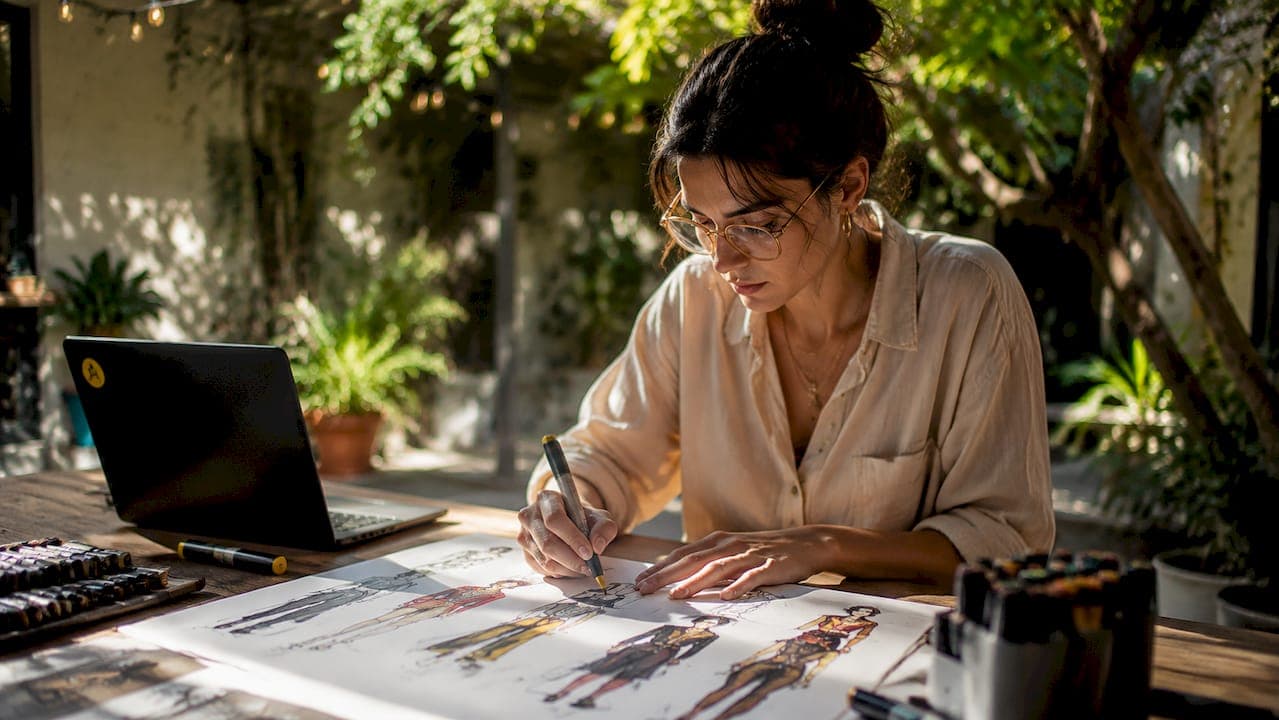
Concept art is defined as a form of visual art used in film, video games, animation, and advertising to communicate ideas before final production begins. It is not gallery art or finished illustration. It is a working document, a visual blueprint that guides entire production teams from the earliest sketch to the final rendered asset. Popularized by Walt Disney Animation Studios since the 1930s, concept art has shaped how creative industries plan, communicate, and build fictional worlds at scale.
What is concept art and why does it matter in production?
Concept art is a production tool first and an artistic achievement second. Its primary job is to answer one question before a single 3D model is built or a line of code is written: "What does this look like?" That question sounds simple, but in a production environment with dozens of collaborators, the answer needs to be clear, consistent, and functional.
Teams of up to 30 people, including programmers, designers, and animators, rely on concept art as their shared visual reference. Without it, each team member interprets a character or environment differently. The result is inconsistency, rework, and wasted budget. Concept art eliminates that ambiguity before it becomes expensive.

The importance of concept art also shows up in cost control. Catching design flaws early through concept sketches saves weeks of costly production time that would otherwise go toward fixing 3D assets or animation rigs. A character whose proportions do not work for rigging is far cheaper to fix at the sketch stage than after a 3D artist has spent 40 hours modeling it.
Concept art in video games carries particular weight because game assets must function across multiple contexts: cutscenes, gameplay, marketing, and merchandise. A single character design may need to read clearly at thumbnail size and hold up under close inspection in a cinematic. Concept art solves that problem before the asset pipeline even starts.
- Visual alignment: Concept art gives every department a shared visual language, reducing misinterpretation across disciplines.
- Early problem detection: Design issues in proportion, silhouette, or function appear at the sketch stage, not during 3D modeling.
- Cost efficiency: Revisions on paper cost almost nothing. Revisions in a 3D pipeline cost days.
- Creative direction: Art directors use concept art to set the tone, color palette, and mood of an entire project.
Pro Tip: When reviewing concept art for a production, always check the silhouette first. If a character or object reads clearly as a black shape, it will work at any scale and in any medium.
How does concept art differ from illustration and conceptual art?
The confusion between these three terms is common, and it matters. Mixing them up leads artists to build the wrong portfolio, apply for the wrong jobs, and misunderstand what studios actually need.
Concept art is functional visual communication for production, while illustration is a finished artwork created for an audience. An illustration tells a story on its own terms. Concept art exists to serve a production pipeline. The moment a concept drawing leaves the art department and reaches the modeler, it has done its job.
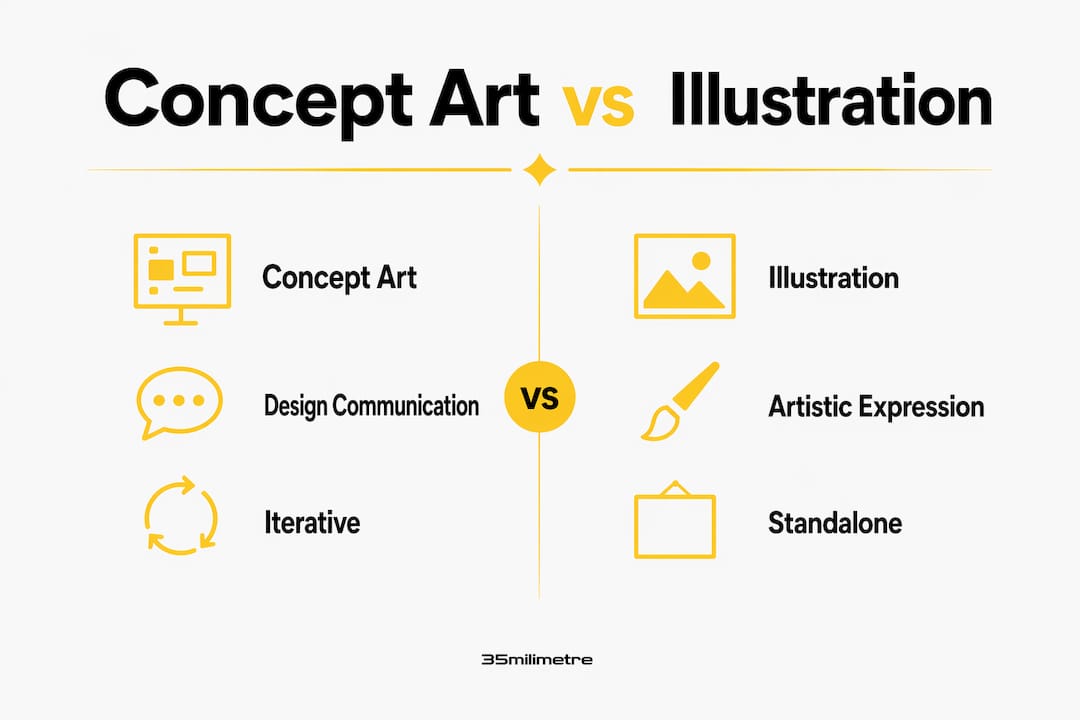
Concept art is also not "conceptual art," which is a fine art movement that prioritizes ideas over visual form. Conceptual art, associated with artists like Marcel Duchamp and Sol LeWitt, challenges the definition of art itself. Concept art, by contrast, is an applied discipline with a clear deliverable: a drawing that tells a 3D artist exactly how to build something. You can read more about the broader distinction between applied art disciplines and fine art movements in this guide to contemporary art styles.
| Type | Primary purpose | Intended audience | Finished product? |
|---|---|---|---|
| Concept art | Guide production teams | Modelers, animators, directors | No |
| Illustration | Communicate a story or idea | General audience | Yes |
| Conceptual art | Challenge ideas about art itself | Gallery viewers, critics | Varies |
The practical takeaway is direct. If you are drawing a character to help a modeler build it accurately, that is concept art. If you are drawing the same character for a book cover, that is illustration. The subject can be identical. The purpose is completely different.
What does the concept art creation process look like?
The concept art process is iterative by design. It does not move in a straight line from rough sketch to finished drawing. It cycles through phases of exploration, feedback, and refinement until the design solves every production requirement.
-
Pre-conception and mood exploration. The process starts with blue sky, exploratory phases that may look rough or unfinished. Artists gather reference images, study real-world materials, and produce loose thumbnails to establish the visual tone. This phase is deliberately messy. The goal is quantity of ideas, not quality of finish.
-
Concept sketches and variations. Once a direction is approved, artists develop multiple variations of the same design. A character might go through 20 silhouette variations before the art director selects one to develop further. Each iteration responds to feedback from directors and other departments.
-
Refined concept drawings. Selected sketches get developed into cleaner, more detailed drawings. Color, texture, and lighting studies appear at this stage. These drawings communicate mood and material to the broader team.
-
Technical model sheets. The final stage produces precise technical drawings that specify exact proportions, surface details, and functional design notes. These sheets go directly to outsourced 3D artists and animators as their primary reference. A model sheet for a vehicle might include front, side, and rear orthographic views alongside callouts for mechanical details.
The entire process depends on feedback and iteration from directors and peers. Concept art that never gets revised is concept art that was never truly tested. The willingness to redraw, rethink, and respond to criticism is what separates working concept artists from those who treat every sketch as a finished piece.
Pro Tip: Keep every iteration, even the ones you discard. Studios want to see your thinking process, not just your best drawing. A folder of 30 rough thumbnails tells a recruiter more about your problem-solving ability than one polished final.
What skills and portfolio strategies help concept artists succeed?
The most important skill in concept art is visual problem-solving, not technical drawing ability. Studios hire concept artists to answer design questions, not to produce beautiful images. An artist who can rapidly generate 15 silhouette variations and articulate why each one does or does not work is more valuable than one who renders a single character beautifully but cannot iterate.
Communication skills matter as much as drawing skills. Concept artists work alongside directors, programmers, designers, and animators who each have different visual literacy and different priorities. Translating a director's verbal brief into a drawing, then explaining your design choices clearly, is a daily requirement of the role.
Portfolio strategy follows directly from these priorities. An effective concept art portfolio documents the artist's process, including sketches, variations, references, and callouts, to demonstrate problem-solving and iterative thinking. Recruiters at major studios consistently say they want to see how an artist thinks, not just what they can produce at the end.
- Show your process: Include rough thumbnails, reference boards, and multiple iterations alongside final drawings.
- Demonstrate range: Show characters, environments, and props to prove you can handle different design challenges.
- Add callouts: Annotate your model sheets with material notes and functional details to show production awareness.
- Respond to briefs: Include one or two pieces created from a written brief to show you can interpret direction, not just self-direct.
Continual learning also defines long careers in concept art. Production tools, rendering software, and AI-assisted workflows change quickly. Artists who adapt to new techniques while maintaining strong foundational drawing skills stay relevant across multiple production cycles. Understanding how high-end visuals are developed from brief to final output gives concept artists a significant advantage when working within larger creative teams.
Key Takeaways
Concept art is a production discipline, not a fine art form, and its value lies entirely in how well it guides teams from idea to finished asset.
| Point | Details |
|---|---|
| Definition of concept art | Concept art is functional visual communication that guides production teams, not finished artwork for audiences. |
| Role in production | Teams of up to 30 people rely on concept art to align vision across programming, design, and animation departments. |
| Cost control function | Catching design flaws at the sketch stage prevents costly rework during 3D modeling and animation. |
| Concept art vs. illustration | Illustration is a finished product for an audience; concept art is a working document for a production pipeline. |
| Portfolio priorities | Studios value process documentation, including rough sketches and iterations, over polished final images alone. |
The part of concept art nobody talks about honestly
Most newcomers arrive expecting concept art to be about producing stunning images. The reality is that much of the work involves rough drafts and technical diagrams that will never be seen by anyone outside the production team. That gap between expectation and reality is where a lot of talented artists get discouraged.
At 35milimetre, we work at the intersection of concept, production, and final output. What we see consistently is that the artists who thrive are the ones who genuinely enjoy the problem-solving phase, the messy thumbnails, the rejected variations, the model sheets nobody will ever frame and hang on a wall. They understand that concept art's value lies in its application to production, not in its appearance as a standalone image.
The other thing worth saying directly: feedback is not a threat to your work. It is the mechanism that makes your work useful. A concept drawing that gets revised ten times and ends up looking nothing like your original idea has done its job perfectly. The production moved forward. That is the measure of success in this discipline.
If you are building your skills as a concept artist, resist the urge to polish every drawing before showing it. Show the rough version. Ask for feedback early. The iterative habit you build now is the same one that will make you indispensable on a production team later.
— 35mm
How 35milimetre supports visual production from concept to final output
Concept art sets the direction. What happens next determines whether that vision actually lands.
At 35milimetre, we work with ad agencies, production companies, and creative teams to take visual ideas from rough concept through to polished, production-ready imagery. Our commercial retouching and post-production services cover compositing, color grading, and CGI integration, the stages where concept art meets final execution. Whether you are producing visuals for a product launch, a film campaign, or a media project, we bring the technical depth to make the concept hold up in the final frame. Get in touch to discuss how we can support your next production.
FAQ
What is the definition of concept art?
Concept art is a form of visual art used in film, video games, animation, and advertising to communicate design ideas before final production. It functions as a working document for production teams, not a finished artwork for public display.
How is concept art used in video games?
Concept art in video games guides the creation of characters, environments, and props by giving 3D artists, animators, and designers a shared visual reference. It covers everything from early silhouette explorations to detailed model sheets with technical callouts.
What is the difference between concept art and illustration?
Concept art is functional visual communication created for a production pipeline, while illustration is a finished artwork made for an audience. The same subject can appear in both, but the purpose and intended viewer are completely different.
Do concept artists need to draw realistically?
Concept artists need to communicate design ideas clearly, not draw with photographic realism. Strong silhouette design, proportion control, and the ability to iterate quickly matter far more than rendering skill in most studio environments.
What should a concept art portfolio include?
An effective portfolio documents the full process, including rough thumbnails, reference boards, multiple iterations, and annotated model sheets, alongside final drawings. Studios want to see how you think and solve design problems, not just your best single image.