

Automotive visualization is defined as the process of creating digital 3D representations of vehicles to support design, engineering, marketing, and simulation. It covers everything from early concept sketches rendered in real-time engines like Unreal Engine to photorealistic CGI used in global ad campaigns. Brands like Porsche have moved entire consumer-facing workflows onto cloud-based visualization platforms, replacing physical prototypes and traditional photography with interactive 3D content. For automotive professionals and designers, understanding this discipline means understanding how modern vehicles are conceived, communicated, and sold before a single physical unit rolls off the line.
What is automotive visualization and why does it matter?
Automotive visualization is the industry term for generating computer-based imagery and interactive models of vehicles at any stage of their lifecycle. The practice spans concept design, engineering review, marketing production, and simulation testing. Each stage uses visualization differently, but the core goal is the same: replace costly physical processes with digital ones that are faster, more flexible, and more repeatable.
The importance of automotive visualization becomes clear when you look at production timelines. Real-time 3D visualization can reduce automotive production timelines by up to 60%. That figure represents months shaved off vehicle launches, fewer physical prototypes, and faster feedback loops between design and engineering teams.
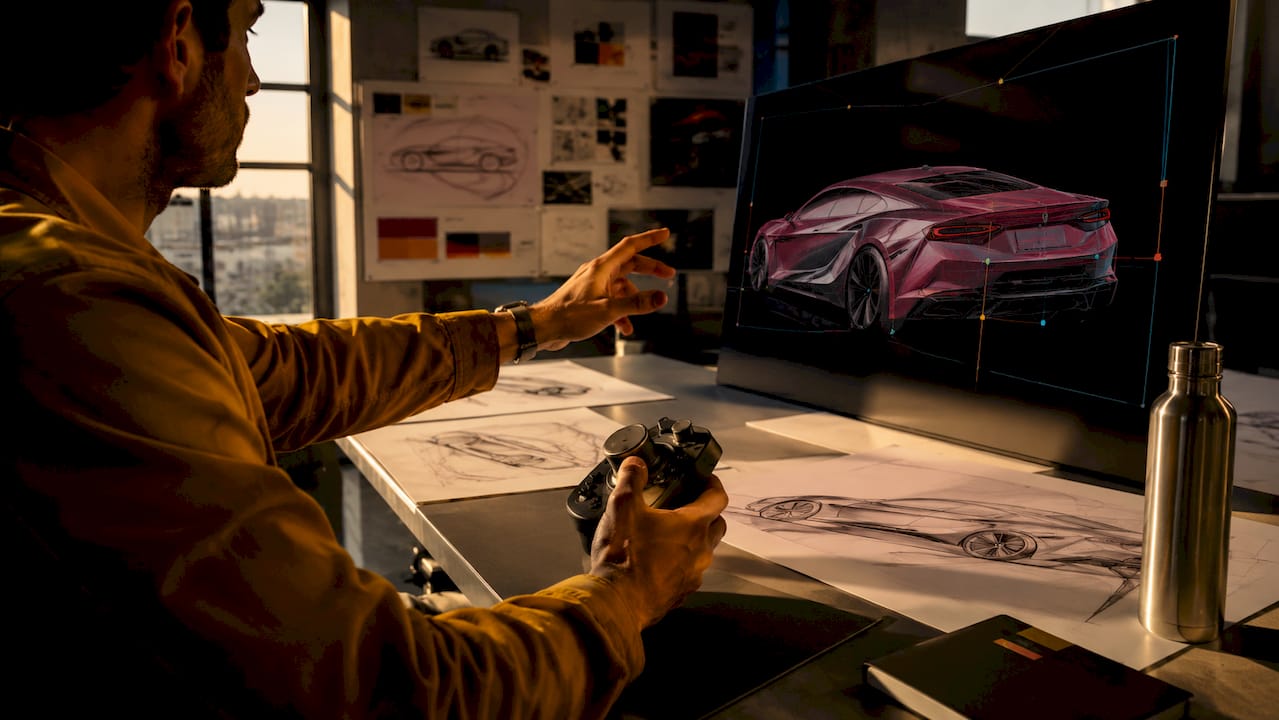
Visualization also changes how decisions get made. A designer reviewing a surface in a virtual environment can evaluate light behavior, material response, and proportion in real time. That same review in a physical clay model takes weeks and costs significantly more. The digital approach does not just save money. It produces better-informed decisions earlier in the process.
What are the core technologies behind automotive rendering?
The technical foundation of automotive visualization rests on three rendering techniques: Physically Based Rendering (PBR), Image-Based Lighting (IBL), and High Dynamic Range Imaging (HDRI). PBR, IBL, and HDRI combined deliver cinematic-quality realism for next-generation automotive HMI and surface visualization. Each technique handles a different aspect of how light interacts with a vehicle's surface.
PBR simulates how real materials absorb and reflect light. IBL wraps the vehicle in a 360-degree lighting environment captured from the real world. HDRI provides the high-contrast lighting data that makes metallic surfaces, glass, and paint behave convincingly. Together, they produce images that are nearly indistinguishable from photography.
Automotive visualization also splits into two distinct rendering workflows: real-time and offline.
- Real-time engines like Unreal Engine and Unity process frames fast enough for interactive use. Designers can rotate a vehicle, change paint colors, and swap trim levels in seconds.
- Offline rendering engines like Arnold and V-Ray use ray tracing to calculate every light bounce with maximum accuracy. Offline rendering provides maximum ray-tracing realism but is less suited for interactive visualization.
- CAD-to-mesh conversion is the pipeline step that brings engineering data into a visualization engine. It requires careful tessellation and polygon reduction to maintain surface fidelity without crashing real-time performance.
- Proprietary material libraries simulate metallic flakes, clear coats, and translucent surfaces. Automotive paint materials require physics-based proprietary textures to appear realistic. Generic material libraries simply do not capture the complexity of automotive finishes.
Pro Tip: When converting CAD data for real-time use, always run a polygon audit before importing into Unreal Engine or Unity. Incorrect CAD-to-mesh conversion is one of the most common performance bottlenecks in automotive visualization pipelines. Reducing polygon count at non-critical surfaces while preserving fidelity on visible panels is the standard professional approach.
How does automotive visualization fit into vehicle development?
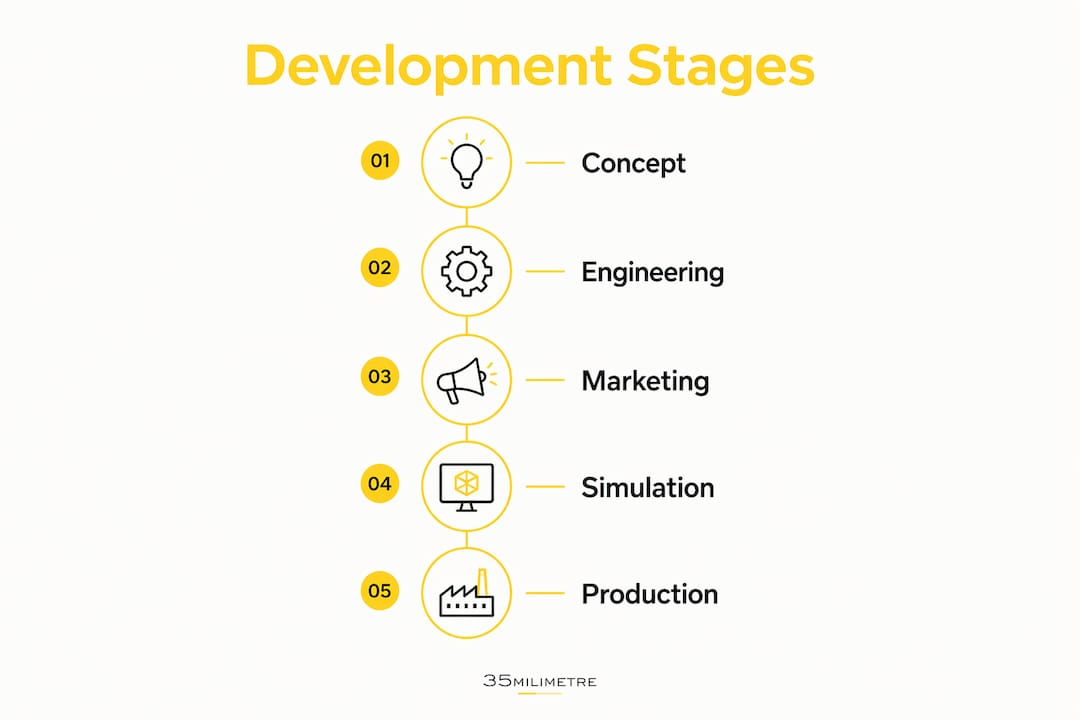
Automotive visualization operates across four stages: concept design, engineering, marketing, and simulation. Each stage has distinct goals, tools, and outputs, but they share a common thread of replacing physical processes with digital ones.
-
Concept design. Designers use visualization to test proportions, surface language, and color palettes before committing to physical models. A single 3D asset can be iterated dozens of times in a day. This stage benefits most from real-time engines, where immediate visual feedback drives faster creative decisions. You can see how visual identity thinking connects directly to this early design phase.
-
Engineering review. Visualization lets engineering teams examine assemblies, clearances, and ergonomics in a virtual environment. Reviewers can strip back body panels to inspect chassis geometry or simulate door seal behavior without building a physical mule. This reduces the number of costly engineering prototypes required before sign-off.
-
Marketing production. Photorealistic renderings and CGI sequences are produced before physical vehicles exist. A launch campaign can be fully shot, lit, and edited using only digital assets. This is where offline rendering engines like Arnold and V-Ray deliver their highest value, producing imagery that meets broadcast and print quality standards.
-
Simulation. Visualization supports aerodynamic analysis, crash testing previews, and driver-assistance system training. These applications require accurate geometry and material properties to produce valid results. The same 3D assets used in marketing can feed simulation workflows with minimal rework.
The benefit of this four-stage structure is compounding efficiency. Assets built for concept design feed engineering review. Engineering assets feed marketing production. Marketing assets feed simulation. Each stage adds value to the same core data rather than starting from scratch.
How does automotive visualization compare to traditional rendering?
The distinction between automotive visualization and traditional automotive rendering comes down to interactivity and workflow purpose. Traditional rendering produces a fixed image. Visualization produces an experience that can be navigated, configured, and streamed.
| Feature | Real-time visualization | Offline rendering |
|---|---|---|
| Primary use | Configurators, reviews, AR | Print, broadcast, film |
| Rendering speed | Frames per second | Minutes to hours per frame |
| Visual fidelity | High, improving rapidly | Maximum, ray-traced |
| Interactivity | Full user control | Static output |
| Best engine | Unreal Engine, Unity | Arnold, V-Ray |
| Asset requirement | Optimized, low-poly | High-poly, detailed |
Real-time visualization powers interactive configurators, cloud-streamed showroom experiences, and augmented reality applications. Offline rendering still dominates when the final output is a print advertisement or a broadcast commercial where every pixel must be perfect.
The gap between the two is narrowing. Unreal Engine's Lumen and Nanite technologies now deliver near-offline quality at real-time speeds. For most marketing and design review applications, real-time visualization has become the default choice.
Pro Tip: Choose your rendering workflow based on the final output format, not the asset quality. If the deliverable is an interactive configurator or a cloud-streamed dealership tool, build for real-time from the start. Retrofitting a high-poly offline asset for real-time use costs more time than building it correctly the first time.
What are the marketing and consumer engagement applications?
Automotive visualization transforms marketing by removing the physical constraints of traditional production. Virtual environments enable shoots in locations, weather conditions, and lighting scenarios that would be impossible or prohibitively expensive to arrange in the real world. A vehicle can be photographed at sunrise on a Icelandic salt flat or in a rain-soaked Tokyo alley without leaving the studio.
The applications extend well beyond static imagery:
- Cinematic launch sequences use CGI to tell a vehicle's story before it reaches showrooms. Designers and directors control every frame, from camera angle to atmospheric conditions.
- Safety feature storytelling uses visualization to show internal components in motion. Visualization techniques enable showing safety features like airbags deploying dynamically, turning engineering specifications into compelling visual narratives.
- Interactive configurators let consumers build their vehicle in real time, selecting colors, wheels, and trim levels with instant visual feedback. These tools increase purchase confidence and reduce showroom friction.
- Cloud-based platforms stream photorealistic 3D content across apps, websites, and dealership screens. Porsche replaced its 2D visualization workflow with a cloud-based 3D streaming platform that delivers consistent, photorealistic interactive experiences across every consumer touchpoint.
- Augmented reality overlays vehicle models onto real environments through smartphones and tablets, giving consumers a spatial sense of scale and presence before visiting a dealership.
Visualization also enables emotional storytelling by exposing vehicle internals in motion and blending engineering facts with lifestyle narratives. This is the capability that separates modern automotive marketing from traditional photography. A photograph shows what a car looks like. Visualization shows what it does, how it works, and why it matters. For a deeper look at how these techniques translate into real campaign results, the automotive visuals guide at 35milimetre covers this in detail.
Key Takeaways
Automotive visualization is the single most efficient tool available for compressing vehicle development timelines while simultaneously raising the quality of design, engineering, and marketing outputs.
| Point | Details |
|---|---|
| Core definition | Automotive visualization creates digital 3D vehicle representations for design, engineering, marketing, and simulation. |
| Timeline impact | Real-time 3D visualization can reduce production timelines by up to 60%, compressing months of physical work. |
| Technology stack | PBR, IBL, and HDRI combined deliver cinematic realism; real-time engines handle interaction, offline engines handle final output. |
| Workflow integration | Visualization assets built for concept design feed engineering, marketing, and simulation without rebuilding from scratch. |
| Marketing power | Cloud-based platforms and interactive configurators replace static photography with dynamic, consumer-controlled experiences. |
Where visualization meets storytelling: a perspective from 35milimetre
Working across automotive and technology accounts for over two decades, we have watched visualization shift from a niche engineering tool to the central nervous system of vehicle development and marketing. The change did not happen overnight, and it did not happen evenly. Some teams still treat visualization as a finishing step, something you do after the real decisions are made. That is the wrong way to think about it.
The studios and brands getting the most value from visualization bring it in at the concept stage and never let it leave. They use the same 3D assets to review engineering geometry, produce marketing content, and feed simulation workflows. The asset becomes a living document rather than a one-time deliverable. That approach is where the real efficiency gains live.
The part of this discipline that still gets underestimated is the material work. Getting automotive paint to behave correctly in a real-time engine requires physics-based shaders that most generalist 3D artists have never built. Metallic flakes, clear coat depth, and the way a pearl finish shifts under different lighting conditions are genuinely hard problems. Studios that solve them produce work that looks like photography. Studios that skip them produce work that looks like a video game.
Cloud streaming and real-time rendering improvements are making the interactive side of visualization accessible to smaller teams and tighter budgets. That is a real opportunity for designers and marketers who have been priced out of high-end configurator development. The tools are there. The challenge now is building the asset pipelines and material libraries to use them well.
— 35milimetre
Professional automotive visualization for your next campaign
Producing photorealistic automotive visuals requires more than powerful software. It requires a team that understands how light behaves on a carbon fiber hood, how to composite a CGI vehicle into a live-action environment without breaking the illusion, and how to deliver assets that work across print, digital, and interactive channels.
35milimetre brings over two decades of post-production and compositing experience to every automotive project. From commercial retouching and visual post-production to full CGI builds and AI-enhanced imagery, the studio works directly with ad agencies, automotive brands, and professional photographers to produce visuals that hold up at any scale. If your next vehicle launch needs imagery that goes beyond what a camera can capture, 35milimetre is the team to call.
FAQ
What is automotive visualization used for?
Automotive visualization is used across four stages: concept design, engineering review, marketing production, and simulation. Each stage uses 3D digital assets to replace or supplement physical processes.
What is automotive rendering vs. visualization?
Automotive rendering refers specifically to producing a final image from a 3D scene. Automotive visualization is the broader discipline that includes rendering, interactive configuration, simulation, and cloud-based consumer experiences.
How does automotive visualization work technically?
Automotive visualization converts CAD engineering data into optimized 3D meshes, applies physics-based materials, and renders the result using either real-time engines like Unreal Engine or offline engines like Arnold and V-Ray.
What are the benefits of automotive visualization for marketing?
Visualization removes the constraints of physical production, enabling shoots in any environment, at any stage of vehicle development, with full creative control over lighting, weather, and camera position.
What software is used in automotive visualization?
Common automotive visualization software includes Unreal Engine and Unity for real-time applications, Arnold and V-Ray for offline rendering, and Altia GUI tools for HMI visualization. Material and lighting setups rely on PBR, IBL, and HDRI techniques across all platforms.