

Marketers pour significant budgets into campaigns, yet one factor consistently determines whether those campaigns cut through the noise or quietly disappear: the quality and strategy behind their visual content. Humans process images 60,000 times faster than text, which means your audience has already formed an impression before they read a single word of your copy. The mistake most teams make is treating visuals as decoration added after the real strategy is done. In reality, visual content is the strategy, and understanding how to create, organize, and deploy it purposefully is what separates campaigns that convert from ones that merely exist.
Table of Contents
- Understanding visual content creation
- Key methodologies and workflows
- Choosing high-impact visual formats
- Mapping visuals to the buyer's journey
- What most marketers miss about visual content creation
- Unlock advanced visual content solutions with 35milimetre
- Frequently asked questions
Key Takeaways
| Point | Details |
|---|---|
| Visuals accelerate engagement | People process images much faster than text, making visuals core to marketing impact. |
| Structured workflows win | High-performing content relies on planned, efficient workflows aligned to business goals. |
| Choose formats strategically | Infographics and videos outperform static images for narrative and conversion. |
| Map every asset to the buyer's journey | Visuals tied to buyer stages drive conversion and reinforce storytelling. |
| Measure what matters | Track KPIs—engagement, CTR, conversions—to connect visuals to real results. |
Understanding visual content creation
Visual content creation is far more than picking attractive images or commissioning a designer to produce something that looks polished. At its core, visual content creation is the process of designing and producing engaging visual assets, including images, videos, infographics, and graphic elements, for digital marketing campaigns, social media, websites, and communication channels. That definition is broader than most people initially appreciate, and it matters because the scope of what counts as "visual content" has expanded dramatically alongside the platforms that distribute it.
The types of assets that fall under this umbrella include static photography, motion graphics, CGI product renders, data-driven infographics, short-form video, brand illustrations, and composited advertising imagery. Each serves a distinct function within a campaign, and treating them as interchangeable is one of the most common and costly mistakes we see. A carefully composited hero image for a technology brand carries different communicative weight than an infographic explaining product specifications, even if both feature the same product.
Why does this distinction matter for your campaign outcomes? Because visuals are processed faster, recalled more readily, and shared more frequently than any other content type. When your audience scrolls a feed, a single frame does the work of a paragraph. It establishes tone, communicates brand identity, and prompts an emotional response, all in a fraction of a second. Understanding design impact in advertising helps clarify just how much creative decisions at the visual level drive measurable results downstream.
"Your visual content is not a supporting element of your campaign. It is the first, and often only, impression your audience will carry forward."
The assets that consistently drive the highest engagement across digital channels include high-resolution photography with professional color grading, short-form video under 60 seconds, branded infographics that translate complex data into scannable visuals, motion graphics and animated social assets, and CGI or 3D product renders for e-commerce and technology sectors. Each of these formats has a distinct production process and a distinct strategic role, which is exactly why the methodology behind creating them deserves as much attention as the creative direction itself.
Key methodologies and workflows
With the foundation covered, let's explore how visual content creation is organized in practice, step by step.
Effective visual content doesn't emerge from isolated creative decisions. It follows a repeatable framework that aligns production with strategy. The key methodologies for visual content follow a logical sequence: first, understand your audience and define your visual brand identity; second, create a content calendar with clear production workflows; third, batch content creation to increase efficiency; fourth, audit existing assets regularly to eliminate off-brand material; fifth, map visuals to the buyer's journey; and sixth, measure performance using KPIs including engagement rate, click-through rate, and conversion metrics.
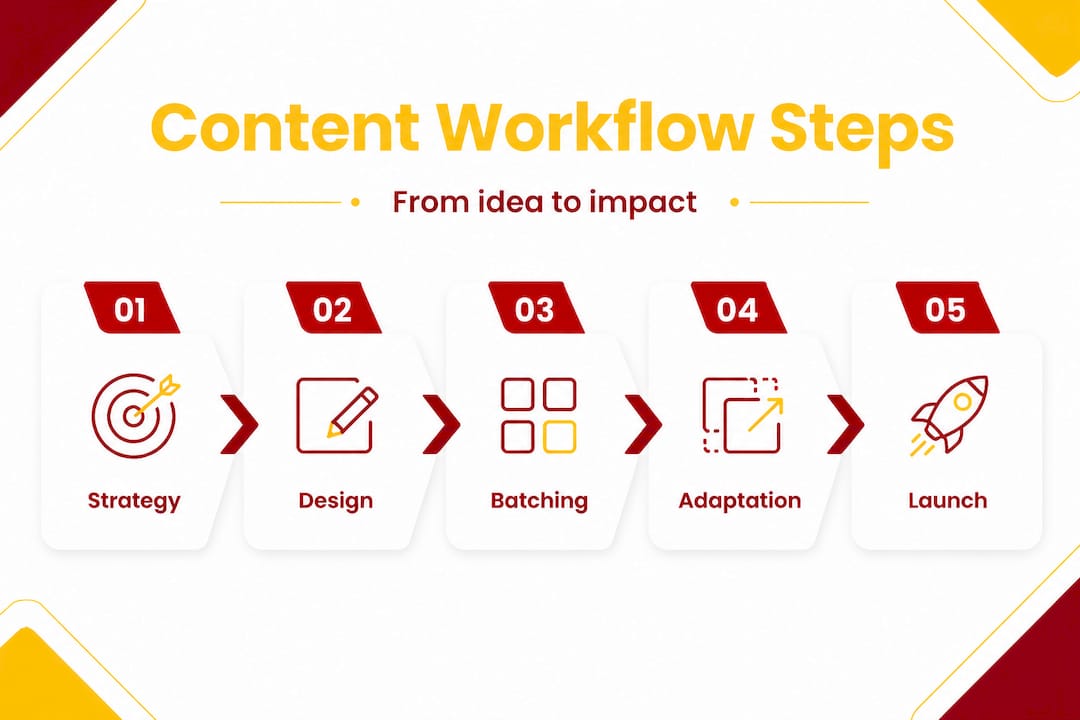
That sequence is not arbitrary. Each step builds on the one before it, and skipping any of them creates gaps that surface later as inconsistent brand presentation, wasted production budget, or content that performs poorly because it was created without a clear audience or stage in mind.
The table below maps each workflow step to its real-world impact on campaign performance.
| Workflow step | Real-world impact |
|---|---|
| Define visual brand identity | Consistent recognition across channels |
| Build content calendar | Predictable production schedules, fewer last-minute rushes |
| Batch content creation | Reduced per-asset cost and faster deployment |
| Audit existing assets | Eliminates off-brand visuals that erode trust |
| Map to buyer's journey | Higher relevance per touchpoint, better conversion |
| Measure with KPIs | Data-driven iteration and budget justification |
Building an efficient workflow for agency visuals is particularly critical for teams managing multiple clients or product lines simultaneously. Without a structured system, even talented creative teams drift toward reactive production, churning out assets that respond to immediate requests rather than serving a coherent campaign strategy. For brands in fast-moving categories, a well-documented creative workflow for FMCG brands makes the difference between a consistent seasonal push and a disorganized collection of one-off visuals.
Pro Tip: Use AI-assisted tools to handle the batching phase of your workflow. AI can generate multiple format variations of a single hero asset, resizing and adapting it for different platforms and placements while maintaining core brand elements. This frees your creative team to focus on the high-judgment work: art direction, compositing, and quality review. Just make sure every AI-generated asset passes through a brand consistency audit before it goes live.
Choosing high-impact visual formats
Once workflows are set, picking the right visual format can make or break your campaign's performance.

Not all visual formats are created equal, and the choice between an infographic, a video, and a static image is a strategic one, not an aesthetic preference. Each format has measurable strengths, common challenges, and specific campaign scenarios where it outperforms the alternatives. Data-backed formats like infographics and videos consistently outperform static graphics for storytelling and engagement, particularly when campaigns need to communicate nuanced information or guide an audience through a decision.
The comparison below gives you a framework for choosing the right format based on your campaign objective.
| Format | Strengths | Challenges | Best use case |
|---|---|---|---|
| Infographics | High shareability, simplifies complex data | Time-intensive to produce accurately | Product comparisons, statistics-driven campaigns |
| Video | Highest engagement and recall rates | High production cost and time | Brand storytelling, product demonstrations |
| Static images | Fast to produce, versatile across placements | Lower engagement than motion content | Social ads, e-commerce product display |
| CGI/3D renders | Photorealistic precision, no physical shoot needed | Requires specialist 3D artists | Technology, automotive, and packaging campaigns |
The strategic uses for each format break down practically. Infographics work exceptionally well for B2B campaigns where decision-makers need to process technical comparisons quickly. Video excels at top-of-funnel brand awareness and product launches, where emotional resonance matters as much as information. Static imagery, when executed with professional compositing and color grading, remains the backbone of paid social and display advertising. CGI and 3D renders have become increasingly important for brands that need to show products in controlled, idealized environments without the logistical cost of a physical shoot.
Knowing which essential design assets your campaigns require in advance prevents the common problem of scrambling to produce the wrong format under deadline pressure. When you build your content calendar with format selection baked in from the start, you allocate production resources correctly and create assets that actually match the placement and audience you're targeting.
Brand storytelling with visuals is most effective when the format choice aligns with the emotional register of the story you're telling. A raw, cinematic video campaign communicates vulnerability and authenticity. A precision-rendered CGI image of a product communicates technical excellence and attention to detail. Neither is better in absolute terms; both are right or wrong depending on what your brand needs to say at that moment.
Pro Tip: When budget is tight, prioritize video for awareness-stage campaigns and invest in high-quality static imagery for conversion-stage placements. The production cost difference is significant, but the payoff from getting each format matched to the right funnel stage is measurable in your CTR and conversion data.
Mapping visuals to the buyer's journey
Selecting the format is only half the battle. Mapping it to the buyer's journey multiplies its impact.
The buyer's journey provides a framework that transforms visual content from a collection of attractive assets into a purposeful system. When you map visuals to the buyer's journey and measure performance with KPIs like engagement, CTR, and conversions, you gain the ability to diagnose exactly where your visual strategy is working and where it is losing people.
At the awareness stage, your audience doesn't yet know they need your product or service. Visuals here need to capture attention and communicate a broad emotional truth about your brand. Short-form video, bold brand illustrations, and motion graphics are particularly effective because they prioritize impact over information density. The goal is recognition and emotional resonance, not conversion.
At the consideration stage, your audience is actively comparing options. This is where infographics, product comparisons, and detailed photography earn their keep. A buyer weighing two technology solutions wants to see precise, well-rendered imagery that conveys product quality, alongside visual data that makes the decision easier. Composited hero images, 3D renders, and branded comparison graphics all serve this stage well.
At the conversion stage, your visuals need to reduce friction and build final confidence. Clean, high-resolution product photography, testimonial videos, and packaging imagery that mirrors the physical unboxing experience all work here. The visual job at this stage is to make the purchase feel safe, obvious, and worth it.
The specific asset types that best serve each stage break down as follows. For awareness: brand video, motion graphics, social-first illustrations, and cinematic composites. For consideration: infographics, product renders, comparison imagery, and case study visuals. For conversion: product photography, packaging shots, video testimonials, and marketplace-ready imagery.
"Tracking full-funnel metrics, not just engagement, is what separates visual strategies that drive revenue from ones that generate likes."
The insight embedded in that statement is one that many marketing teams learn the hard way. Engagement metrics feel good and are easy to report, but they don't always correlate with business outcomes. A video with strong engagement at the awareness stage might still be failing if it attracts the wrong audience, and a static image with modest engagement might be driving significant conversion volume that gets attributed elsewhere in your analytics. Visual storytelling for brands becomes measurably more effective when you build your KPI framework around the full funnel from the start.
What most marketers miss about visual content creation
Here's the part that rarely gets said plainly: most marketing teams treat visual content creation as a production problem when it is actually a measurement problem.
The conventional advice is to produce more, publish more, and test different formats until something sticks. That approach generates activity, but it doesn't build the kind of systematic understanding that actually improves campaign ROI over time. We've worked with agencies and brands that produce impressive volumes of visual content and still can't tell you, six months later, which assets moved the needle on conversions and which ones simply generated impressions.
The harder, more valuable work is building the connection between what you create, where it appears in the funnel, and what business outcome it influences. That requires auditing your existing assets before creating new ones, mapping every visual to a specific buyer stage and KPI, and tracking provenance so you know exactly which version of an asset ran where and how it performed. This is unglamorous work, but it is what separates studios and agencies that consistently deliver ROI from those that consistently deliver beautiful content that underperforms.
We've also seen teams overcorrect toward viral-first thinking, chasing engagement metrics and trending formats without asking whether the content serves their actual audience at the right moment in their decision process. A clever animated post that generates high shares is only valuable if it's reaching people who are likely to become customers. Building an efficient workflow for agency visuals forces the discipline of connecting every asset to a purpose before production begins, which is the discipline that actually compounds over time.
The other thing most marketers miss is the cumulative brand dilution that happens when AI-generated assets and quickly produced social content are published without systematic quality review. AI tools are genuinely useful for batching and variation generation, and we use them ourselves. But without a consistent audit process and clear brand provenance standards, the small inconsistencies stack up, and your brand starts to look slightly different across channels in ways your audience can sense even if they can't articulate why.
Unlock advanced visual content solutions with 35milimetre
The strategies in this article require not just creative talent but production systems, format expertise, and the ability to move efficiently from concept to campaign-ready asset.
At 35milimetre, we specialize in exactly that kind of end-to-end visual production for agencies, startups, and brands that need imagery working as hard as their strategy does. From compositing and retouching to CGI product renders, AI-enhanced imagery, and structured asset audits, our team brings over two decades of post-production experience to campaigns where the visual standard genuinely matters. If your next campaign needs visuals that perform across every stage of the buyer's journey, we're ready to build them with you.
Frequently asked questions
What are the most effective visual content formats for marketing campaigns?
Infographics and videos are proven to drive higher engagement and storytelling impact compared to static images, making them the strongest choices for campaigns that need to communicate complex information or build emotional connection.
How can agencies ensure brand consistency in visual content creation?
Implementing regular asset audits and structured production workflows is the most reliable method, as brand consistency via audits prevents the gradual drift that happens when content is produced reactively across multiple team members or tools.
What KPIs should marketers track for visual content effectiveness?
The most actionable indicators are engagement rate, CTR, and conversions, tracked at each stage of the buyer's journey rather than as aggregate totals, which gives you the granularity to optimize specific funnel stages.
How does AI improve visual content creation workflows?
AI for visual content workflows streamlines batching and format adaptation, allowing teams to generate multiple platform-specific variations of a core asset efficiently while reserving human creative judgment for art direction and quality control.