

Storytelling in advertising is defined as the practice of embedding brand messages within emotionally resonant narratives that shift consumer perception and drive behavior. The role of storytelling in advertising goes far beyond creative preference. Narrative-driven ads are twice as effective at changing consumer behavior as feature-benefit messaging, according to Ipsos analysis of 15,000 ads. Brands like Nike, Dove, and Patagonia have built category dominance not by listing product specs, but by constructing stories their audiences want to live inside. This guide breaks down why narrative works at a neurological level, which frameworks deliver the greatest impact, and how you can integrate authentic storytelling into your advertising strategy right now.
How does storytelling improve ad memorability and consumer behavior?
Storytelling works on the brain in ways that feature lists simply cannot replicate. When audiences encounter a narrative with tension and resolution, the brain releases oxytocin, a neurochemical tied to trust and empathy. This biological response is not incidental. Storytelling ads increase brand recall by 57% and boost purchase likelihood by 55%, making the neurochemical mechanism directly traceable to commercial outcomes.
The memorability gap between story and fact is equally striking. Facts embedded in narratives are up to 22 times more likely to be remembered than facts presented in isolation. Consumers encounter between 6,000 and 10,000 brand messages every single day, which means the only realistic path to recall is giving your message a narrative container that the brain wants to hold onto.
"Storytelling is the electricity that powers a brand's marketing infrastructure, optimizing recall and organic word-of-mouth over instant conversions." — Andi Cross
The table below illustrates the performance gap between narrative-driven and feature-led advertising across three key metrics.
| Metric | Feature-led ads | Storytelling ads |
|---|---|---|
| Brand recall increase | Baseline | +57% |
| Purchase likelihood increase | Baseline | +55% |
| Behavioral change effectiveness | 1x | 2x |
Pro Tip: When briefing a creative team, specify the emotional arc you want the audience to experience, not just the product benefit you want them to remember. The arc is what the brain encodes.
What storytelling frameworks deliver the greatest advertising impact?

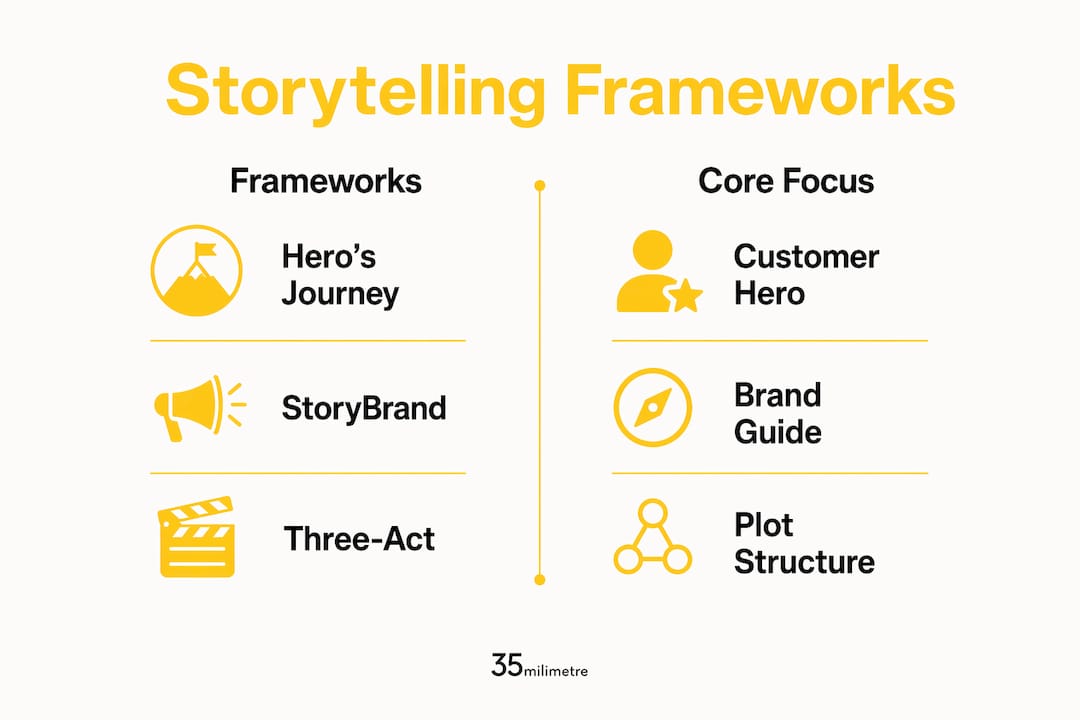
Three frameworks dominate high-performing brand advertising: the Hero's Journey, the StoryBrand method, and the Three-Act Structure. Each mirrors how humans naturally process information, which is why structured storytelling frameworks maintain audience attention more reliably than unstructured creative.
The Hero's Journey, drawn from Joseph Campbell's work and widely applied in film and advertising, positions the audience member as a hero facing a challenge. The brand enters as a guide or mentor, not the protagonist. This distinction matters enormously. Casting the customer as hero and the brand as mentor increases relatability and consumer connection, while brand-as-hero narratives read as self-serving and lose audience trust quickly.
The StoryBrand framework, developed by Donald Miller, distills the Hero's Journey into a seven-part script designed specifically for marketing. It forces brands to clarify what problem they solve, what failure looks like without them, and what transformation the customer achieves. The Three-Act Structure, borrowed directly from screenwriting, provides the simplest scaffolding: establish a world, introduce conflict, resolve it in a way that reflects the brand's values.
A fourth approach worth understanding is what Ipsos calls "Misfits-inspired" storytelling. This technique deliberately introduces illogical, surprising, or counterintuitive elements into a narrative. Misfits-inspired storytelling drives brand memorability nearly three times higher than conventional narrative ads. The surprise element forces the brain to pay closer attention and process the message more deeply.
| Framework | Core mechanic | Best suited for |
|---|---|---|
| Hero's Journey | Customer as hero, brand as guide | Long-form video, brand films |
| StoryBrand | Problem, guide, transformation | Website copy, campaign messaging |
| Three-Act Structure | Setup, conflict, resolution | TV spots, social video |
| Misfits narrative | Surprise and illogical elements | High-recall awareness campaigns |
Pro Tip: The most common storytelling mistake in advertising is making the brand the hero. Run every creative brief through one question: "Is the customer the one who changes in this story?" If the answer is no, rewrite the brief.
How does storytelling differ from traditional feature-benefit advertising?
Feature-benefit advertising treats the audience as a target to be persuaded with specifications. Storytelling treats the audience as a participant in a shared experience. The difference in outcome is measurable. Only 49% of ads attempt to tell relatable stories, meaning more than half of all advertising investment is deployed in a format that underperforms on recall, sentiment, and organic sharing.
The World Federation of Advertisers identifies storytelling as the single most powerful creative effectiveness lever available to brand marketers. Feature-led ads engage the analytical brain. Narrative ads engage the emotional brain, and emotional encoding produces longer-lasting memory traces. A consumer who remembers how an ad made them feel is far more likely to act on that feeling than one who recalls a list of product attributes.
Andi Cross frames this distinction with precision:
"Storytelling is not a tactic layered on top of marketing. It is the infrastructure that makes every other marketing investment work harder."
The practical advantages of narrative over feature-led advertising include stronger emotional engagement that persists beyond the ad exposure, higher rates of organic sharing because people share stories rather than specifications, greater brand trust built through consistent narrative identity, and deeper consumer loyalty driven by identification with the brand's values rather than its product catalog. These outcomes compound over time in ways that feature-based campaigns rarely achieve.
How can brands practically integrate storytelling into their advertising strategy?
Authentic storytelling cannot be manufactured in a campaign brief and then contradicted by the actual brand experience. Brand storytelling must be verifiable and consistently lived across the organization, or consumer skepticism will erode whatever emotional equity the advertising builds. This is the single most underestimated challenge in applying narrative to advertising.
Patagonia's environmental storytelling works because the company's supply chain, legal structure, and founder behavior all confirm the narrative. Dove's "Real Beauty" campaign succeeded because it was backed by research, product reformulation, and a decade of consistent messaging. Nike's storytelling resonates because the brand's internal culture, athlete partnerships, and product design all point in the same direction. Spotify's Wrapped campaign turns user data into a personal story that each listener feels was written specifically for them. These are not creative accidents. They are the result of authentic storytelling integrated throughout marketing and operations.
For brand strategists building this capability, the practical path involves several concrete steps. Start by auditing whether your current brand narrative is verifiable. Ask whether a skeptical journalist could confirm your story through external evidence. Then map where storytelling currently breaks down in the customer experience, because a powerful ad followed by a mediocre product interaction destroys the narrative. Finally, brief your creative partners on the transformation the customer undergoes, not the features that enable it.
Ad campaign imagery strategies play a critical role here. The visual execution of a story either confirms or undermines the narrative. A campaign about human resilience shot with flat, generic stock imagery sends a contradictory signal. The production quality of your visuals is not separate from your storytelling. It is part of it.
Pro Tip: Brief your product development and customer service teams on the brand narrative, not just your marketing team. Inconsistency between the story you tell and the experience you deliver is the fastest way to lose consumer trust.
What are examples of impactful storytelling in advertising?
The most instructive campaigns share a structural quality: they tell stories about people, not products. Nike's "Find Your Greatness" campaign avoids product features entirely and instead shows ordinary people pushing their personal limits. The emotional resonance comes from recognition. Viewers see themselves in the story, not a celebrity athlete.
Dove's "Real Beauty" campaign introduced a cultural conversation about beauty standards and gave real women a role in that conversation. The brand became a platform for a story larger than any single product. Red Bull's sponsorship of Felix Baumgartner's stratospheric skydive in 2012 is perhaps the most extreme example of this principle. Red Bull's Baumgartner story provided suspense, human stakes, and global attention without a single mention of an energy drink's ingredients. The brand's identity, "gives you wings," was demonstrated rather than stated.
Spotify's Wrapped campaign turns behavioral data into a personal narrative delivered to each user annually. The genius of Wrapped is that it makes the user the protagonist of their own story, with Spotify as the platform that witnessed and remembered it. The organic sharing rate is extraordinary precisely because people share their own stories, and Spotify's brand travels with them.
Four lessons emerge from these campaigns that apply directly to your next brief.
- Make the audience the protagonist, not the brand or its product.
- Ground the story in a cultural truth or human experience that exists independently of the brand.
- Use tension and resolution deliberately. Without conflict, there is no story worth remembering.
- Let the brand's values emerge from the story's outcome rather than stating them explicitly.
For deeper context on how visual production supports these narrative strategies, the visual storytelling examples resource at 35milimetre's blog is worth exploring.
Key takeaways
Narrative-driven advertising outperforms feature-based messaging on every meaningful metric because stories engage the emotional brain, trigger oxytocin, and create memory traces that persist long after the ad exposure ends.
| Point | Details |
|---|---|
| Storytelling doubles effectiveness | Narrative ads are twice as effective at changing consumer behavior as feature-benefit messaging. |
| Memory advantage is significant | Facts inside stories are up to 22 times more memorable than standalone facts. |
| Framework choice matters | Hero's Journey, StoryBrand, and Misfits-inspired structures each serve different campaign objectives. |
| Authenticity is non-negotiable | Stories must be verifiable and consistent across the entire brand experience, not just advertising. |
| Customer as hero is the rule | Casting the brand as protagonist reduces relatability and undermines consumer trust. |
Why storytelling has become the sharpest tool in our creative arsenal
We have spent over two decades working on the visual side of advertising, and the shift we have witnessed in what makes a campaign land is not subtle. Ten years ago, a technically perfect image with a clear product benefit could carry a campaign. Today, that same image without a narrative context barely registers. Consumers have developed extraordinary filters for transactional advertising, and those filters are getting stronger every year.
What we find genuinely interesting is how storytelling changes the brief we receive from agencies and brand teams. When a client comes to us with a narrative, the visual decisions become clearer. The color grading, the compositing choices, the way light falls in a scene, all of these serve the emotional arc of the story. When a client comes to us with a feature list, every visual decision feels arbitrary. The story is what gives production craft its purpose.
The challenge we see most often is brands wanting the emotional payoff of storytelling without committing to the organizational consistency it requires. A beautifully produced campaign narrative that contradicts the actual product experience does not build trust. It accelerates skepticism. The brands that win with storytelling, Patagonia, Nike, Dove, are the ones where the story and the reality are the same thing. That alignment is harder to achieve than any production technique, but it is also the only thing that compounds in value over time. Marketers who treat storytelling as a strategic asset rather than a creative execution choice are the ones building brands that last.
— 35mm
Bring your brand story to life visually
A compelling narrative deserves equally compelling visuals. At 35milimetre, we work with ad agencies, brand teams, and photographers to translate storytelling concepts into imagery that carries emotional weight, whether that means compositing, color grading, CGI, or AI-enhanced production. The visual layer of your campaign is where the story either lands or falls apart.
If you are building a campaign around a narrative and need post-production work that serves the story rather than just polishing the surface, explore what 35milimetre's visual post-production services can do for your next project. We have delivered high-end campaign visuals for major technology and automotive brands, and we bring that same standard to every brief we take on.
FAQ
What is the role of storytelling in advertising?
Storytelling in advertising transforms brand messages into emotionally engaging narratives that improve recall, build trust, and change consumer behavior. Narrative-driven ads are twice as effective as feature-benefit messaging at influencing purchasing decisions.
Why does storytelling improve ad memorability?
Narratives trigger oxytocin release in the brain, which enhances trust and emotional encoding. Facts embedded in stories are up to 22 times more memorable than facts presented without a narrative context.
What storytelling frameworks work best for brand advertising?
The Hero's Journey, StoryBrand, Three-Act Structure, and Misfits-inspired narratives are the most proven frameworks. Each mirrors how humans naturally process information, maintaining attention and improving message retention.
How is storytelling different from feature-benefit advertising?
Feature-benefit ads engage the analytical brain with specifications. Storytelling engages the emotional brain, producing longer-lasting memory traces, higher organic sharing rates, and stronger brand loyalty over time.
How do brands like Nike and Dove use storytelling effectively?
Nike's "Find Your Greatness" and Dove's "Real Beauty" succeed by making the customer the protagonist and grounding the narrative in a cultural truth that exists beyond the product. Both campaigns demonstrate brand values through story outcomes rather than explicit claims.