

A storyboard is defined as a sequence of drawn or rendered frames that maps out every shot, transition, and timing beat of an ad before a single camera rolls. The role of storyboards in advertising goes far beyond sketching ideas. They function as visual contracts between clients, creative directors, and production teams, locking in shared expectations before any budget is committed to set. When everyone reads the same visual document, the risk of costly miscommunication drops sharply. At 35milimetre, we have seen firsthand how a well-built storyboard separates campaigns that run smoothly from those that spiral into expensive reshoots and last-minute revisions.
How storyboards reduce production risks and save budget
Storyboards justify budgets by making every shot's cost visible before production starts. Each frame corresponds to a production cost, from lighting setups to talent fees, and a storyboard forces the team to decide whether each shot earns its place. That discipline alone prevents the kind of on-set debates that burn daylight and money.
The financial argument for storyboarding is concrete. When a director arrives on set without a clear visual plan, the crew waits while decisions get made in real time. Waiting costs money. A storyboard eliminates that dead time by resolving camera position, framing, and shot order during pre-production, when changes cost nothing but a pencil stroke.

Reshoots are the most expensive line item most agencies never plan for. A storyboard catches coverage gaps before they become production failures. If a scene requires a cutaway that nobody planned, the editor has nothing to work with and the client pays for a return to set. Storyboards prevent that scenario by forcing the team to think through every transition in advance.
Legal disclaimers add another layer of complexity that storyboards handle directly. Disclaimers consume 2–3 seconds of a 30-second spot, and professionals treat them as hard frames in the storyboard. That means the pacing of every other shot must account for that fixed block of time. Ignoring disclaimers at the storyboard stage routinely causes timing problems that require re-editing or, worse, a full reshoot.
Key production risks that storyboards prevent:
- Coverage gaps: Missing shots identified during pre-production, not in the edit suite.
- Continuity breaks: Mismatched eyelines or prop positions caught frame by frame.
- Budget overruns: Unnecessary shots cut before crew and equipment are booked.
- Client surprises: Visual expectations confirmed before production, not after delivery.
Pro Tip: Treat every legal disclaimer as a locked frame in your storyboard from day one. Build your shot count around it, not after it.
What makes an effective advertising storyboard?
Effective storyboards focus on narrative turning points, not every moment of the ad. The beat-to-panel technique keeps storyboards concise by mapping only the frames where something changes: the product reveal, the emotional reaction, the call to action. This prevents panel sprawl, where a storyboard becomes a decorative picture book instead of a decision-making tool.
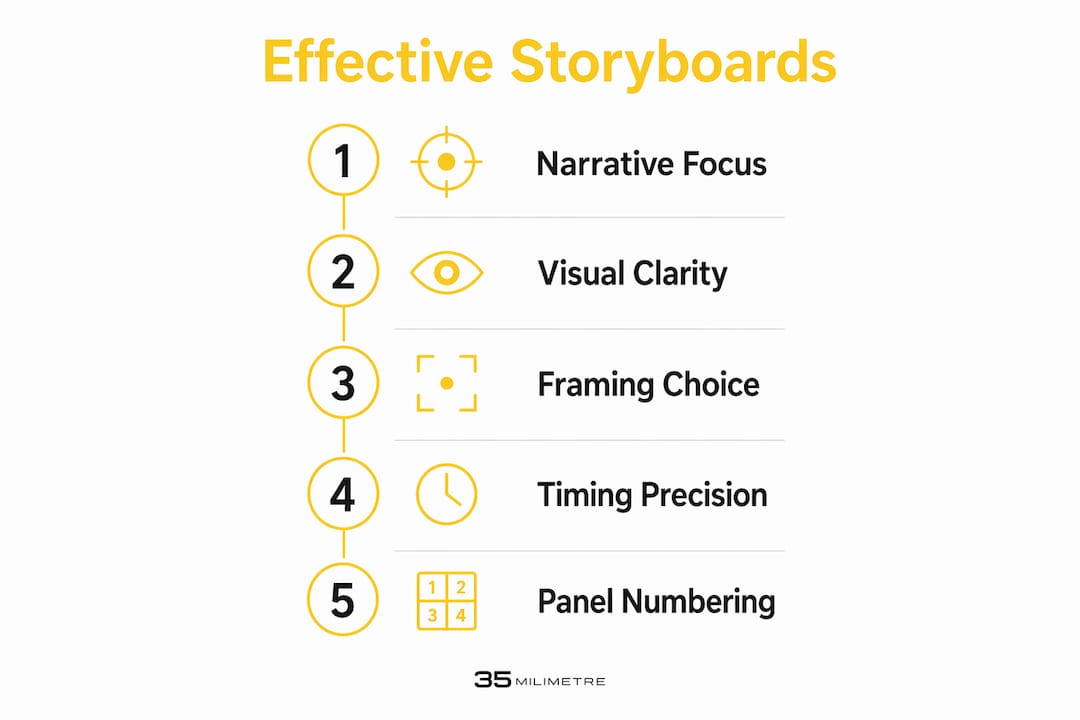
Clarity beats artistry every time. Simple visuals like stick figures and arrows communicate camera movement and subject position more reliably than polished illustrations that leave room for interpretation. The goal is not to impress the client with drawing skill. The goal is to make sure every person in the room understands exactly what will appear on screen.
Framing decisions are where most storyboards earn their value. Each frame must clarify what is inside the shot and what is deliberately excluded. A wide shot that accidentally includes a competitor's logo or an unplanned background element creates legal and creative problems. Defining the frame boundary in the storyboard prevents those problems entirely.
Timing is the discipline that separates professional storyboards from amateur ones. A standard 30-second commercial uses 10–15 shots, each lasting 2–3 seconds, and the opening frame must capture viewer interest within 3 seconds. That constraint shapes every panel. If your storyboard has 20 panels for a 30-second spot, something is wrong with either the shot count or the timing math.
| Storyboard approach | Best use case | Key limitation |
|---|---|---|
| Beat-to-panel | Fast-paced commercials, social ads | Requires strong narrative instinct |
| Full-frame sequence | Complex multi-scene brand films | Time-intensive to produce |
| Thumbnail sketch | Internal team alignment, quick pitches | Too rough for client presentations |
| AI-generated frames | Rapid concept testing, multi-direction comparison | May not reflect final production style |
Pro Tip: Number every panel and note the intended duration in seconds directly below it. Your editor will thank you, and your client will have no room to dispute timing in post-production.
How AI is transforming storyboarding in 2026 advertising
AI has removed the single biggest barrier to professional storyboarding: drawing skill. AI-driven prototyping lets teams generate reference-quality frames in hours rather than days, enabling visual decision-making before a single production dollar is spent. That speed changes how early in the campaign process storyboarding happens.
The practical impact on creative teams is significant. A creative director can now generate three distinct visual directions for a campaign concept overnight and present all three to a client the next morning. The client picks a direction based on actual visuals, not verbal descriptions. That single shift compresses the approval cycle and reduces the risk of creative misalignment late in production.
AI-generated frames also make it easier to stress-test ideas before committing to them. A lighting concept that looks strong in a written brief may fall flat when rendered as a frame. Seeing it early, before the crew is booked and the set is built, allows the team to course-correct without cost. This is where storyboards shorten feedback loops in ways that written shot lists simply cannot.
The benefits AI brings to the storyboard process in 2026:
- Speed: Multiple creative directions generated and compared in a single working day.
- Accessibility: Teams without dedicated illustrators can produce presentation-quality frames.
- Iteration: Visual concepts revised in real time during client meetings.
- Alignment: Stakeholders react to images, not abstractions, locking in consensus faster.
At 35milimetre, we have integrated AI image generation into our pre-production workflow precisely because it collapses the gap between concept and visual proof. The storyboard is no longer a bottleneck. It is the fastest path to a shared creative vision. For agencies building high-efficiency visual workflows, AI-assisted storyboarding is now a baseline expectation, not a luxury.
Storyboards vs. shot lists: which planning tool wins?
A shot list is a written inventory of every shot required for a production. A storyboard is a visual sequence that shows what each of those shots actually looks like. The difference matters more than most planners admit.
Shot lists work well for experienced crews who share a common visual language. A seasoned director of photography reading "medium close-up, over-the-shoulder, natural light" knows exactly what to set up. But that same description tells a client almost nothing. Storyboards provide confidence to clients that written shot lists cannot, because clients are not trained to visualize from technical notation.
Storyboards also protect legal interests in ways shot lists cannot. When a client approves a storyboard, they are approving a specific visual interpretation of the brief. That approval is documented. If the delivered ad looks different from the approved storyboard, the agency has a clear record of what was agreed. A shot list offers no equivalent protection because it describes logistics, not creative intent.
| Planning tool | Visual clarity | Client communication | Legal protection | Production detail |
|---|---|---|---|---|
| Storyboard | High | Strong | Yes, documented approval | Moderate |
| Shot list | None | Weak | No | High |
| Animatic | Very high | Very strong | Yes | Low |
| Treatment document | Low | Moderate | Partial | Low |
For visual storytelling in ads that involves multiple stakeholders, a storyboard is the only tool that serves all parties simultaneously. Shot lists belong in the production folder, not in the client meeting. The two tools are complementary, not interchangeable.
Key Takeaways
Storyboards are the most effective pre-production tool in advertising because they align creative vision, protect budgets, and give clients a visual contract they can approve before production begins.
| Point | Details |
|---|---|
| Storyboards as visual contracts | Approved storyboards document creative intent and protect agencies from scope disputes. |
| Beat-to-panel efficiency | Focus panels on narrative turning points to keep storyboards functional, not decorative. |
| Timing precision matters | Plan for 10–15 shots in a 30-second spot and treat legal disclaimers as locked frames. |
| AI accelerates alignment | AI-generated frames compress approval cycles by replacing verbal descriptions with actual visuals. |
| Storyboards outperform shot lists | Shot lists serve crews; storyboards serve clients, directors, and legal records simultaneously. |
Why storyboards are more valuable now than ever
The storyboard is making a comeback, and not because the industry got nostalgic. Budgets are tighter, timelines are shorter, and the cost of a wrong creative decision compounds faster than it did a decade ago. We have watched campaigns stall at the client approval stage because the creative team presented a mood board and a verbal pitch instead of a storyboard. The client could not visualize the final product, so they hesitated. Hesitation costs weeks.
What storyboards force is early creative commitment. You cannot draw a panel without deciding where the camera sits, what the subject is doing, and what the frame excludes. Those decisions, made on paper or screen before production, are the decisions that used to get made on set at $10,000 per hour. The storyboard moves that cost to zero.
The teams we work with who skip storyboarding almost always cite time pressure as the reason. That logic inverts the actual risk. Skipping a storyboard does not save time. It defers the decision-making cost to the most expensive phase of production. The storyboard's comeback as an alignment tool is not a trend. It is a rational response to a production environment where every hour on set counts.
— 35milimetre
Professional post-production that starts where your storyboard ends
A storyboard defines the vision. Executing it at the level your client expects is a different challenge entirely.

At 35milimetre, we work with ad agencies and production teams to bring storyboard-driven visuals to life through commercial post-production services that include compositing, retouching, color grading, and CGI. We understand how a storyboard translates into production requirements because we have spent over two decades working from exactly those documents. If your campaign demands visuals that match the precision of your pre-production planning, our team is built for that work. Reach out to discuss how we can support your next production from the storyboard stage through final delivery.
FAQ
What is the role of storyboards in advertising?
A storyboard is a visual planning tool that maps every shot, timing beat, and transition of an ad before production begins. It aligns clients, creative teams, and production crews around a shared visual plan, reducing the risk of costly on-set mistakes.
How many panels does an advertising storyboard need?
A standard 30-second commercial requires 10–15 panels, reflecting the typical shot count of 10–15 shots at 2–3 seconds each. Legal disclaimers and mandatory frames should be included as fixed panels from the start.
Can AI replace traditional storyboard artists?
AI tools generate reference-quality frames quickly, but they work best as a prototyping layer rather than a full replacement. Human creative judgment still drives narrative structure, framing decisions, and the beat-to-panel choices that make a storyboard effective.
Why do storyboards matter more than shot lists for client presentations?
Storyboards communicate visual intent in a way that clients without production training can evaluate and approve. Shot lists describe logistics for crews and offer no visual confirmation of the creative direction.
How do storyboards protect agencies legally?
A client-approved storyboard documents the agreed creative interpretation of the brief. If the delivered ad is disputed, the storyboard serves as a record of what was approved, protecting the agency from scope and creative disputes.