
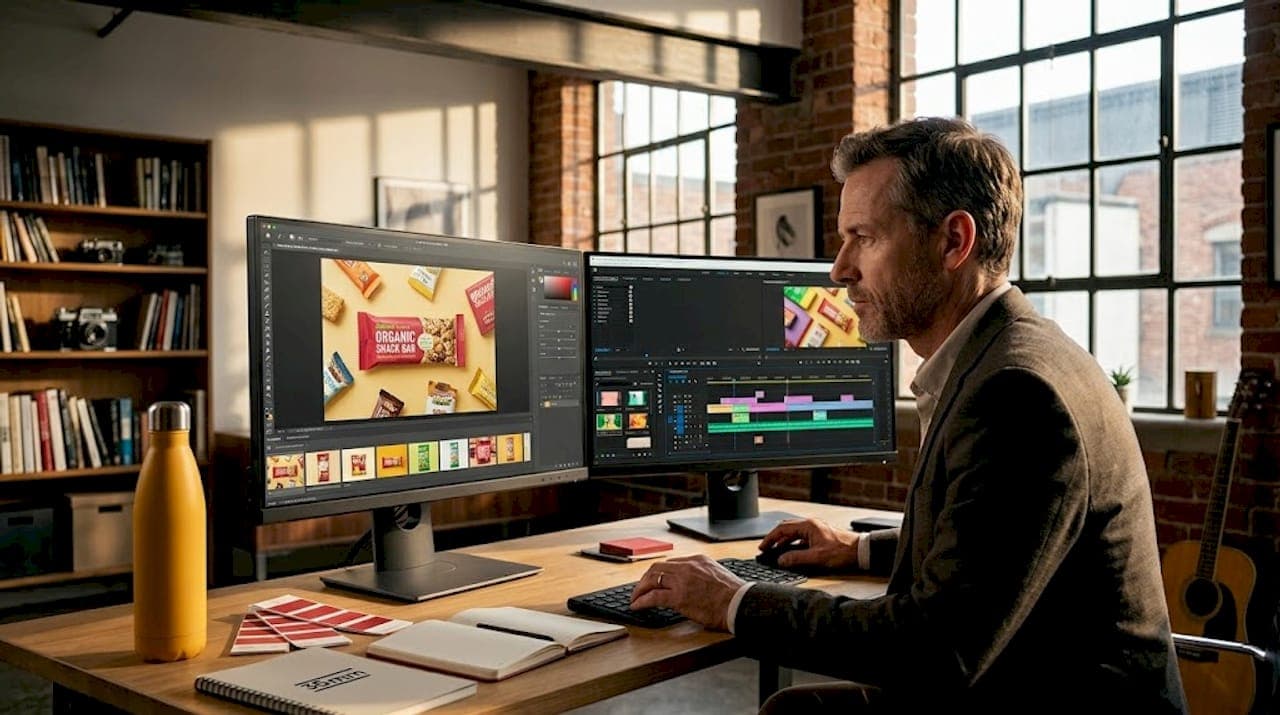
Most FMCG brands spend heavily on shoots and talent, then treat post-production as a finishing formality. That's a costly miscalculation. The role of post-production in FMCG advertising is far more strategic than most marketing teams recognize. It's where raw footage becomes a brand story, where color choices trigger emotional responses, and where a single campaign gets adapted for twenty markets without reshooting a frame. This article breaks down what post-production actually does, why it shapes consumer behavior at a neurological level, and how smart workflows make your team faster without sacrificing quality.
Table of Contents
- Key Takeaways
- The role of post-production in FMCG: what it actually covers
- Color grading and its measurable impact on purchase decisions
- Post-production techniques that elevate storytelling
- Optimizing post-production workflows for FMCG teams
- Traditional vs. emerging post-production approaches
- My take on where most FMCG brands get post-production wrong
- Work with a post-production team that knows FMCG
- FAQ
Key Takeaways
| Point | Details |
|---|---|
| Post-production drives perception | Color grading and compositing shape how consumers feel about a product before they read a single word. |
| Color psychology is measurable | Warm tones improve emotional positivity; high-contrast packaging increases fixation by up to 32%. |
| Automation scales content fast | Automated templates can reduce render times from two weeks to 40 seconds without losing brand control. |
| Hybrid CGI and photography wins | Combining traditional photography with CGI yields the best balance of authenticity and production flexibility. |
| Workflow integration matters | Bringing post-production into campaign planning early reduces costly revisions and speeds up market delivery. |
The role of post-production in FMCG: what it actually covers
Post-production is the phase where everything comes together. Once the shoot wraps, the real creative work begins: editing for pacing and narrative, color grading to reinforce mood, sound mixing for emotional impact, and visual effects or compositing to build scenes that a camera alone could never capture. As critical creative decisions made during post-production shape narrative and audience impact, it's far more than a technical cleanup operation.
In the FMCG context, this phase carries particular weight. Your product competes on shelves and screens simultaneously, and the visual impression formed in the first two seconds of an ad can determine whether a viewer leans in or scrolls past. Post-production structures the story, guides creative decisions, and coordinates color, sound, and delivery into one cohesive brand experience.
Think of post-production as the director's cut of your campaign. The shoot gives you raw material. Post-production gives you meaning.
Pro Tip: Involve your post-production team during pre-production planning, not after the shoot. Decisions about lighting, color temperature on set, and shot selection are far easier and cheaper to make before the camera rolls than to fix in editing.
The phases most relevant to FMCG marketers break down like this:
- Editorial (picture editing): Selecting and sequencing shots to build a narrative arc that moves the viewer from awareness to desire.
- Color grading: Adjusting the tonal and chromatic values of footage to reinforce brand identity and emotional tone.
- Motion graphics and compositing: Layering product visuals, text, and effects to create polished, brand-consistent frames.
- Sound design and mixing: Crafting audio that supports the visual mood, from background ambience to voiceover integration.
- Versioning and delivery: Adapting the master asset into multiple formats, ratios, and language versions for different markets and platforms.
Color grading and its measurable impact on purchase decisions
Color is not decoration. It is a decision-making trigger. Research confirms that packaging color directly drives purchase decisions, with machine learning models predicting consumer choices with 89.2% accuracy based on color-driven visual engagement metrics alone. When those same color principles are applied in post-production to video and digital advertising, the effect compounds across every touchpoint in your FMCG marketing strategy.

The psychological mechanism is well understood. Warm tones (reds, ambers, yellows) generate faster attention capture and higher emotional arousal, which explains why so many food brands lean toward golden hues in their ads. Warm color grading improves emotional positivity, while neutral tones offer visual comfort and cool tones appear calmer but less emotionally engaging. For FMCG brands in categories like snacks, beverages, and comfort foods, warm grading is not an aesthetic preference. It's a conversion lever.
Color also interacts with consumer self-perception. Strategic color use in post-production increases perceived product value and purchase intent differently across consumer segments. High self-monitoring consumers, those acutely aware of social signals, respond better to activating, saturated colors paired with image-focused appeals. Low self-monitoring consumers respond better to evaluative colors paired with quality-focused messaging. This distinction matters when you're tailoring campaign variants for different audience segments.
| Color Tone | Emotional Effect | Best FMCG Application |
|---|---|---|
| Warm (red, amber, gold) | Increases arousal, appetite, urgency | Food, beverages, snacks |
| Neutral (balanced whites, beiges) | Visual comfort, trust, clarity | Health, personal care, dairy |
| Cool (blue, teal, green) | Calm, refreshment, cleanliness | Drinks, cleaning products, wellness |
| High contrast | Increases fixation duration significantly | Packaging-forward campaigns |
"Color in advertising influences attention, emotion, and consumer purchase paths through attention stimulation, memory reinforcement, and context interaction — making it one of the most measurable levers in post-production."
Pro Tip: Don't choose color grades based on what looks appealing to the creative team. Reference neuromarketing data for your specific product category and test two grade variants with a small audience sample before locking the master. The difference in engagement can be significant.
For a concrete example, look at how color-driven consumer engagement was applied at a global scale. When FMCG brands invest in consistent color grading across seasonal and regional campaign variants, they reinforce memory encoding. A consumer who sees your brand's warmth signature across multiple touchpoints starts to associate that warmth with the product experience itself. That association is built in post-production, one grade at a time.
Post-production techniques that elevate storytelling
The most effective FMCG ads don't just show the product. They show a world the consumer wants to belong to. Post-production is what builds that world. Editing creates rhythm and emotional pacing. Compositing places the product inside scenes that a shoot could never achieve affordably. CGI renders materials, liquids, and textures with precision that exceeds physical production. And motion graphics carry brand language across every frame.
Here's where the distinction between FMCG post-production techniques matters most for your campaigns:
- CGI and 3D rendering allow you to show product internals, ingredient stories, or idealized serving suggestions without a single food stylist on set. The upfront investment pays back across dozens of campaign variants.
- Compositing lets you combine live-action footage with digital environments, so a product shot in Istanbul can authentically appear on a New York kitchen table or a Parisian café terrace.
- Motion graphics and kinetic type add brand personality to otherwise static product sequences, making social-first content feel designed rather than repurposed.
- Retouching and color correction ensure that packaging colors in advertising match physical shelf reality, a detail that sounds minor but drives measurable recognition at point of sale.
The hybrid approach combining CGI and photography yields the best quality and speed balance for most FMCG brands. Traditional photography retains authenticity for hero shots and emotional lifestyle content. CGI handles scalability, variant generation, and technical precision. Neither replaces the other. They work better together.
Investing in visual storytelling through post-production is also how brands create the emotional consistency that makes advertising memorable. A single campaign might need 40 different format versions. Post-production makes that scalable without sacrificing the narrative thread.
Optimizing post-production workflows for FMCG teams
Efficiency in post-production is not about cutting corners. It's about building systems that give your team more creative capacity, not less. For FMCG brands managing high-volume content calendars across multiple markets, workflow design is where budget is won or lost.
The most significant shift in recent years is the adoption of automated templates for localization. Nutella's approach to this is instructive: by implementing dynamic creative templates for scalable content, the brand reduced render times from two weeks to 40 seconds and cut overall production time in half while maintaining full brand control. That's not a marginal gain. That's a fundamental change in what a marketing team can produce in a quarter.
Here's a practical framework for optimizing your FMCG post-production workflow:
- Build a modular asset library. Create master shots, backgrounds, and graphic elements that can be recombined for different campaigns rather than recreating from scratch each time.
- Standardize your brand color grade. Document your exact grading specifications as a LUT (Look-Up Table) that any editor or colorist can apply consistently across markets.
- Establish version control early. Define how many market variants, aspect ratios, and language versions you need before post-production begins. Surprises at the end of a project multiply costs.
- Integrate agency and in-house workflows. Set clear handoff protocols between your internal brand team and external post-production partners. Shared asset folders, brief templates, and feedback cycles should be agreed upon before work starts.
- Invest in cloud-based review tools. Frame-accurate feedback platforms eliminate the ambiguity of email-based notes and dramatically reduce revision cycles.
Learning how to build an efficient creative workflow for FMCG brands is increasingly a competitive advantage. Teams that treat post-production as a structured discipline rather than an ad-hoc service consistently produce more content at higher quality for the same budget.
Traditional vs. emerging post-production approaches
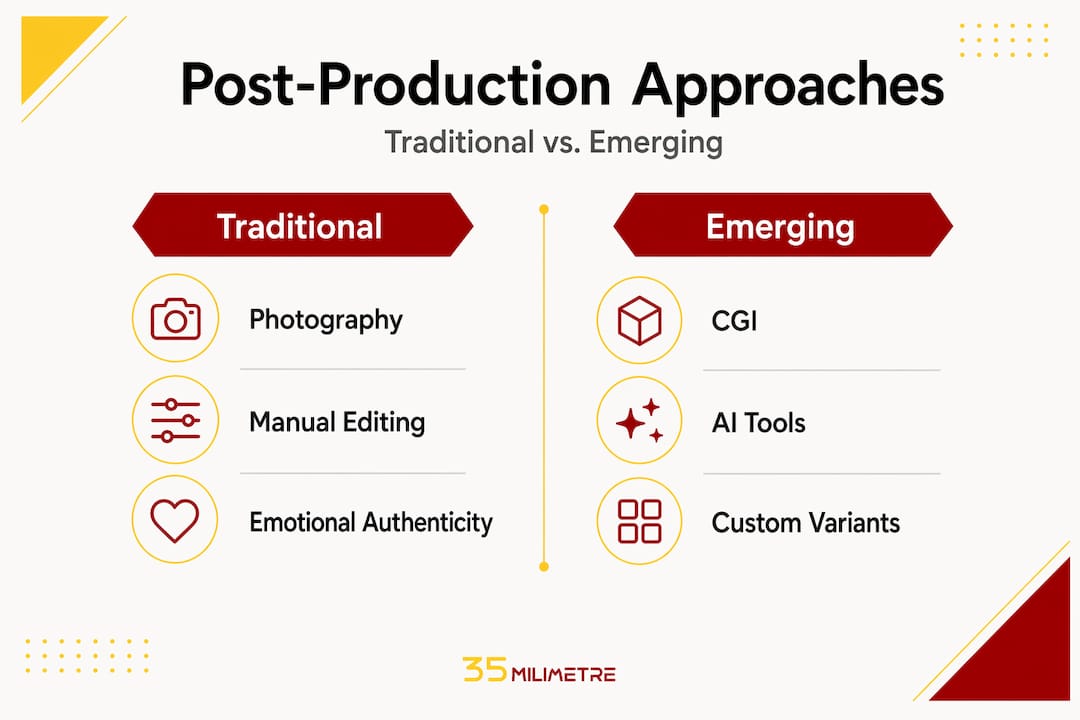
The FMCG production process is at an inflection point. CGI and AI-assisted post-production are no longer experimental. They're production standards. But that doesn't mean traditional photography is obsolete. The decision of when to use which method is a strategic one, and it affects cost, timelines, and brand perception.
| Approach | Strengths | Limitations | Best For |
|---|---|---|---|
| Traditional photography | Emotional authenticity, tactile quality | Higher cost per variant, longer timelines | Hero campaigns, lifestyle content |
| CGI and 3D rendering | Scalable, flexible, precise | Upfront cost, risk of looking synthetic | Product detail, variant generation |
| AI-enhanced post-production | Fast iteration, cost-effective | Requires strong art direction | Social content, localization |
| Hybrid (photography + CGI) | Authenticity with scalability | Requires skilled compositing | Most FMCG product advertising |
The CGI vs. traditional photography decision should not be framed as either/or. FMCG brands that invest in a hybrid model benefit from the trust that real photography builds while unlocking the scale that CGI provides. AI image generation is adding a third dimension to this, enabling rapid concept visualization and market-specific adaptations at a speed that was unimaginable three years ago.
The future trend to watch is the integration of AI-driven color grading and personalization, where post-production variables like saturation and warmth are adjusted dynamically based on the viewer's platform, location, or behavioral profile. It's not fully mainstream yet, but the FMCG brands building those capabilities now will have a substantial lead.
My take on where most FMCG brands get post-production wrong
I've worked on product visuals for major brands for over twenty years, and the pattern I see most consistently is this: post-production gets the smallest share of the campaign budget and the least amount of strategic attention, yet it's the phase that determines whether the work lands or disappears.
Most brand managers I've worked with think about post-production as a service that cleans up what the shoot produced. The mindset needs to flip. Post-production is where the campaign is made, not where it's finalized. The relationship between post-production quality and perceived product value is direct and measurable. Consumers don't analyze your color grade consciously. They just feel that one brand looks premium and another looks ordinary. That feeling is built frame by frame in post.
The uncomfortable truth is that a modest investment in quality post-production consistently outperforms a larger spend on production when the final asset is what reaches the consumer. I've seen beautifully shot campaigns undermined by rushed grading, and I've seen modest shoots transformed into genuinely compelling brand stories through thoughtful editorial and compositing work. The post-production tips that actually move the needle are rarely about expensive tools. They're about intention, consistency, and giving skilled people the time to do the work properly.
If you take one thing from this, let it be this: stop planning post-production after you've locked your production budget. Build it in from the start. It changes everything.
— 35mm
Work with a post-production team that knows FMCG

If your FMCG campaigns deserve sharper visuals, faster turnaround, and creative consistency across every market, 35milimetre can help. We specialize in commercial retouching and visual post-production for brands that need results, not approximations. From color grading and compositing to CGI and AI-enhanced imagery, our team brings two decades of hands-on experience to every project. We work closely with ad agencies and brand teams to make the production process feel less like a bottleneck and more like a creative advantage. If you want to see what strategic post-production can do for your next FMCG campaign, let's talk.
FAQ
What is the role of post-production in FMCG advertising?
Post-production shapes raw footage into a finished brand story through editing, color grading, compositing, and sound design. It's the phase where creative decisions directly influence how consumers perceive and emotionally respond to your product.
How does color grading affect consumer behavior in FMCG?
Research shows that warm color grading increases emotional positivity and attention, while high-contrast visuals increase fixation duration by up to 32%. These effects directly influence purchase intent and brand recognition.
When should FMCG brands use CGI instead of photography?
CGI excels for product variant generation, technical product detail, and high-volume content needs. Traditional photography remains stronger for emotional, lifestyle-driven hero campaigns. A hybrid approach delivers the best results for most FMCG brands.
How can FMCG teams speed up post-production workflows?
Automated templates and modular asset libraries are the most effective tools. Nutella used dynamic creative templates to cut render times from two weeks to 40 seconds, with production time reduced by half.
How does post-production impact brand consistency across markets?
Standardized color grades, master asset libraries, and version-controlled workflows allow global FMCG brands to adapt campaigns for local markets while maintaining a unified visual identity. This is where post-production workflows in FMCG deliver compounding returns over time.