

Digital compositing is defined as the process of combining multiple visual elements from different sources into a single, unified image that appears to have been captured by one camera at one moment. The role of digital compositing in modern filmmaking and media production is not decorative. It is structural. Every photorealistic frame in a major film or commercial passes through a compositor's hands before it reaches the screen. Techniques like chroma keying, rotoscoping, and color correction form the backbone of this process. Understanding how compositing works gives filmmakers and creative professionals a sharper view of what separates good visuals from truly invisible ones.
What is the role of digital compositing in visual production?
Digital compositing integrates live-action plates, 3D CGI renders, matte paintings, and FX simulations into a single photorealistic frame. That definition sounds technical, but the practical meaning is straightforward: compositing is the stage where everything shot on set and everything built in a computer finally becomes one image. Without it, CGI creatures float in front of backgrounds, green screens stay green, and digital environments look pasted on.
Compositing sits at the final stage of the VFX post-production pipeline. By the time a shot reaches the compositor, the 3D renders, motion capture data, and practical effects are already complete. The compositor's job is to make all of those pieces disappear into each other. That invisibility is the goal. When compositing works, the audience never thinks about it.
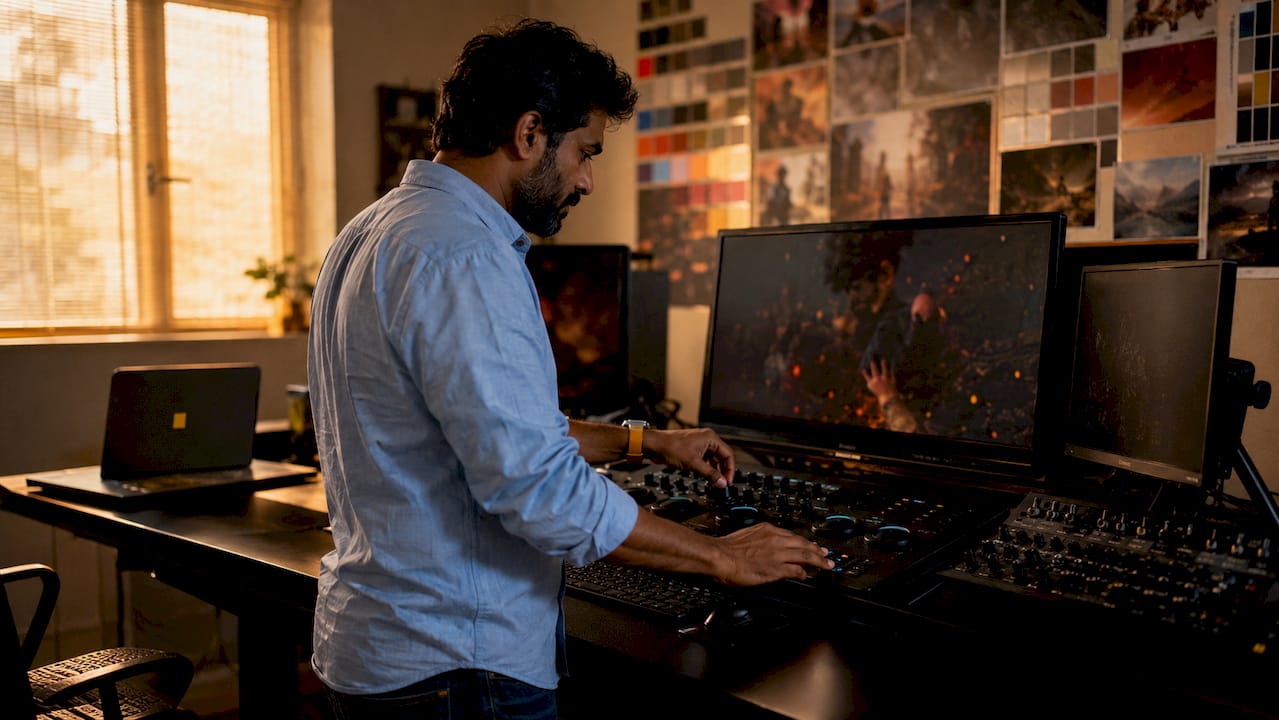
The importance of digital compositing extends beyond technical execution. It shapes what stories can be told. A director who knows compositing is possible can write scenes set on alien planets, inside collapsing buildings, or alongside creatures that do not exist. Compositing turns those scripts into images. For creative professionals working in advertising, film, or branded content, that creative freedom is the real value.
What are the core techniques used in digital compositing?
Core compositing techniques include chroma keying, manual rotoscoping, motion tracking, and rigorous color correction. Each technique solves a specific integration problem, and most complex shots require all of them working together.
Chroma keying isolates a subject filmed against a green or blue screen by removing a specific color range from the image. The result is a clean cutout that can be placed over any background. Chroma keying is fast, but it requires careful lighting on set to avoid color spill on the subject's edges.
Rotoscoping is the manual process of drawing frame-by-frame masks around subjects or objects in footage. It is slower than chroma keying but far more precise. Rotoscoping handles situations where chroma keying fails: hair, transparent objects, or subjects filmed without a clean background.
Motion tracking records the movement of the camera or specific points in a shot, then applies that movement data to synthetic elements. Without motion tracking, a CGI object placed in a live shot would stay fixed while the camera moves, instantly breaking the illusion.
Color correction unifies the look of all elements in a composite. A CGI render lit in a slightly different color temperature than the live footage will read as fake immediately. Color correction brings every layer into the same visual space.
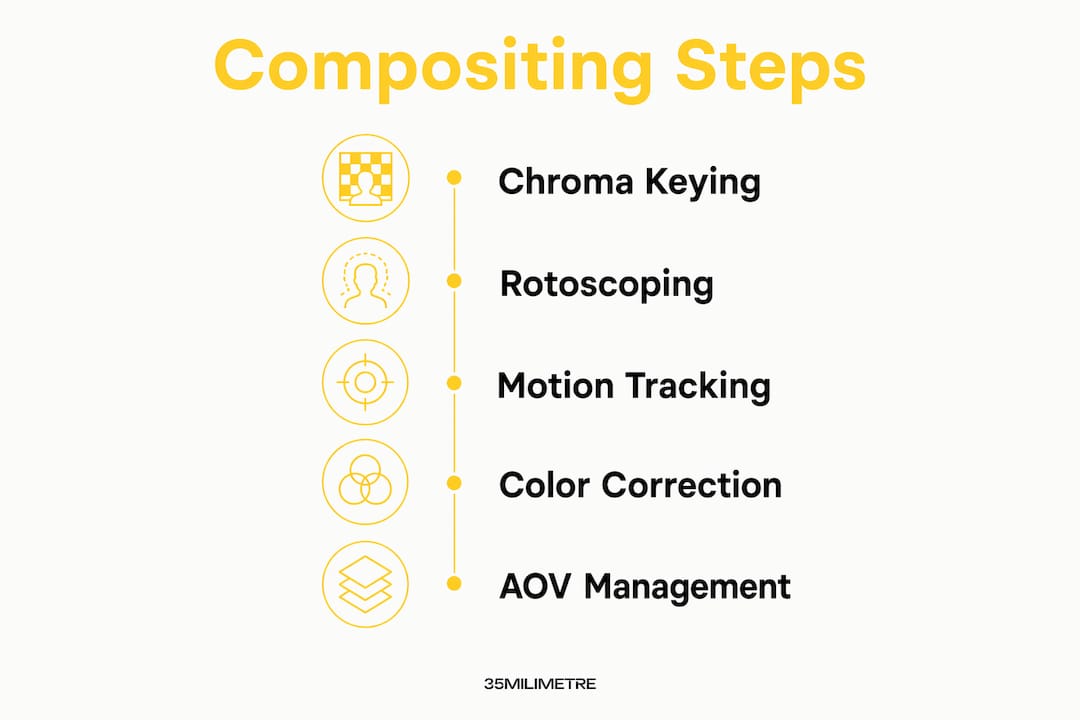
Two workflow types organize how these techniques are applied. Node-based systems like Nuke and Fusion handle complex shots with multiple passes and precise control over every operation. Layer-based systems like After Effects work faster for motion graphics and simpler composites. Node-based workflows represent the industry standard for high-end film and VFX production. Layer-based tools remain the preferred choice for broadcast and motion design work with faster turnaround requirements.
AOV management adds another layer of control. Compositors rebuild the final CG image from individual render passes: diffuse, specular, reflection, subsurface scattering, and shadow. This lets them adjust a single lighting component without re-rendering the entire 3D scene. That flexibility saves hours on complex shots.
Pro Tip: Always check that your light direction on CGI elements matches the key light in your live footage before any other adjustment. A mismatched shadow angle is the fastest way to break a composite, and no amount of color grading will fix it afterward.
How does compositing enhance storytelling and visual quality in film?
Compositing makes impossible scenes possible without putting actors or crew in danger. A car chase through a collapsing city, a performer standing on the edge of a skyscraper, a battle between creatures that do not exist: all of these are compositing problems before they are storytelling achievements. The ability to blend CGI with live footage convincingly is what gives directors the confidence to write those scenes in the first place.
The compositor functions as both artist and technician. On the technical side, the job involves matching lens characteristics, managing render passes, and tracking camera movement. On the artistic side, it involves reading a scene's emotional tone and deciding how much grain, how much depth of field blur, and how much color shift will make a synthetic element feel like it belongs. Those two skill sets rarely live in the same person, which is why experienced compositors are genuinely hard to find.
Demand for compositors is growing as streaming platforms and high-end productions raise their visual ambitions. A single prestige television episode now routinely contains hundreds of VFX shots that would have been reserved for feature films a decade ago. That volume creates pressure across the entire pipeline, and compositing absorbs much of it. Every shot that needs a sky replacement, a crowd extension, or a digital set extension lands on a compositor's workstation.
Digital compositing for animations follows a similar logic. Even fully animated productions use compositing to add depth of field, lens flares, atmospheric haze, and color grading that make rendered frames feel cinematic rather than synthetic. The role of VFX in compositing for animation is to add the final layer of optical realism that pure rendering cannot achieve on its own.
What challenges do compositors face in complex productions?
Matching lens characteristics like chromatic aberration, distortion, grain, and depth of field between live footage and CGI is the most technically demanding part of compositing. Each camera lens introduces specific optical properties into the image. A CGI element rendered without those properties looks clean in a way that real footage never does. The compositor's job is to add imperfection deliberately and precisely.
The most common integration challenges break down into four areas:
- Grain matching: Live footage contains film grain or digital noise. CGI renders are perfectly clean. Adding matching grain to synthetic elements is not optional; it is the difference between a shot that reads as real and one that reads as digital.
- Edge quality: The boundary between a composited element and its background reveals everything. Poor chroma keying leaves color fringing. Poor rotoscoping leaves hard edges. Directional light wrapping applied selectively on edges simulates natural optical scattering and softens those boundaries convincingly.
- Depth of field consistency: If the background is slightly out of focus, a sharp CGI element placed in front of it will look wrong. Compositors apply synthetic depth of field blur to match the camera's focal plane.
- Revision cycles: Compositing is iterative. Directors request changes, color grades shift, and 3D renders get updated. A compositor who cannot manage a clean, organized node tree or layer structure will lose hours rebuilding work that should have been non-destructive.
Employers prioritize a compositor's ability to produce clean executions under pressure over software knowledge alone. Technical problem-solving and artistic judgment matter more than knowing every keyboard shortcut. That distinction separates compositors who last in production from those who burn out after their first major project.
Pro Tip: Deliver your 3D renders as multi-pass EXR files with clearly labeled AOVs from the start of a project. Compositors who receive flat renders lose the ability to adjust lighting, shadows, or reflections without going back to the 3D artist. Clean asset delivery cuts revision time significantly.
What software tools define professional compositing today?
Node-based software like Nuke is the industry standard for high-end visual effects production. Its flexibility and control over complex multi-pass composites make it the tool of choice at major VFX studios worldwide. Fusion, built into DaVinci Resolve, offers a comparable node-based environment at a lower entry cost and has gained significant ground in independent and mid-tier productions.
Layer-based compositing excels at rapid 2D and limited 3D effects, and After Effects remains the dominant tool for motion graphics and broadcast work. The tradeoff is clear: layer-based systems are faster to learn and faster to execute for simpler work, but they become difficult to manage when shot complexity increases. A node-based tree scales; a layer stack does not.
| Software | Workflow type | Best for | Typical use |
|---|---|---|---|
| Nuke | Node-based | Complex VFX shots | Feature film, high-end TV |
| Fusion | Node-based | Mid-tier VFX, color work | Independent film, broadcast |
| After Effects | Layer-based | Motion graphics, 2D effects | Broadcast, advertising |
Color space management runs underneath all of these tools. Professional compositing pipelines work in linear light color spaces like ACEScg or scene-linear EXR to preserve accurate light math across every operation. Converting to a display color space happens only at the final output stage. Compositors who skip this step introduce errors that compound through every adjustment they make. Understanding post-production color standards is not optional at the professional level.
Key Takeaways
Digital compositing is the final integration stage of VFX production, where technical precision and artistic judgment combine to make synthetic and live elements indistinguishable from each other.
| Point | Details |
|---|---|
| Compositing defines visual realism | Every photorealistic VFX frame depends on compositing to unify live footage, CGI, and effects. |
| Node-based workflows lead the industry | Nuke and Fusion handle complex shots; layer-based tools suit faster, simpler projects. |
| Core techniques work together | Chroma keying, rotoscoping, motion tracking, and color correction each solve a specific integration problem. |
| AOV management saves production time | Multi-pass renders let compositors adjust lighting and shadows without re-rendering 3D scenes. |
| Demand is rising with streaming growth | High-end streaming productions now require feature-film-level compositing on tight schedules. |
What compositing has taught us after two decades
Compositing is far more than stacking layers. It involves complex technical and mathematical processes to match synthetic elements convincingly to real footage. That insight took time to fully appreciate, even for experienced practitioners.
The most common mistake we see from teams new to compositing is treating it as a finishing step rather than a discipline that shapes every earlier decision. The way a scene is lit on set, the lens chosen for a shot, the color temperature of the practical lights: all of these become compositing problems or compositing assets depending on how carefully they were planned. When a production treats compositing as an afterthought, the compositor inherits every shortcut taken upstream.
The intensity and volume of revisions in compositing makes it genuinely demanding work. A single shot can go through fifteen rounds of feedback before it is approved. That is not a failure of process. That is the nature of making something invisible. The audience never sees the work, which means the work is never finished until it is perfect.
The future of compositing will be shaped by real-time rendering, AI-assisted rotoscoping, and the growing demand for immersive media formats. Those tools will change the speed of the work. They will not change what the work requires: a compositor who understands light, color, optics, and the specific way human eyes detect something that does not belong.
— 35milimetre
How 35milimetre approaches post-production compositing
35milimetre has spent over two decades working at the intersection of image manipulation, CGI, and visual post-production. The studio's work spans commercial campaigns, automotive imagery, and technology brand visuals, all of which demand the kind of compositing precision that makes synthetic and live elements genuinely indistinguishable.

The team at 35milimetre handles everything from complex multi-pass CGI integration to high-end retouching and color work for ad agencies, startups, and professional photographers. If your production needs compositing that holds up under close scrutiny, the studio brings the technical depth and creative judgment to deliver it. Reach out to discuss your project and see what professional compositing services can do for your visual output.
FAQ
What is digital compositing in simple terms?
Digital compositing is the process of combining multiple visual elements, such as live footage, CGI, and effects, into one unified image that looks like it was captured in a single shot.
What are the main digital compositing techniques?
The core techniques are chroma keying, rotoscoping, motion tracking, and color correction. Each one solves a specific problem in blending disparate visual elements into a single frame.
What software do professional compositors use?
Nuke is the industry standard for high-end film and VFX work. Fusion is widely used in independent productions, and After Effects dominates motion graphics and broadcast compositing.
How does compositing differ from traditional optical compositing?
Traditional optical compositing used physical film and optical printers to combine elements in-camera. Digital compositing performs the same integration mathematically in software, with far greater precision and control.
Why is color correction critical in compositing?
Color correction unifies the color temperature, contrast, and tone of every element in a composite. Without it, CGI and live footage read as visually separate even when the geometry and lighting match correctly.