
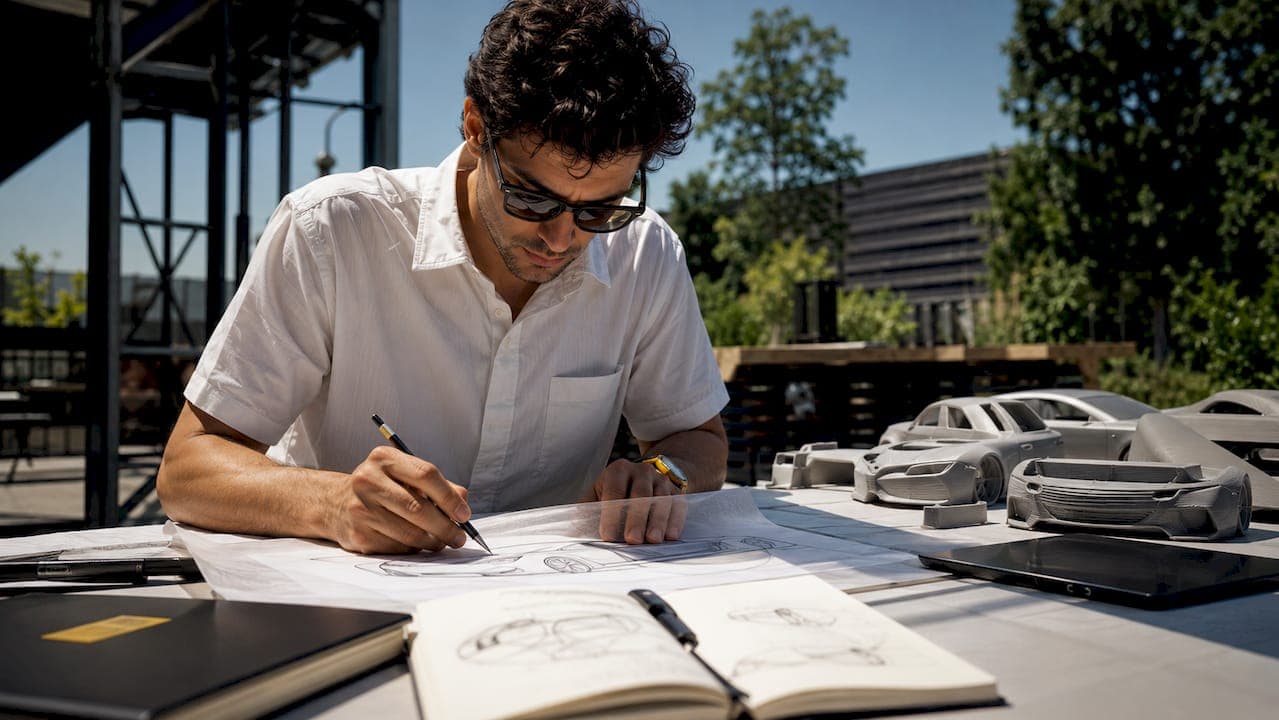
AI in automotive visuals is defined as the application of artificial intelligence systems to accelerate vehicle design, generate photorealistic imagery, and optimize visual workflows across design studios and marketing teams. The role of AI in automotive visuals has shifted from experimental to foundational in 2026, with machine learning models now handling tasks that once required entire departments working for months. What used to take a team of specialists several weeks to produce, a single designer can now deliver in under a day. For automotive professionals and creatives, understanding where AI fits into the pipeline is no longer optional. It is the difference between staying competitive and falling behind.
How does AI accelerate automotive design workflows?
AI tools have reduced concept-to-animation time from months to less than one day for a single designer. That compression is not incremental improvement. It is a structural change in how automotive design teams operate.
The core shift comes from AI-assisted 3D modeling. Generative AI can produce detailed surface geometry from rough sketch inputs, giving designers a photorealistic starting point within hours rather than weeks. This feeds directly into rapid prototyping cycles, where teams can evaluate ten design directions in the time it previously took to develop one.

Platforms like CATIA's 3DEXPERIENCE integrate AI to speed early-stage ideation and visualization, combining parametric modeling with Sub-D surfacing techniques inside a single collaborative environment. That integration matters because it removes the handoff delays between concept artists, surface modelers, and visualization specialists. The pipeline becomes continuous rather than sequential.
Generative AI also handles environment and scene creation. A designer can describe a coastal road at dusk in a text prompt and receive a photorealistic backdrop within minutes. That capability removes the need for location scouting or stock library licensing in early concept presentations.
Key capabilities AI brings to design workflows:
- Sketch-to-3D conversion: AI interprets hand-drawn or digital sketches and generates surface geometry automatically.
- Parametric variation: Machine learning models generate dozens of design variants from a single base form, each respecting defined constraints.
- Scene generation: Text-to-image and text-to-environment models produce context-aware backdrops for concept renders.
- Noise reduction and upscaling: AI post-processing cleans up renders and increases resolution without re-rendering at full quality.
- Collaborative review: AI-powered annotation tools flag design inconsistencies across team members in real time.
Pro Tip: Use AI for the first three rounds of iteration to generate volume quickly, then apply human judgment to select and refine the strongest directions. Speed and quality are not in conflict when you sequence them correctly.
For a broader look at how AI is reshaping creative production, the role of AI in creative studios in 2026 covers the workflow shifts happening across industries.
What impact does AI have on aerodynamic simulation visuals?
Major automakers now use AI to run hundreds to thousands of aerodynamic simulations daily, a volume that traditional computational fluid dynamics methods cannot match. That scale changes the design conversation entirely.
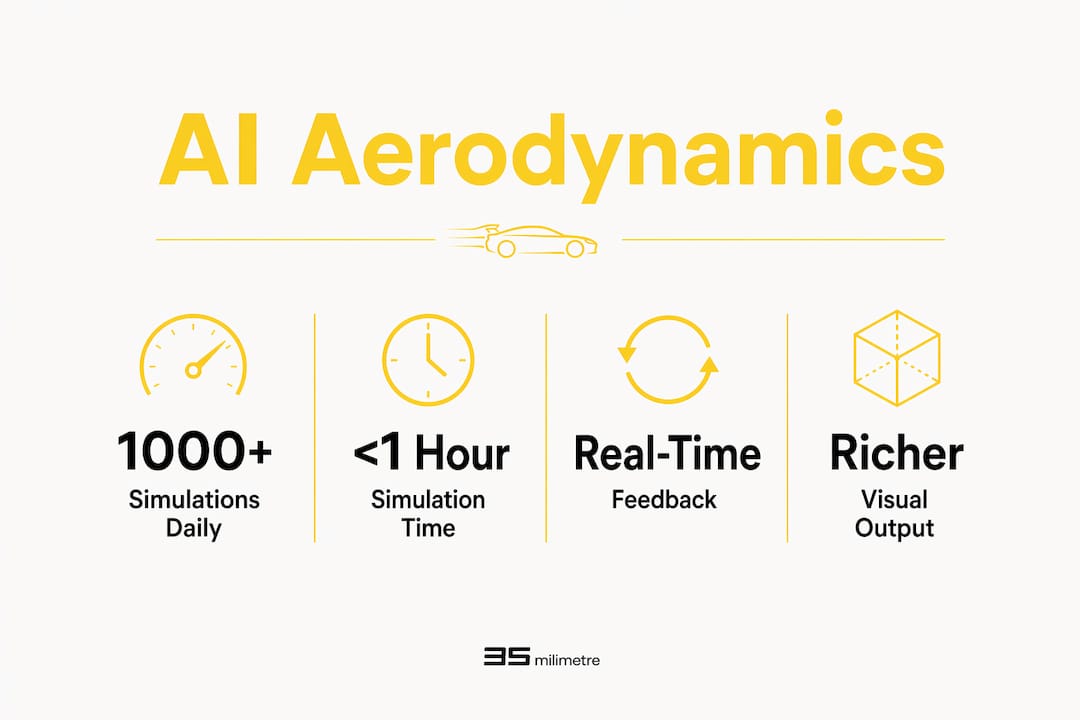
Traditional CFD analysis requires hours or days per simulation run. Physical wind tunnel testing adds weeks and significant cost. AI-powered virtual wind tunnels, trained on neural networks, deliver near-instant feedback on drag coefficients and air pressure distribution across a vehicle's surface. Designers see the aerodynamic consequence of a body line change in real time, not after a two-week testing cycle.
| Method | Time per simulation | Iterations per day | Real-time feedback |
|---|---|---|---|
| Physical wind tunnel | Days to weeks | 1–3 | No |
| Traditional CFD | Hours to days | 5–20 | No |
| AI virtual wind tunnel | Seconds to minutes | Hundreds to thousands | Yes |
The visual output from AI aerodynamic tools is also richer than traditional CFD reports. Pressure maps, airflow visualizations, and drag overlays render directly onto the 3D model surface, making the data immediately readable for designers rather than engineers alone. That accessibility closes the gap between the design studio and the engineering team.
The practical result is that surface contour decisions, which previously required engineering sign-off after weeks of testing, can now be evaluated and adjusted within a single design session. Automotive professionals working on concept development gain a direct line between aesthetic choices and performance data.
How is generative AI changing automotive marketing visuals?
AI-assisted visualization tools now enable marketing and design teams to create concept imagery in hours instead of weeks. That compression affects not just production timelines but the entire creative strategy behind automotive campaigns.
Generative AI produces photorealistic environments from text prompts, placing a vehicle in a mountain pass, a city street at night, or a desert salt flat without a single location shoot. Marketing teams can produce dozens of context variations for a single vehicle model, testing audience response to different visual narratives before committing to a full production budget.
The storytelling impact is significant. A static render of a vehicle on a white background communicates specifications. A generative AI scene places that same vehicle in a moment, a mood, a world. That shift from product documentation to visual storytelling is what campaign-ready content looks like in 2026.
Advanced visualization techniques now go further than static images. Teams are incorporating Gaussian splats and collision data into review environments, allowing stakeholders to evaluate scale, spatial context, and user interaction in immersive settings. This extends automotive visualization well beyond the still image into interactive spatial experiences.
Key ways generative AI is reshaping automotive marketing production:
- Environment generation: Text prompts produce photorealistic backdrops in minutes, eliminating location costs for early-stage content.
- Color and trim variation: AI renders the same vehicle across multiple paint and interior configurations without re-modeling.
- Animation from stills: Machine learning models generate motion sequences from static renders, producing short video content at low cost.
- Audience-specific versioning: Marketing teams create regional or demographic variants of the same visual asset quickly and at scale.
What is edge AI's role in automotive image processing?
Edge AI moves image processing directly into automotive camera systems, reducing latency in vision-based applications including advanced driver assistance systems and occupant monitoring. The core advantage is speed. When AI runs on the device rather than in the cloud, the processing happens in milliseconds rather than seconds.
For automotive image processing, that speed matters in two distinct contexts. The first is safety-critical systems, where ADAS cameras must detect and classify objects faster than human reaction time. The second is media and presentation, where live visualization tools need responsive rendering for real-time design reviews and interactive client presentations.
Edge AI also improves the quality of in-camera processing. Noise reduction, dynamic range optimization, and object detection all run locally, producing cleaner image data before it ever reaches a post-production pipeline. For automotive professionals working on live visualization or broadcast-quality vehicle presentations, that upstream quality improvement reduces the correction work downstream.
Pro Tip: When building a visualization workflow that includes live camera feeds, specify edge AI-capable hardware at the capture stage. Fixing image quality problems in post-production costs more time than preventing them at the source.
The integration of edge AI into automotive imaging systems reflects a broader pattern in machine learning automotive visuals: the processing is moving closer to the moment of capture, making the entire pipeline faster and more responsive.
Key Takeaways
AI in automotive visuals delivers the most value when it compresses iteration cycles without removing human creative judgment from the process.
| Point | Details |
|---|---|
| Design cycle compression | AI reduces concept-to-photorealistic-render time from months to under one day. |
| Aerodynamic simulation scale | AI virtual wind tunnels run thousands of simulations daily versus single-digit runs with traditional CFD. |
| Marketing content speed | Generative AI produces photorealistic environments from text prompts in hours, not weeks. |
| Edge AI image quality | Processing at the camera level reduces latency and improves image quality before post-production begins. |
| Human oversight remains critical | AI handles repetitive tasks; human designers define brand direction, aesthetic intent, and final judgment. |
Where human creativity still leads
We have spent over two decades working with automotive visuals at 35milimetre, and the most consistent thing we have observed is this: the studios that use AI best are the ones that use it least visibly.
The temptation is to let generative AI define the output. The result is imagery that looks technically correct but feels generic. Top design studios use AI selectively, applying it mainly for upscaling, noise reduction, and variation generation rather than for determining the design direction itself. That restraint is not a limitation. It is a craft decision.
The limited interpretability of generative AI models remains a real barrier in safety-critical and brand-critical workflows. When you cannot explain why the AI made a particular visual choice, you cannot defend that choice to a client or a regulatory body. Human oversight is not a workaround. It is the quality control layer that makes AI output trustworthy.
What we have found at 35milimetre is that the most productive framing is to treat AI as a production assistant, not a creative director. It handles volume, variation, and technical correction. We handle intent, brand coherence, and the judgment calls that separate a good image from a great one. That division of labor is where AI amplifies human creativity rather than diluting it.
The future of automotive visual production belongs to teams that can hold both capabilities at once: the speed of AI and the discernment of experienced creatives.
— 35mm
Automotive visuals built for the standard AI is raising
The bar for automotive imagery has moved. Clients now expect photorealistic renders, environment composites, and campaign-ready visuals on timelines that were impossible three years ago. 35milimetre delivers exactly that.
Our team combines over two decades of post-production expertise with active AI-enhanced workflows, covering everything from commercial retouching and compositing to full CGI builds for automotive campaigns. We work directly with ad agencies, automotive brands, and professional photographers who need imagery that performs at the highest level. If your project demands visuals that match the quality the market now expects, we are ready to build them with you.
FAQ
What is the role of AI in automotive visuals?
AI in automotive visuals refers to the use of artificial intelligence to accelerate design workflows, generate photorealistic imagery, and run aerodynamic simulations. It reduces production timelines from months to hours while improving the quality and variety of visual output.
How does AI improve vehicle imagery for marketing?
Generative AI produces photorealistic environments and scene variations from text prompts, allowing marketing teams to create context-aware vehicle imagery in hours instead of weeks. This gives campaigns more visual variety without proportionally higher production costs.
What is edge AI's role in automotive image processing?
Edge AI processes image data directly inside automotive camera systems, reducing latency for applications like ADAS and live visualization. It improves image quality at the capture stage, which reduces correction work in post-production.
Does AI replace automotive designers and visual artists?
AI handles repetitive and volume-intensive tasks, but design leadership at GM and Bentley confirms it augments human creativity rather than replacing it. Human designers retain responsibility for brand direction, aesthetic judgment, and final creative decisions.
What is a virtual wind tunnel in automotive design?
A virtual wind tunnel is an AI-powered simulation environment that models airflow and drag across a vehicle's surface in seconds. It replaces or supplements physical wind tunnel testing, enabling automotive teams to run thousands of aerodynamic iterations per day.