

Most marketing and creative professionals know design studios produce polished visuals, but very few recognize just how much strategic and financial weight those studios carry. Agencies that integrate optimized design studio processes save 70-75% of proposal time, cutting weekly workload from 15-20 hours down to 4-5 hours while adding roughly 8,000 euros in monthly revenue. That kind of measurable return reframes the entire conversation. Design studios are not decorators. They are performance engines, and understanding that distinction shapes how smart agencies and brand teams build for the future.
Table of Contents
- How design studios shape visual strategy from the start
- Innovative methodologies and workflows that set studios apart
- Comparing design studios with in-house teams: pros, cons, and hybrid strategies
- Measuring performance and ROI: time, revenue, and campaign results
- What most agency leaders miss about design studios' true value
- Take your visual content to the next level
- Frequently asked questions
Key Takeaways
| Point | Details |
|---|---|
| Strategic leadership | Design studios guide brand strategy from the start, ensuring unified and scalable visual content. |
| Innovative workflows | Research-first, collaborative, and AI-driven methods set studios apart in creative industries. |
| Hybrid team advantage | Combining studio agility with in-house continuity gives brands greater flexibility and double impact. |
| Quantifiable ROI | Studio collaboration drives measurable gains in time, revenue, and campaign engagement metrics. |
| Future-proof messaging | Studios’ methodologies help brands adapt to digital shifts and maintain high-impact creative standards. |
How design studios shape visual strategy from the start
After understanding design studios' underestimated impact, let's explore how they shape strategy from the outset.
A design studio's job is not simply to make things look good. It is to build a visual language that works consistently across every touchpoint your audience encounters, from a paid social ad to a trade show booth to an automotive product launch film. That shift in scope, from execution to strategy, changes everything about how a studio integrates with your team.
According to industry analysis, design studios lead visual strategy from day one, create unified systems for scalability, and tie design directly to performance metrics like engagement and conversions. This is not a philosophical stance. It is a workflow reality. When a studio builds out a brand's visual system at the beginning of a campaign cycle, every downstream asset, whether that is a CGI product render, a composited hero image, or a motion graphic, inherits the same rules. Consistency at that level reduces revision cycles, accelerates production timelines, and protects brand equity.
"Design is not just what it looks like and feels like. Design is how it works." The same logic applies to visual systems: a well-designed content framework does not just look cohesive, it performs cohesively across every channel.
There are several concrete ways this strategic leadership translates into real outcomes.
- Studios create master design systems (typography, color grading standards, compositional rules) that every vendor and in-house team can follow.
- They set visual KPIs (key performance indicators) aligned with campaign goals, not just creative preferences.
- They conduct pre-production audits to identify inconsistencies in existing brand materials before new content is made.
- They act as the connective tissue between creative directors, brand managers, and post-production artists.
Understanding design impact in advertising at this level helps agency leaders make smarter decisions about where to invest production budget. And for teams that need a practical starting point, knowing which essential design assets a studio should deliver first is just as important as understanding the strategy behind them.
Innovative methodologies and workflows that set studios apart
With the strategic role established, let's examine what makes design studio workflows uniquely innovative.
Modern design studios do not rely on intuition alone. Their methodologies are structured, repeatable, and built to scale. Research sits at the foundation of nearly every project a serious studio takes on, whether that means audience analysis before a technology product launch or competitive benchmarking before an automotive brand refresh. The research phase is not a formality. It is the basis for every creative decision that follows.
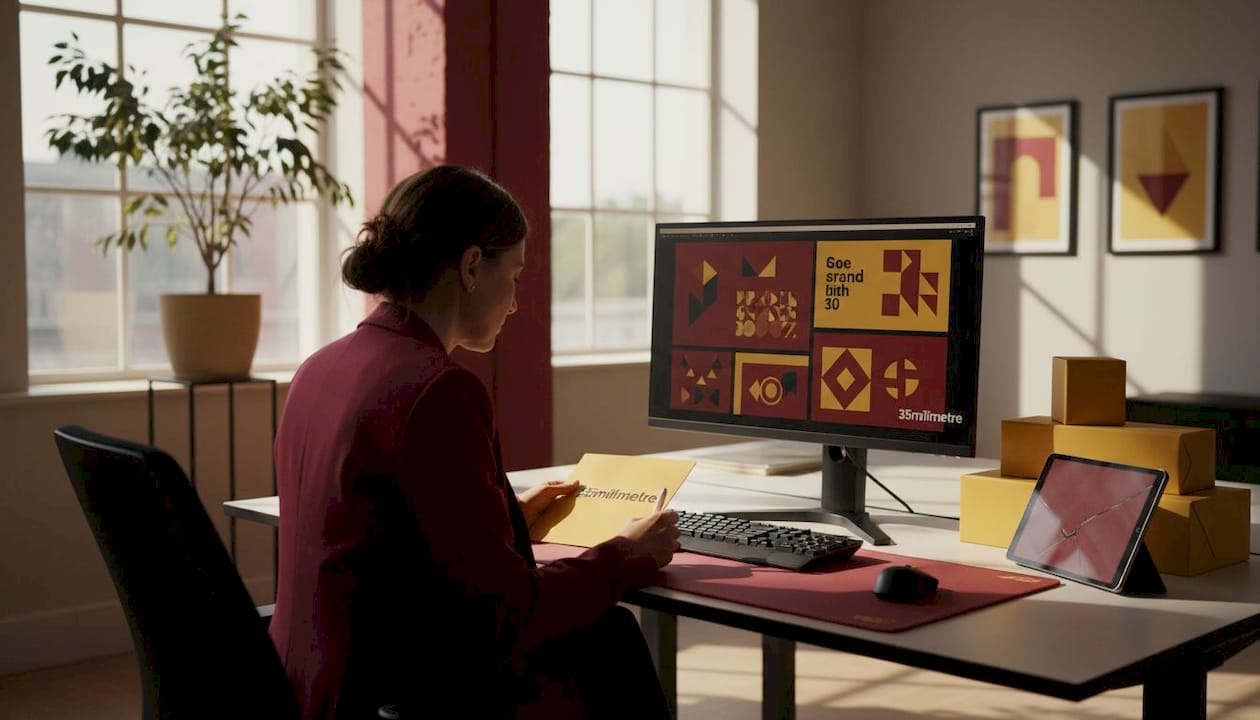
Current studio methodologies emphasize research-first approaches, collaborative workflows, agile project management, data-driven insights, AI-assisted ideation, digital prototyping through CAS (computer-aided styling) and VR/AR environments, and clay modeling for automotive applications. This stack of methods is far more sophisticated than most clients realize when they first engage a studio.
Here is how those methods typically progress through a project lifecycle:
- Discovery and research: The studio conducts stakeholder interviews, audience mapping, and competitive analysis before a single pixel is created.
- Concept and ideation: AI-assisted ideation tools, mood boards, and reference libraries accelerate the early creative phase without sacrificing originality.
- Digital prototyping: CAS tools and VR environments allow clients to review and approve spatial or product visuals before committing to expensive physical production.
- Agile iteration: Short sprint cycles (usually one to two weeks) allow feedback to be integrated quickly, reducing the risk of late-stage misalignment.
- Production and delivery: Final assets are built to a pre-agreed specification sheet, ensuring they are ready for all required platforms without reformatting.
In the automotive sector, this workflow gets an additional layer. Clay modeling still plays a role in early concept validation, running in parallel with digital renders so designers can evaluate form in physical space before locking a direction. That parallel process, analog and digital working together, is a good model for how studios in any sector approach complexity.
Pro Tip: Ask your studio partner for a written methodology document before a project begins. If they cannot describe their process clearly on paper, it will be harder to hold them accountable to a timeline or a creative brief.
For agencies exploring innovative creative workflows for consumer brands, the same principles apply. And for teams leaning into AI-generated imagery, understanding how brand storytelling with AI fits into a broader post-production strategy is increasingly relevant.
| Methodology | Primary Benefit | Best Suited For |
|---|---|---|
| Research-first approach | Reduces creative misalignment | Brand strategy, product launches |
| Agile sprints | Faster iteration, fewer revisions | Campaign production, digital content |
| AI-assisted ideation | Expands concept range quickly | Visual exploration, early concepting |
| CAS and VR prototyping | Pre-approves visuals before production | Automotive, product design |
| Clay modeling | Physical form validation | Automotive, industrial design |
Comparing design studios with in-house teams: pros, cons, and hybrid strategies
As innovative workflows drive results, it's vital to understand how studios compare to in-house teams and why hybrid models often win.
The debate between hiring in-house creative talent and engaging an external design studio is one that comes up in virtually every agency and brand-side conversation we have. The honest answer is that neither option wins outright. Each has a distinct role, and understanding that distinction is what allows leaders to build the right model for their organization.
Studios offer fresh perspectives, specialist breadth, and agility for workload spikes, while in-house teams provide continuity, deep brand knowledge, and cost efficiency for steady ongoing work. The smartest brands are moving toward hybrid models that combine both.
Here is what each option realistically delivers:
- Design studios bring cross-industry exposure, specialist skills (compositing, CGI, 3D product rendering, motion), and the ability to scale up quickly for a product launch or major campaign without a long hiring cycle.
- In-house teams understand your brand's history and internal culture deeply, work within your processes naturally, and are cost-effective for high-volume, lower-complexity production work.
- Hybrid models use the in-house team for brand guardianship and day-to-day execution while routing complex, high-stakes, or overflow work to a studio partner.
The key to making a hybrid model work is clear role definition. Ambiguity about who owns what leads to duplicated effort and creative friction. When a studio knows it is responsible for the hero campaign visuals and the in-house team handles social adaptations, everyone produces better work. Reviewing design impact comparison data shows this division of labor consistently produces stronger overall campaign results than either approach alone.
| Criteria | Design Studio | In-House Team | Hybrid Model |
|---|---|---|---|
| Creative freshness | High | Moderate | High |
| Brand consistency | Moderate | High | High |
| Scalability | High | Low | High |
| Cost efficiency | Variable | High for steady work | Balanced |
| Specialist capability | High | Dependent on headcount | High |
| Speed for peak demand | High | Low | High |
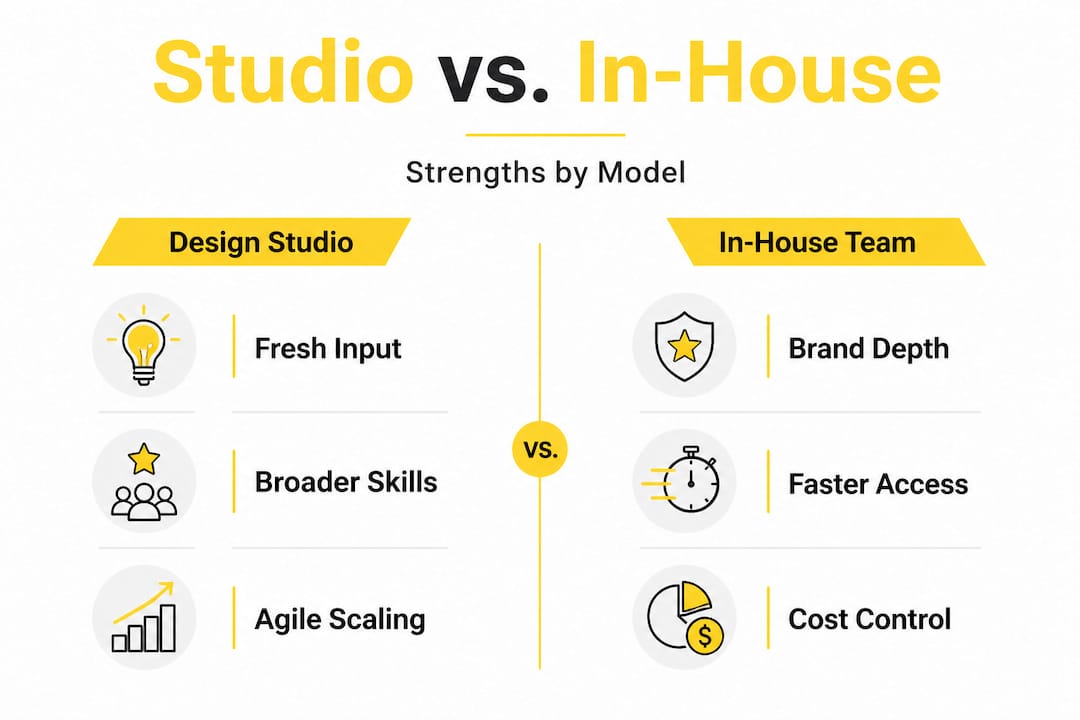
The table makes clear that no single model dominates every dimension. The hybrid approach consistently delivers across the most important variables, which is exactly why it is becoming the standard for top-performing brands.
Measuring performance and ROI: time, revenue, and campaign results
Having compared studio and in-house options, it's now essential to quantify the performance gains driving industry adoption.
Numbers matter. Creative work has historically been difficult to quantify, which is part of why design studios are sometimes treated as a discretionary budget item rather than a strategic investment. That perception is changing fast, and the data driving that change is worth examining closely.
Agencies using optimized design processes save 70-75% on proposal time, with proposal hours dropping from 15-20 hours per week to just 4-5 hours. The same benchmarks show a revenue increase of approximately 8,000 euros per month, a 50% reduction in time-to-market for UX redesigns, a 32% lift in click-through rate (CTR), and a 21% drop in cost per acquisition (CPA). Those are not marginal improvements. They represent a fundamental shift in what a well-run design process can deliver.
Here is a practical framework for tracking those gains within your own organization:
- Baseline your current state: Before engaging a studio, document your average proposal time, campaign production timeline, and key performance metrics (CTR, CPA, engagement rate).
- Set studio-specific KPIs: Agree upfront on what the studio is responsible for improving, whether that is asset quality, turnaround speed, or campaign click-through performance.
- Review at the campaign level: After each campaign, compare results against your baseline. Attribute improvements to specific workflow or quality changes the studio introduced.
- Conduct quarterly ROI reviews: Calculate the studio's cost against revenue impact and time savings. Treat it the same way you would evaluate any other vendor investment.
Pro Tip: Track time-to-approval alongside time-to-delivery. Studios that produce high-quality work but require extensive revision cycles are not actually saving you time. The real efficiency gain comes from reducing the total number of feedback rounds, not just the production speed.
For teams building a business case internally, high-performance design assets that are properly documented and tied to campaign outcomes are the most persuasive evidence you can present to leadership. One well-documented case study showing a 32% CTR lift is worth more than any presentation about brand values.
What most agency leaders miss about design studios' true value
Here is a perspective shaped by over two decades of working at the intersection of post-production and brand strategy: the biggest mistake agency leaders make is treating a design studio as a vendor rather than a strategic partner. You bring in a vendor to execute a task. You bring in a partner to solve a problem you have not fully defined yet.
That distinction sounds subtle, but it changes everything about how a project unfolds. When a studio is positioned as a vendor, they receive a brief, they deliver against it, and they invoice. When they are positioned as a partner, they push back on briefs that will not perform, they flag inconsistencies in the brand system before production begins, and they bring methodologies that accelerate your process even when you are not running an active project together.
The industry's shift toward hybrid models is the clearest signal that the smartest brands have already figured this out. They are not choosing between studios and in-house teams. They are building ecosystems where each plays a defined role. Studios carry the weight of innovation and specialist execution. In-house teams carry the weight of brand stewardship and operational continuity. When those roles are clear, the friction disappears and the results improve measurably.
What concerns us, honestly, is the number of well-funded agencies still operating without that framework. They have strong in-house teams and they occasionally hire studios for big projects, but there is no system connecting those two resources. The result is inconsistency, brand drift, and a lot of expensive rework. The hidden cost of that approach is not just budget. It is the campaigns that never performed as well as they could have.
Studio-driven visual systems, built on the kind of methodology we described earlier, are essentially future-proofing mechanisms for brand messaging. They create a body of documented creative rules and production standards that survive staff turnover, agency transitions, and platform shifts. That institutional knowledge, encoded in a well-built design system, is one of the most durable assets a brand can own. For teams exploring what that looks like in practice, creative production insights from studios working at the brand storytelling level offer a useful reference point.
The takeaway is straightforward: do not wait for a major campaign to start thinking about how your studio partnerships are structured. Build the framework now, define the roles clearly, and measure the results consistently. The studios doing the best work in technology and automotive are the ones whose clients have already made that shift.
Take your visual content to the next level
The evidence is clear: design studios that operate as strategic partners, backed by structured methodologies and performance-driven workflows, deliver results that go far beyond aesthetics. If you are ready to move from theory to execution, partnering with a post-production and design team that understands both the creative and the commercial side of visual content is the logical next step.
At 35milimetre, we have spent over twenty years working with ad agencies and major brands in technology and automotive to produce high-end imagery that genuinely performs. From compositing and color grading to CGI, AI-enhanced imagery, and full campaign retouching, our visual post production services are built to integrate with your existing workflow, whether you run a hybrid model or need a dedicated studio partner for a specific project. Let's build something that works.
Frequently asked questions
How do design studios improve campaign performance?
Design studios lead visual strategy from day one, building unified systems that tie every creative decision to measurable outcomes like engagement rates and conversions. The result is content that performs more consistently across every channel it runs on.
What differentiates design studios from in-house teams?
Studios offer fresh perspectives and specialist breadth with the agility to scale quickly for campaign spikes, while in-house teams provide continuity and deep brand familiarity. Most high-performing brands use both through a clearly structured hybrid model.
What kinds of methodologies do design studios use?
Studios apply research-first approaches and agile management alongside AI-assisted ideation, digital prototyping through CAS and VR environments, and, in automotive contexts, clay modeling for physical form validation. These methods make the creative process faster, more accountable, and more repeatable.
What real-world benefits do studios deliver to agencies?
Agencies save up to 75% on proposal time and see measurable revenue gains, while campaigns supported by studio-level visual production consistently show higher CTR and lower CPA compared to baseline performance.