

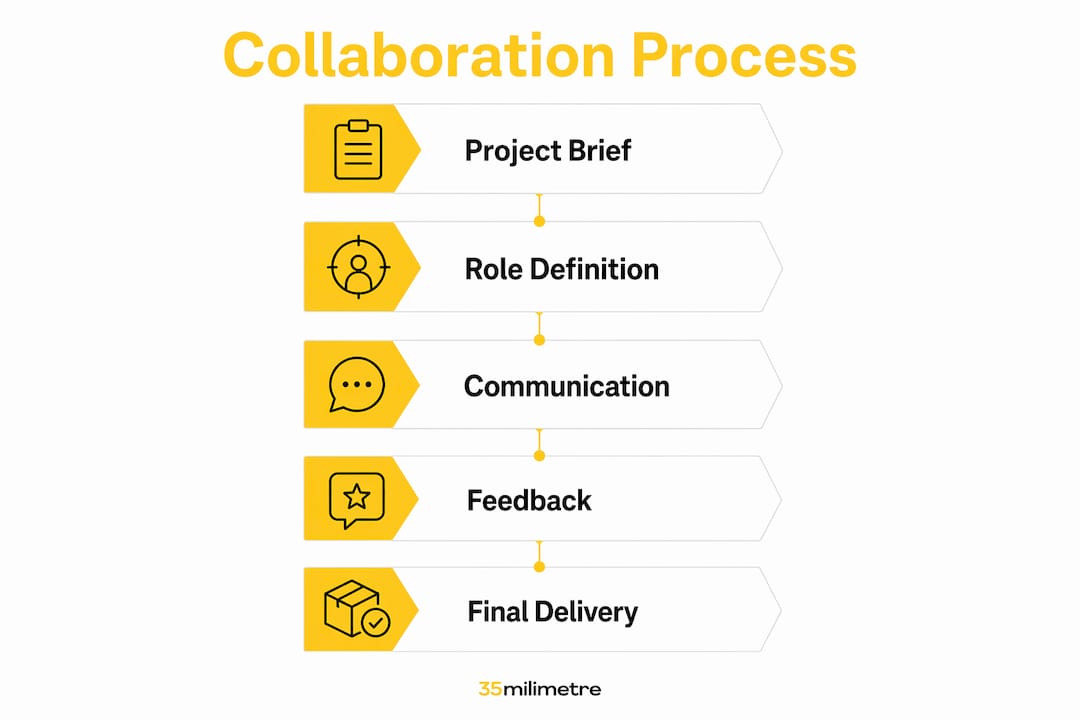
A well-run studio collaboration process is the difference between a visual project that lands exactly right and one that unravels under the weight of unclear expectations. At its core, it is the coordinated workflow through which clients, agencies, and studios align on goals, divide responsibilities, and move creative work from concept to final delivery without losing quality or momentum. For boutique post-production studios, where every team member carries real creative weight, that structure is not optional.
The key elements that make this process work include:
- A written project brief covering goals, deliverables, timeline, revision policy, and budget
- Clearly assigned roles: creative lead, single point of contact, and final decision-maker
- A communication rhythm that blends live meetings with async feedback tools
- Documented scope with a change-request process to prevent budget overruns
- Final delivery packages with high-resolution assets, brand guidelines, and technical documentation
A solution-driven mindset ties all of these elements together. When both parties treat the project as a shared business challenge rather than a transaction, the collaboration produces better work and lasts longer.
Table of Contents
- What goes into an effective project brief?
- How should communication and feedback flow during production?
- How do you keep scope and timelines from slipping?
- What should the final delivery package include?
- How 35milimetre approaches studio collaboration
- Work with 35milimetre on your next visual project
- Key Takeaways
What goes into an effective project brief?
The project brief is the single most important document in any studio collaboration. A professional brief should be concise, ideally limited to one page, and must explicitly state the project goal, scope of deliverables, definitive timeline, revision policy, and budget range to prevent scope creep. Anything longer tends to get skimmed; anything shorter leaves too much open to interpretation.
A strong brief also names the people responsible for decisions. Knowing who has final approval on a composite image or a color grade before production starts prevents the feedback loops that eat budgets. For a deeper look at drafting briefs that actually hold up under pressure, the guide on briefing a creative studio covers the specifics in detail.
Key elements every brief should include:
- Project goal stated in one or two sentences
- Defined deliverables with format, resolution, and quantity
- Hard timeline with milestone dates, not just a final deadline
- Revision policy specifying how many rounds are included
- Budget range so the studio can scope work realistically
Pro Tip: Create a one-page roles sheet for every project. List names, responsibilities, and who makes the final call on revisions. It takes ten minutes and eliminates the most common source of approval delays.
How should communication and feedback flow during production?
Effective collaborative workflows blend synchronous meetings for directional decisions with async feedback tools to protect deep creative work. A retouching artist mid-composite or a 3D artist building a product render cannot afford to stop every two hours for a status call. Reserve live sessions for major creative decisions, directional pivots, and conflict resolution.
For day-to-day feedback, async tools with timestamped comments remove the ambiguity of "around the two-minute mark" style notes. Platforms like Slack for threaded communication, Microsoft Teams for file coauthoring, and Google Workspace for shared document editing each support real-time version control and reduce the back-and-forth email chains that slow projects down. When a disagreement does surface, moving it out of comment threads and into a live conversation resolves it faster and with less friction.
Consistent naming conventions matter just as much as the tools themselves. A file labeled ProjectName_AssetTitle_v03_2026-06 tells everyone exactly what they are looking at. Without that discipline, handoffs become guesswork.
Practices that protect creative time and communication quality:
- Use live sessions for creative decisions, not status updates
- Apply timestamped async feedback for audio, video, and image reviews
- Establish a naming convention before the first file is created
- Keep conflict resolution synchronous to preserve tone and context
- Build trust by responding to feedback within agreed windows
How do you keep scope and timelines from slipping?
Scope creep is the most predictable risk in any creative project, and it almost always starts with a vague brief or an undocumented change request. Defining and sticking to a clearly written project scope from day one is the first line of defense. When a client wants to add a deliverable or shift a deadline, that request needs to be documented, assessed for budget and timeline impact, and formally approved before work begins.
Collaborative co-development spreads expertise across teams, which reduces the risk of technical surprises and deadline shifts by enabling mutual support within the production pipeline. A boutique studio with a post-production artist, a graphic designer, and a 3D artist working in close coordination can absorb a sudden creative pivot far more gracefully than a siloed workflow where each role operates independently.
Assigning a single point of contact on the client side is equally critical. When five stakeholders can redirect a project simultaneously, the studio gets five conflicting instructions. One decision-maker, clearly named in the brief, keeps approvals moving. For agencies managing multiple visual campaigns, the ad agency visuals workflow guide addresses how to structure these handoffs at scale.
Scope management practices worth building in from the start:
- Document every change request with its impact on timeline and cost
- Require written approval before acting on any scope addition
- Negotiate deadlines transparently; push back when a timeline is unrealistic
- Assign one decision-maker per client organization
- Review scope alignment at each milestone, not just at the end
What should the final delivery package include?
Final delivery is where a lot of studios lose points they earned during production. A professional handoff should include high-resolution assets in required formats, comprehensive brand guidelines, and supporting documentation so internal teams can use and maintain the work without coming back to the studio for every small update.
For a visual content project, that typically means:
- High-resolution master files in layered PSD or native format
- Exported formats: JPEG, PNG, TIFF, and any platform-specific variants
- Brand guidelines covering color values, typography, and usage rules
- Technical documentation explaining compositing layers or 3D render settings
- A version-controlled file archive organized by asset type and date
A short knowledge-sharing session with the client's internal team after delivery pays dividends. It helps them apply brand standards correctly across channels, which protects the visual consistency the studio worked to build. The most valuable learning from any project, though, comes from a formal post-project retrospective where both parties review what worked, what slowed things down, and what to do differently next time.
How 35milimetre approaches studio collaboration
At 35milimetre, the collaborative process is built on two decades of working directly with ad agencies, technology brands, and automotive clients on high-end visual content. The studio's boutique structure, a post-production artist, a graphic designer, and a 3D artist led by Mehmet Turan, means every project has a named creative lead and a short chain of communication. Clients talk to the people actually building the work, not an account layer.
The studio operates with a solution-driven mindset at every stage. That means engaging with the business challenge behind the visual brief, not just executing a list of deliverables. When a timeline is unrealistic or a brief is underspecified, 35milimetre says so before production starts. That kind of early clarity protects both the client's budget and the quality of the final image.
"Trust and clarity formed by clear roles, well-scoped briefs, and reliable workflows are the cornerstones for productive and creative studio collaborations — beyond technology or tools." The 35milimetre team applies this principle on every project, from CGI product renders for technology launches to retouched automotive imagery for global campaigns.
The studio's expanding work in AI-enhanced imagery adds another layer of capability without changing the core process. Whether the deliverable is a composited hero shot, a 3D product render, or a packaging visualization, the workflow stays the same: a clear brief, defined roles, structured feedback, and a thorough handoff. For teams that want a practical starting point, the creative workflows checklist outlines the steps 35milimetre uses across visual production projects.
Work with 35milimetre on your next visual project
35milimetre offers something most large production setups cannot: direct access to the specialists doing the work, from the first brief to the final file. For agencies and brands that need high-end compositing, retouching, CGI, or AI-enhanced imagery, the studio brings over twenty years of production experience to every project, with a process built to keep timelines tight and quality consistent. There is no account management layer between you and the creative team. You brief the people building your visuals, and they brief you back when something needs to change. To start a project or discuss your next campaign, visit 35milimetre's post-production services and reach out directly.
Key Takeaways
A structured studio collaboration process, built on clear briefs, defined roles, and disciplined communication, is the foundation of every successful high-end visual project.
| Point | Details |
|---|---|
| Brief defines everything | A one-page brief covering goals, deliverables, timeline, revision policy, and budget prevents scope disputes before they start. |
| Roles prevent delays | Naming a creative lead and a single client decision-maker in writing eliminates conflicting approvals during production. |
| Async protects creative time | Timestamped feedback tools handle routine notes; live sessions are reserved for directional decisions and conflict resolution. |
| Delivery includes documentation | Final packages should contain layered master files, exported formats, brand guidelines, and technical documentation for internal teams. |
| 35milimetre applies this process | The studio's boutique team structure gives clients direct access to the post-production artists, designers, and 3D specialists building their visuals. |