
Stable Diffusion can be used commercially under Stability AI's Community License, and for most studios, agencies, and small brands, that use is free. The one hard line is revenue: if your organization's total annual income remains below the revenue threshold set by Stability AI, you're covered without paying a licensing fee, though you still need to register as a commercial user and follow the Acceptable Use Policy. Output ownership generally sits with you, but copyright law on AI-generated images remains unsettled, so treat that ownership as strong, not airtight.
TL;DR:
- Organizations below the revenue threshold must register as a commercial user before using Stable Diffusion for paid projects; exceeding it requires negotiating an Enterprise License.
- All model versions under the Community License, including SD 3.5 variants, share the same rules, but mixing different releases may require separate license considerations.
- Output ownership is granted to users, but copyright protections remain legally unsettled, so retaining documentation of human contributions is critical for establishing rights.
- Use restrictions prevent generating unlawful, deceptive, or harmful content, and license obligations extend to redistribution and third-party services embedding the models.
- Running or fine-tuning the models involves hardware costs and compliance risks; detailed provenance logging and client contract clauses mitigate legal uncertainties.
Table of Contents
- What Does the Stability AI Community License Actually Permit?
- How Does the $1 Million Revenue Threshold Work?
- Who Owns the Images Stable Diffusion Generates?
- What Can't You Do With Stable Diffusion Commercially?
- Checklist: Making AI Images Commercially Defensible
- How 35milimetre Vets Model Releases Before Client Work
- Does It Cost Anything to Use Stable Diffusion Commercially?
- Can You Fine-Tune Stable Diffusion for Commercial Projects?
- Does Training Data Affect Your Commercial Use Rights?
- What Ethical and Privacy Risks Should Commercial Users Watch For?
- What's Next for Stable Diffusion Licensing?
- Get Client-Ready AI Imagery Without Managing the License Risk Yourself
- Sources
- FAQ
What Does the Stability AI Community License Actually Permit?
The Community License is the legal document governing how you can use most current Stable Diffusion models, and it's more permissive than the licensing structure Stability AI used a few years ago. Under this license, individuals and organizations with total annual revenue below the threshold set by Stability AI get free rights to use the models for both commercial and non-commercial work. That covers advertising imagery, product renders, packaging concepts, client deliverables, and anything else you'd bill a customer for.
The Stability AI license grants commercial use explicitly, but it's not a blank check. "Commercial purpose" under the license means any use intended for or directed toward commercial advantage or monetary compensation, which is a broad definition that catches freelance work, agency retainers, and internal brand assets alike. If you're generating images for a paying client, you're operating commercially even if the studio itself is small.
This license currently applies to Stable Diffusion 3.5 and its variants, including SD 3.5 Large, SD 3.5 Large Turbo, and SD 3.5 Medium, all of which Stability AI released with model weights and documentation on Hugging Face and GitHub. Each variant trades off speed against fidelity, and the license terms apply the same way across all three since they fall under the same Community License umbrella. Legacy releases, including the original CompVis-era Stable Diffusion models, used a different licensing structure entirely, which we'll cover further down. If your production pipeline mixes model generations, don't assume one license covers them all.
How Does the $1 Million Revenue Threshold Work?
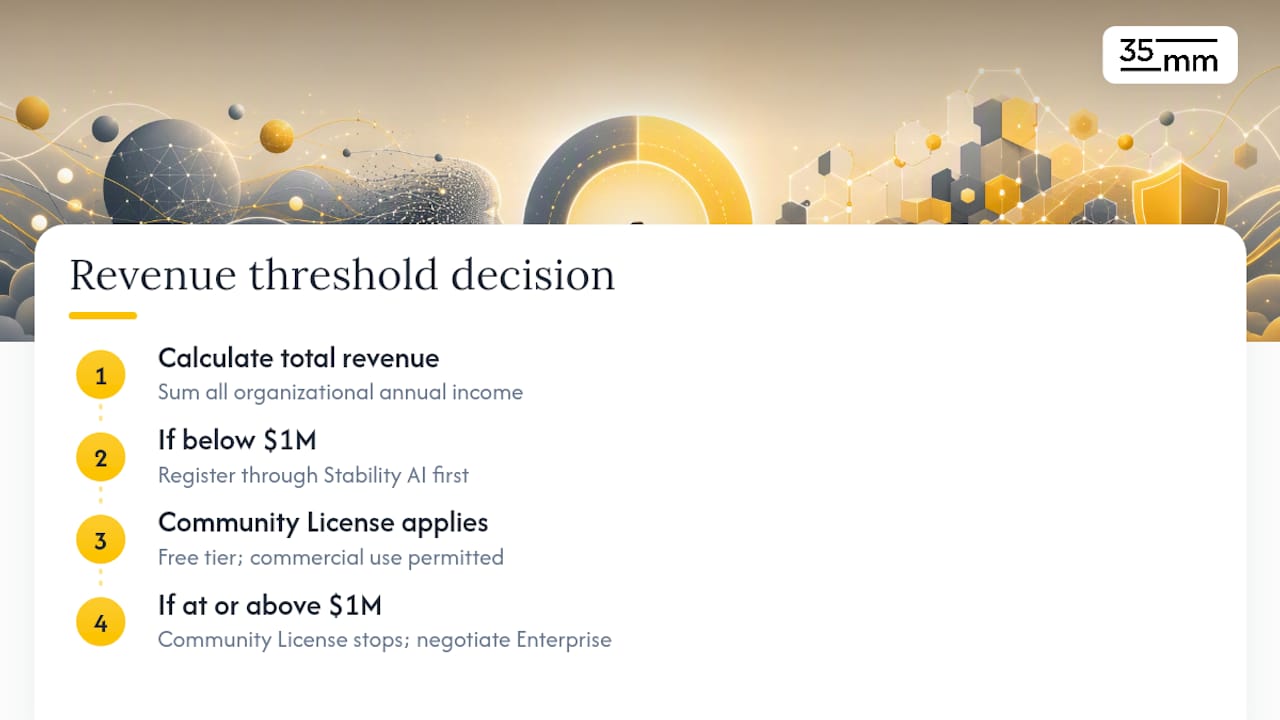
Stability AI's rule is straightforward on paper: total annual revenue below the threshold keeps you on the free Community License tier. The Stability AI license is explicit that this threshold applies to organizations and individuals with total annual revenue under that figure, and the calculation is not limited to AI-related income. If your studio bills $850,000 a year across retouching, CGI, and traditional photography, and only $40,000 of that comes from AI-assisted work, the full $850,000 counts toward the cap.
That aggregation rule catches people off guard. A production company with several revenue lines under one legal entity has to add them all together, not isolate the AI-generated portion, because the license terms apply at the organizational level.
Commercial users below the threshold still need to register through Stability AI's designated registration process before using the models commercially. This isn't optional paperwork. It's a condition of the free license grant. If your organization exceeds the revenue threshold, the Community License no longer applies, and you need to contact Stability AI directly to negotiate an Enterprise License instead.
Who Owns the Images Stable Diffusion Generates?
Under the Community License, you generally own the outputs you generate and any derivative works you build from them. The SD3.5 LICENSE.md states this plainly, giving commercial users rights over generated images subject to the license's registration and Acceptable Use Policy obligations. For a studio delivering final assets to a paying client, that ownership language is what makes the whole arrangement workable.
Here's the catch: license-granted ownership and enforceable copyright are two different things. The U.S. Copyright Office's analysis of AI and copyright makes clear that copyrightability of works produced with minimal human authorship is legally unsettled. A prompt alone, without substantial creative editing or arrangement by a human, may not qualify for the same copyright protection a photograph or illustration would get automatically.
Pro Tip: Treat "I own this image" and "this image is copyrighted" as separate claims. You can own the license rights to use an output commercially while still lacking a strong copyright claim if someone copies your exact output.
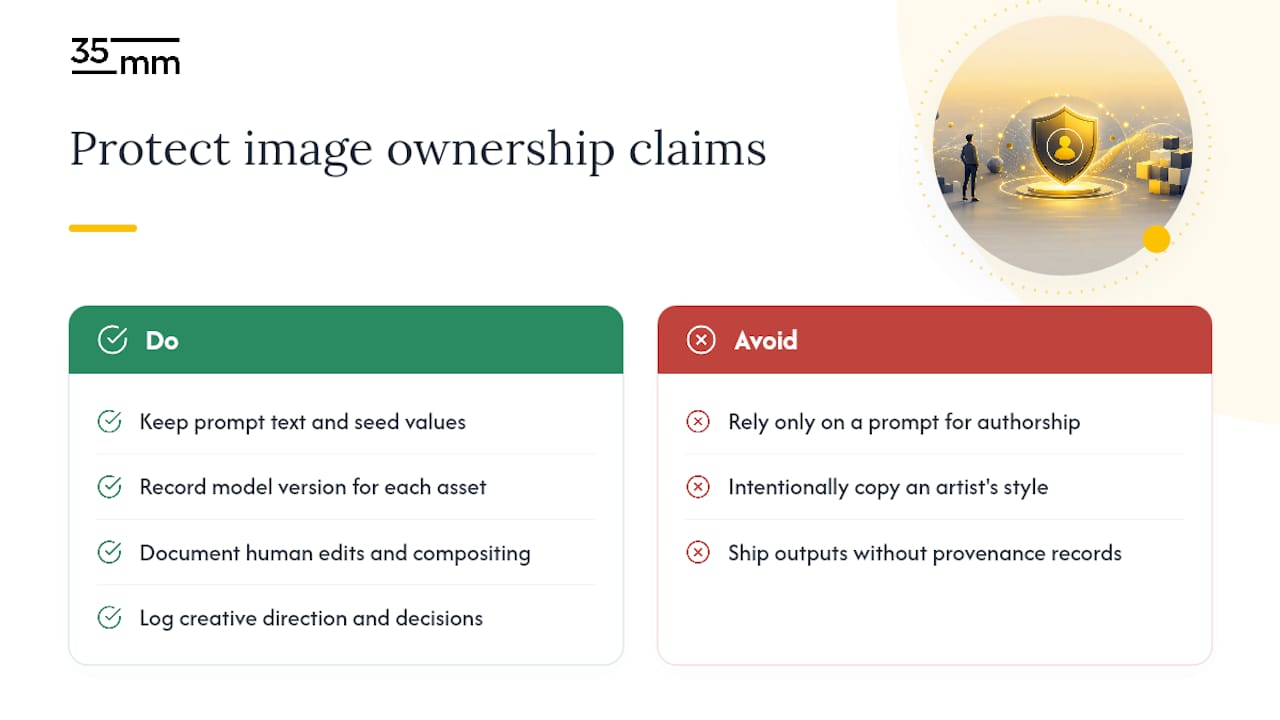
The practical fix isn't legal, it's operational. Retain your prompt text, seed values, and model version for every asset you ship. Document any human editing, compositing, or creative direction layered on top of the raw generation, since that human contribution is often what strengthens a copyright claim. And never let a prompt intentionally reproduce a specific artist's style or a protected character design closely enough to invite a dispute. Our own breakdown of AI image copyright issues goes deeper into how provenance documentation holds up when a client or competitor questions ownership.
What Can't You Do With Stable Diffusion Commercially?
Every license in the Stable Diffusion lineage, from the original CompVis release through the current Community License, attaches use-based restrictions rather than a simple "commercial yes/no" switch. The Acceptable Use Policy prohibits generating content that is unlawful, harasses or defames individuals, produces certain disallowed content categories, or is used to deceive people about the content's nature (such as deepfakes presented as authentic footage).
These restrictions aren't limited to your own use. The CompVis license requires anyone redistributing the model or a derivative of it to pass along the same use-based restrictions to downstream users. If you fine-tune a model and hand it to a client, or if you build a hosted generation tool for other creators to use, you're on the hook for making sure those restrictions travel with it.
For studios and agencies, this shows up in two practical ways. If you operate a hosted service where clients or third parties generate images through your tool, you need terms of service that mirror the AUP, not just a vague "don't misuse this" clause. And if you're delivering trained model checkpoints as part of a client project rather than just final images, the license obligations transfer with the model file itself. One exception worth knowing: if you're using a third-party product that already embeds a Stability AI model, the product's own license terms often govern your use instead of the core model license, since the integrating developer typically absorbs that compliance burden.
Checklist: Making AI Images Commercially Defensible
Before an AI-generated asset goes into a paid campaign, run it through a short compliance pass. This is the sequence we recommend to creative teams handling client work:
- Register your commercial use with Stability AI if your organization's revenue puts you on the Community License and you haven't registered yet.
- Log the model version, full prompt text, seed number, and generation settings for every asset, stored somewhere retrievable months later.
- Check the prompt and output against known copyrighted works, confirming no living artist's name, specific character, or protected logo was referenced or reproduced.
- Add attribution notices where the license or your redistribution terms require them, particularly if you're passing along model access rather than just final images.
- Write an AI-usage clause into the client contract stating which assets were AI-generated, who owns the output, and who bears risk if a dispute arises later.
Skipping step five is the most common mistake we see. A client who doesn't know an image was AI-generated can't make an informed call about how it fits their own brand risk tolerance, and that conversation is a lot easier before delivery than after a complaint. Our guide to AI-enhanced imagery workflows walks through how to structure that documentation without slowing production down.
How 35milimetre Vets Model Releases Before Client Work
Running Stable Diffusion in a commercial studio means someone has to own license review the same way someone owns color grading or file delivery. At 35milimetre, that review happens before a new model version touches a client brief, not after.
The process breaks into a few consistent steps:
- License intake: read the current LICENSE.md or Community License terms for the specific model version, flagging any change from the prior release.
- Legal flagging: note revenue-threshold language, redistribution obligations, and AUP restrictions relevant to the project type.
- Pilot testing: generate sample outputs internally before committing the model to a paid deliverable.
- Provenance capture: log model version, prompt, seed, and a snapshot of the license text in effect at generation time.
- Brief updates: fold any restrictions or attribution requirements into the client-facing project brief.
Pro Tip: For high-budget campaigns where a single disputed asset could stall a launch, it's often worth contacting Stability AI directly about an Enterprise License rather than relying on Community License terms, even if you're under the revenue threshold. Enterprise agreements can include indemnification language that the free tier doesn't offer. Our internal checklist for vetting AI model releases covers the full intake process agencies can adapt for their own pipelines.
Does It Cost Anything to Use Stable Diffusion Commercially?
For organizations under the $1 million revenue threshold, the Community License generally carries no licensing fee for qualifying users. You're not paying Stability AI a per-image royalty, a subscription tax, or a revenue share for commercial use, which is a meaningful difference from stock-image licensing models where cost scales with usage or distribution.
That doesn't mean the total cost of commercial deployment is zero. Running the models yourself requires GPU compute, whether that's local hardware or a cloud rental, and those costs scale with volume and resolution. Plenty of studios instead run generations through hosted platforms or integrated products that embed Stable Diffusion, and those platforms set their own pricing on top of the underlying free model license. A tool like AmmarAI's image generator illustrates this layering: the base model licensing is separate from what a hosted product charges for access, storage, or generation volume.
Once your organization exceeds the $1 million revenue threshold, the cost picture changes entirely, because you're required to negotiate an Enterprise License with Stability AI directly rather than continuing on the free tier. Stability AI doesn't publish flat Enterprise pricing, since those agreements are negotiated based on usage scale and specific business needs. If your revenue is approaching the threshold, it's worth opening that conversation with Stability AI proactively.
Can You Fine-Tune Stable Diffusion for Commercial Projects?
Fine-tuning a Stable Diffusion model, whether to match a brand's visual style or to specialize it for a product category, doesn't remove you from the base model's license. Derivative and fine-tuned models built on SD3.5 typically inherit the Community License terms of the base model, including the revenue threshold, registration requirement, and Acceptable Use Policy restrictions.
That inheritance matters most when you plan to distribute the fine-tuned model rather than just its outputs. If a fine-tuned checkpoint stays entirely internal, feeding your own generation pipeline, your primary obligation is compliance with the base license terms under which you're operating. If you plan to share that checkpoint with a client, sell access to it, or release it publicly, you're now a redistributor, and the CompVis license precedent on propagating use-based restrictions applies with full force. Whatever restrictions bind you also have to bind whoever receives the model from you.
There's also a practical wrinkle worth flagging: fine-tuning on a narrow dataset of licensed brand photography, product shots, or proprietary imagery can create a hybrid IP situation where your training data's ownership terms and the base model's license terms both apply. Before fine-tuning on client-supplied images for a paid deliverable, confirm the client's own rights to that training material. A studio that fine-tunes on imagery it doesn't have clear rights to is exposed twice over, once through the model license and once through the training data's own copyright status.
Does Training Data Affect Your Commercial Use Rights?
Stable Diffusion models were trained on large datasets scraped from the public web, and that training data almost certainly includes copyrighted photographs, illustrations, and artwork whose creators never consented to inclusion. This is the single most contested legal question surrounding diffusion models, and it's separate from whether your specific commercial use is licensed correctly.
Here's the distinction that matters for your business: the Community License governs your right to use the model and its outputs, but does not resolve legal questions surrounding the original training data or copyright infringement claims. It does not resolve, or even attempt to resolve, whether the model's training process itself infringed on the original creators' copyrights. Multiple lawsuits against AI image generator developers are working through exactly that question in courts right now, and the outcomes could reshape what "using the model" legally means down the line.
For a working studio, the practical risk isn't usually training-data litigation reaching back to touch your specific client project. It's the narrower risk of a generated output landing too close to a specific existing work, whether by direct prompt reference or by the model reproducing a distinctive style closely associated with one artist. That's the scenario provenance logging and prompt review are built to catch. It's also why prompts that explicitly invoke a living artist's name or a copyrighted character deserve extra scrutiny before a client-facing asset ships, regardless of what the underlying model license technically permits.
What Ethical and Privacy Risks Should Commercial Users Watch For?
Licensing compliance and ethical deployment are related but not identical problems, and treating them as the same thing is how studios end up technically compliant but still facing a client backlash. Three areas deserve specific attention in commercial AI image work.
Bias in generated outputs is well documented across diffusion models, particularly around how they represent race, gender, and body types when prompts don't specify those attributes explicitly. For brand and advertising work, that means reviewing batches of generated images for skewed representation before selection, not just picking the first output that looks right.
Privacy risk shows up when prompts reference real, identifiable people, especially private individuals rather than public figures. Generating a likeness of a real person without consent, even loosely, creates exposure that's separate from copyright and closer to right-of-publicity or defamation claims depending on context and jurisdiction.
The Acceptable Use Policy already prohibits deceptive content, but the practical version of that rule in commercial work is disclosure. If a client's marketing team plans to present AI-generated imagery as photography, or won't disclose AI involvement to their own audience, that's a business decision worth flagging before delivery, not something to assume is fine because the license permits generating the image itself.
What's Next for Stable Diffusion Licensing?
The direction is toward clearer, more permissive community licenses, which the SD3.5 launch reflects. Copyright enforcement around AI-only authorship remains unsettled, though, so keep documentation habits conservative and revisit your legal footing every time Stability AI updates the license text.
*— 35mm.
Get Client-Ready AI Imagery Without Managing the License Risk Yourself
Running Stable Diffusion in-house means someone owns license tracking, provenance logging, and revenue-threshold math on top of actually producing usable images. A managed service can handle that entire pipeline, so a creative director or in-house marketing team gets contract-ready deliverables without building a compliance process from scratch.
A workflow pairing AI-enhanced generation with retouching, compositing, and CGI experience means outputs get provenance logging and legal review, then get refined by a human artist before reaching a client. That combination, license-aware generation plus hands-on finishing, is what separates a defensible commercial asset from a raw model output nobody checked. For teams weighing AI imagery against traditional production for an upcoming campaign, our breakdown of the benefits of AI imagery for marketers and designers covers where the trade-offs actually land. If you're planning a campaign that leans on AI-generated visuals, reach out through our services page with your brief and we'll scope what a managed pipeline looks like for your project.
Sources
- Stability AI license
- LICENSE.md · stabilityai/stable-diffusion-3.5-large
- CompVis / stable-diffusion LICENSE
FAQ
Is CC BY 4.0 Free for Commercial Use?
Yes, Creative Commons Attribution permits commercial use as long as you credit the original creator, but that license is unrelated to Stability AI's Community License, which governs Stable Diffusion models under its own separate terms.
Can I Use AI-Generated Images Commercially?
Yes, under the Stability AI Community License, provided your organization's total annual revenue stays under the threshold set by Stability AI, you register as a commercial user, and your use follows the Acceptable Use Policy.
Is Stable Diffusion Legal?
Yes, using Stable Diffusion is legal under the terms of its published license, though the copyrightability of the images it generates remains an open legal question according to the U.S. Copyright Office.
Can You Use AI for Commercial Use?
Generally yes, but the specific rights depend entirely on which AI tool's license you're operating under. For Stable Diffusion, that means following the Community License's revenue threshold and registration requirement, or negotiating an Enterprise License once you exceed it.