
Simple campaign retouching and compositing usually ships in a few days to two weeks. Moderate multi-version work runs 2 to 6 weeks. Complex CGI or VFX-heavy campaigns take 6 to 12 weeks or more. The single biggest lever isn't the studio's skill or software. It's how fast the client approves each stage and how many assets and versions the project actually carries. Lock your launch date first, name one decision-maker, and the rest of the schedule falls into place.
TL;DR:
- Turnaround times vary significantly based on project complexity; simple retouching takes a few days to two weeks, while VFX-heavy campaigns can extend beyond 12 weeks.
- Heavy compositing or CGI projects often require 20 to 34 days of post-production alone, with full campaigns typically lasting 6 to 12 weeks.
- Delays are mostly caused by late or structural feedback and switching vendors mid-project, not by the studio’s editing speed or software.
- Establishing clear scope, decision-makers, and revision limits before production begins helps prevent schedule slippage.
- Request detailed, phase-by-phase estimates that include contingency buffers, revision counts, and specific milestones for better schedule reliability.
Table of Contents
- What Determines Retouching Turnaround Time by Project Complexity
- What Happens in Each Post-Production Phase?
- Why Do Retouching Projects Miss Their Deadline?
- How Should You Request a Turnaround Estimate?
- What Does a Sample Production Schedule Look Like?
- The Studio View on Reliable Turnaround
- Ready for a Realistic Retouching Timeline?
- Sources
- FAQ
What Determines Retouching Turnaround Time by Project Complexity
Complexity isn't about how many images sit in the folder. It's about density. A campaign with heavy compositing, custom CGI, or frame-by-frame VFX work takes longer than a project with triple the photo count but with simple color and cleanup needs.
Simple projects cover single-image retouching, basic color correction, or a straightforward social cutdown with one or two aspect ratios. Think Amazon listing images or a product shot needing background cleanup and color grading. These typically move in a few business days to two weeks, assuming the brief is locked and there's one round of feedback.
Moderate projects involve multi-version deliverables: a brand video with three or four cutdowns, a product line requiring compositing across a dozen SKUs, or a campaign needing coordinated versions for different platforms. Industry benchmarks put a standard TV commercial at 3 to 5 weeks from approved brief to broadcast-ready delivery, and that number holds up well as a general moderate-complexity marker.
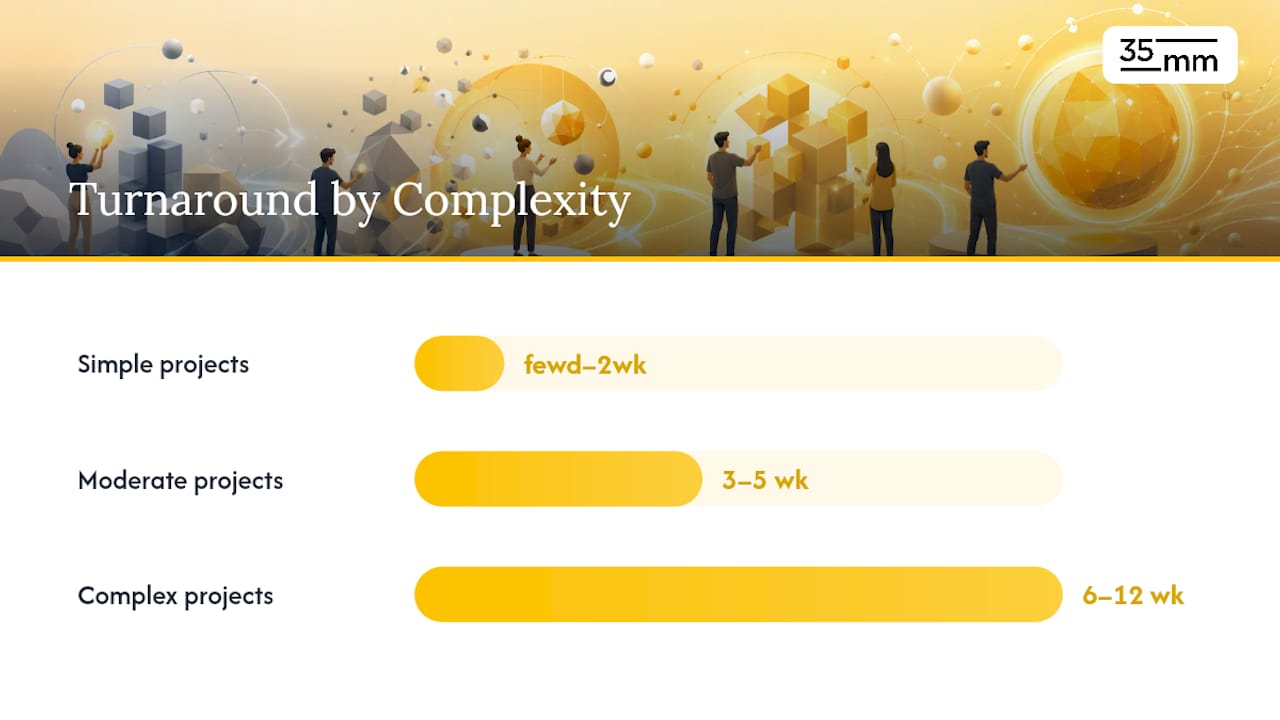
Complex projects bring in CGI rendering, 3D modeling, or VFX-heavy compositing where every frame needs individual attention. Post-production alone can stretch to 20 to 34 days on VFX-heavy work, before accounting for pre-production and client review cycles. A full campaign in this tier often runs 6 to 12 weeks.
A quick rule for scoping any request:
- Simple: single deliverable, minimal versioning, standard retouching or color work
- Moderate: multiple versions or aspect ratios, some compositing, one production shoot
- Complex: CGI/3D assets, VFX compositing, multiple platform-specific versions, layered approval chains
Pro Tip: If a vendor promises a complex CGI turnaround in under two weeks, ask what's being cut. Usually it's render passes, revision rounds, or quality control, not magic.
What Happens in Each Post-Production Phase?
Retouching turnaround time breaks into distinct phases, and understanding each one helps you spot where a schedule is realistic and where it's optimistic.
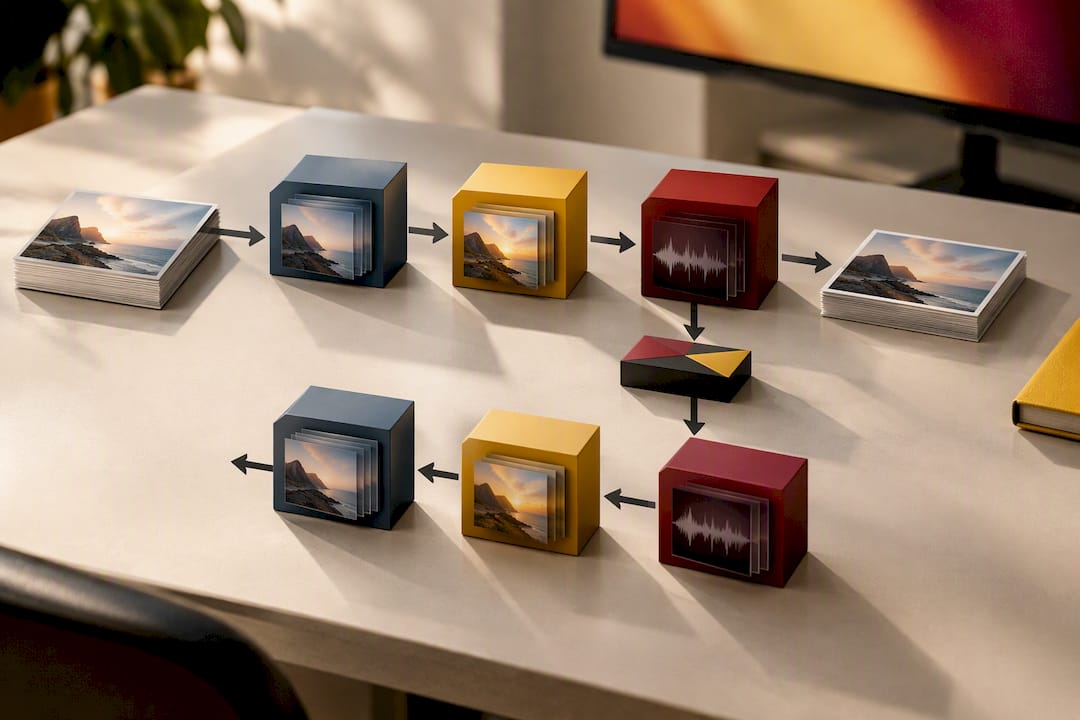
- Assembly and rough cut (1 to 3 days for stills-based work, longer for video): raw assets get organized and a first pass structure gets built.
- Fine retouching and compositing (3 days to 3 weeks depending on density): this is where skin work, background swaps, CGI integration, and detailed cleanup happen. It's usually the longest phase on dense projects.
- Color grading (1 to 5 days): tools like DaVinci Resolve and Adobe Premiere Pro handle most professional grading work, and this phase typically runs after compositing locks.
- Sound and finishing for video deliverables (1 to 3 days): runs in parallel with color when scheduled well.
- Versioning (1 to 5 days per platform set): once the master is approved, cutting it into aspect ratios and platform specs is mechanical but still takes real time.
VFX prep and asset gathering can overlap with early editing. Color and versioning cannot start meaningfully until the creative is locked, which is why late structural changes are so costly.
Why Do Retouching Projects Miss Their Deadline?
Two forces cause most of the slippage buyers actually experience, and neither one is the studio's editing speed.
The revision trap happens when feedback arrives late and addresses structural issues instead of cosmetic ones. A note that says "change the background concept" after color grading has started doesn't cost an hour. It can double the remaining finishing effort, because compositing, color, and sound all have to re-run.
The ramp-up tax hits when brands switch vendors mid-relationship or bring in a new studio cold. A studio typically needs a few projects to learn a brand's visual language, file naming conventions, and approval habits before it hits full speed.
Here's how to protect the schedule from both sides:
- Approve a written brief before work starts. Verbal alignment isn't a brief.
- Name one decision-maker. Committee feedback is where timelines go to die.
- Deliver assets on time. A late shoot delivery pushes every downstream phase by the same number of days.
- Consolidate feedback into a single round per milestone. Staggered notes from five people create five separate revision cycles.
- Ask your vendor to define scope freeze dates and revision counts in writing. Client feedback speed is consistently the largest variable in how long post-production actually takes.
Pro Tip: Ask for a "revision freeze" milestone before color and mix begins. Only small, documented cosmetic fixes are allowed past that point. It's a small contract clause that prevents expensive re-work later.
How Should You Request a Turnaround Estimate?
A vague request gets a vague timeline. Ask vendors to quote against a specific brief, and you'll get numbers you can actually compare across proposals.
Include these in every estimate request:
- Launch date, worked backward to a delivery deadline
- Full deliverable list: image counts, video length, aspect ratios, platform versions
- File specs and legal or claims review requirements
- One named decision-maker and their availability for review windows
- Assumed number of revision rounds
Then ask the vendor to return per-phase timing, not just a single end date, along with a contingency buffer for VFX-heavy or CGI work.
| What to request | Why it matters |
|---|---|
| Per-phase timing breakdown | Shows where time actually goes, not just a total |
| Assumed revision rounds | Prevents scope creep from "unlimited" expectations |
| Contingency buffer | Protects against render delays or approval slippage |
| Delivery format list | Avoids last-minute re-export cycles |
| Acceptance criteria | Defines what "done" looks like before work starts |
What Does a Sample Production Schedule Look Like?
Working backward from a launch date is the single most reliable planning habit in commercial post-production. A five-phase structure, moving from discovery through delivery, gives most moderate campaigns a realistic 6 to 8 week window end to end.
| Week | Milestone | Owner |
|---|---|---|
| Week 1 | Brief approved, kickoff call | Client decision-maker |
| Week 2 | Shoot or asset delivery | Client/production team |
| Weeks 3-4 | Rough cut, first retouching pass | Studio |
| Week 5 | Client review, consolidated feedback | Client decision-maker |
| Week 6 | Fine retouching, color, versioning | Studio |
| — | Final delivery, platform exports | Studio |
Checklist for any launch: confirm the launch date, get the brief signed off, lock shoot dates, set one review window per milestone, and build in buffer days before final delivery. Compressing this schedule is possible, but it usually means fewer revision rounds, added overtime costs, or a smaller version count. Something gives.
The Studio View on Reliable Turnaround
Reliable retouching turnaround time comes down to team structure, not just editing speed. A small core team with senior oversight on every file avoids the handoff delays that plague larger, layered production houses where a junior editor's rough pass has to wait for a senior review queue.
Scalable freelance support absorbs volume spikes without diluting quality control, and AI-assisted workflows now compress certain compositing and product-shot tasks that used to eat days off a schedule. The real discipline is knowing which phases can be accelerated safely and which ones, like structural creative approval, simply can't be rushed without cost.
— 35mm
Ready for a Realistic Retouching Timeline?
Most studios quote a range and hope for the best. 35milimetre works from a fixed-scope brief with named milestones, so the number you get at kickoff is close to the number you get at delivery. That matters most on the projects everyone underestimates: compositing-heavy product campaigns, CGI renders, and multi-version deliverables where one vague brief can quietly add weeks.
The studio's core services cover the ground commissioning teams actually need: photo compositing and retouching for campaign visuals, AI product compositing for faster commerce turnarounds, and full packaging design work for launches with multiple SKUs. When you request a timeline, expect a kickoff call, a per-phase schedule with named milestones, and a stated revision count before anything moves into production. Teams also managing their own studio discovery and booking pipeline can find useful groundwork in photography SEO resources for commercial photographers.
If your next campaign has a hard launch date, start the conversation with 35milimetre's project inquiry page and get a phase-by-phase estimate before you lock your internal deadlines.
Sources
- How long does commercial video production take? | Griffith Media
- How Long Does It Take To Make A TV Commercial? 2026 Guide
- Video Production Timeline Template: How Long Each Phase Actually Takes - Lemonlight
- Video Post-Production: Complete Guide for Marketers
FAQ
How Long Does Simple Retouching Usually Take?
Simple retouching, like single-image cleanup or basic color correction, typically ships in a few business days to two weeks once the brief is approved. The main variable is how quickly the client reviews and signs off on the first pass.
What Makes a Retouching Project "Complex"?
Complexity comes from asset density, not image count: CGI rendering, frame-by-frame VFX compositing, and multiple platform-specific versions all add calendar time. These projects often run 6 to 12 weeks, with post-production alone taking 20 to 34 days on VFX-heavy work.
Why Do Revision Rounds Blow Up the Schedule?
Late structural feedback, changing a concept after color grading has started, forces multiple phases to re-run instead of one. Locking a revision freeze before color and mix begins prevents this kind of costly backtrack.
Does 35milimetre Offer Fixed Pricing for Retouching Work?
Some services, like Amazon photo compositing, are priced per image at $125 one-off, while custom compositing, CGI, and packaging work are quoted per project. Current pricing for custom scopes is available directly on the studio's site.
What's the Single Best Way to Speed Up Turnaround?
Consolidate feedback into one round per milestone and name a single decision-maker. Client approval speed is consistently the biggest factor separating a 3-week schedule from a 6-week one, more than any editing or rendering step.