

A vendor-managed remote post-production workflow delivers finished, campaign-ready images by moving assets through a fixed sequence: intake, proofing, consolidated revisions, and final delivery. The single control that determines whether it runs smoothly is an approved brief with one named approval owner. Standard batches should move through this process in 24 to 48 hours.
Key Takeaways
A remote post-production workflow succeeds when an approved brief with one approval owner drives every stage from intake through delivery, backed by a 24 to 48 hour turnaround standard.
| Point | Details |
|---|---|
| Name one approval owner | A single decision maker consolidating feedback prevents scattered comments from derailing the schedule. |
| Front-load the brief | Specify deliverables, crop ratios, file formats, color profile, and naming conventions before assets ship. |
| Test before scaling | Send a 10 to 20 image batch first to confirm style and turnaround match expectations. |
| Separate fixes from preferences | Mark factual errors apart from subjective taste changes to protect included revision rounds. |
| Choose an experienced studio | 35milimetre offers over two decades of color-critical retouching and CGI work for technology and automotive brands, with test batches available before full commitment. |
Table of Contents
- How Does a Remote Post-Production Workflow Actually Run?
- What Belongs in the Pre-Production Brief?
- How Do You Transfer Files Securely?
- How Should Feedback and Revisions Be Handled?
- What Should Final Delivery Include?
- How Do You Choose the Right Remote Post-Production Studio?
- What Most Guides Get Wrong About This Process
- Ready to Test a Studio Without Committing to Full Volume?
- Sources
How Does a Remote Post-Production Workflow Actually Run?
Every reliable remote post-production collaboration follows the same skeleton, whether the studio is retouching product shots for an e-commerce brand or compositing CGI for an automotive campaign. The stages rarely change. What changes is how disciplined each party is about the handoffs between them.
- Brief approval. The client and studio agree on deliverables, formats, and style before a single frame gets edited.
- Asset arrival and sample checks. The studio reviews a handful of files for technical soundness, color accuracy, and completeness against the shot list.
- Test proofs. A small batch moves through the full edit process so both sides can confirm direction before scaling.
- Consolidated feedback. The approval owner gathers input from stakeholders into one document, not five email threads.
- Revision pass. The studio applies changes within the agreed rounds.
- Final delivery. Masters and flattened exports ship with naming conventions and metadata intact.
Asset naming and color management are not administrative afterthoughts. A batch arriving without a consistent naming convention or a stated color profile forces the studio to guess, and guessing is where revision cycles multiply. Documenting the workflow upfront with a shared project hub keeps everyone working from the same reference points from day one.
What Belongs in the Pre-Production Brief?
Most delays in remote creative workflows trace back to a brief that was too vague to act on. The fix is a checklist the approval owner fills out before anything ships to the studio.
- Final deliverables list (hero shots, lifestyle images, packaging renders) and the primary channels each will run on
- Crop ratios per channel (square for feed, 9:16 for stories, wide for web banners)
- A numbered shot list mapped to SKUs or campaign assets
- Must-pass proofs: the specific images that need sign-off before the studio proceeds to the full batch
- A named approval owner and a stated review timeline
- Master file types (layered PSD or TIFF), color profile (Adobe RGB or sRGB depending on end use), naming convention, and required metadata fields
- Style guide covering background treatment, shadow behavior, color grade, and export specs — the single most valuable document in the entire relationship
- Legal releases and licensing scope: territory, duration, and any sublicensing rights
Pro Tip: Attach three reference images that show exactly the retouching level you expect, not just words describing it. "Clean and natural" means something different to every retoucher on earth.
An opening agreement covering file formats, color profile, and contacts reduces rework more than almost any other single step in the process.
How Do You Transfer Files Securely?
Remote video editing and image post-production both live or die on transfer discipline. Cloud storage with structured, versioned folders beats email attachments every time, since versioning prevents the classic problem of someone editing an outdated file.
- Use a shared drive or dedicated transfer tool with delivery receipts confirming files arrived intact
- Request checksums on large batches so corruption gets caught before editing starts, not after
- Arrival checks should compare shipped assets against the shot list, confirming SKU accuracy, accessory placement, and surface finish where relevant
- Access control matters: limit preview links to reviewers who need them, and require watermarks on proofs shared outside the immediate team
- A basic IP clause in the vendor agreement should state who owns the raw files and who owns the finished deliverables
Pro Tip: Ask any prospective studio how they handle version control on revised files. If the answer is "we just save over the old one," keep looking.
How Should Feedback and Revisions Be Handled?
Cloud-based post-production collapses quickly when feedback arrives from six people in six different formats. The fix is procedural, not technological.
- Route all proofs through the approval owner, who reviews first and consolidates stakeholder input into one document.
- Mark each comment as either a factual fix (wrong crop, incorrect logo placement) or a subjective preference (lighter shadow, warmer tone).
- Confirm the number of included revision rounds in the brief, and treat anything beyond that count as new scope requiring a separate quote.
- Document any scope change in writing before the studio starts the additional work.
Scattered comments and shifting deliverables are the most common cause of blown timelines in remote creative collaboration. A studio that requires one consolidated comment list per round, rather than accepting feedback piecemeal, is protecting the schedule, not being difficult.
What Should Final Delivery Include?
A finished delivery from a competent remote video editing or image studio should never be a single flattened JPEG and a "thanks, hope this works." The deliverable set should match what the brief specified, and nothing less.
- Layered PSD or TIFF masters for anything that may need future edits
- Flattened, channel-specific exports sized and cropped for each platform named in the brief
- Embedded metadata for usage tracking and rights documentation
- A naming manifest that maps every file to its shot list entry, plus any localization variants requested
Color profile handling deserves a specific mention here: a file delivered in the wrong profile can shift noticeably once it hits a web browser or a print proof, and catching that after launch is far more expensive than specifying it upfront.
How Do You Choose the Right Remote Post-Production Studio?
Portfolio fit matters more than a generic list of software skills. Look for color-critical retouching and compositing examples in your actual category, whether that's automotive reflections or CGI packaging renders, not just a broad "we do everything" pitch.
- Ask directly: who is the single point of contact, and how do they consolidate feedback from multiple stakeholders?
- Confirm the SLA in writing, including the standard turnaround window for a normal batch
- Ask what happens when a shoot spans distant time zones, since overlapping hours shrink fast beyond about three zones and handovers slow down
- Clarify licensing and rights language before signing anything
- Request a small test batch rather than committing to full volume on the first project
Pro Tip: A studio confident in its process will offer a test batch without hesitation. Hesitation on that request is itself useful information.
35milimetre has run this exact process for over two decades, working as a compact team of three specialists in retouching, graphic design, and 3D, with the flexibility to bring in additional talent on larger campaigns. The studio's track record spans technology and automotive brands where color accuracy and CGI compositing are not optional. That combination of longevity and a tight core team is worth weighing against studios that scale headcount but lose consistency.
What Most Guides Get Wrong About This Process
Most advice on remote creative collaboration focuses on tools: which cloud drive, which proofing app, which project board. Tools matter less than most guides suggest. A studio with mediocre software and one clear approval owner will outperform a studio with excellent software and five conflicting reviewers, every time.
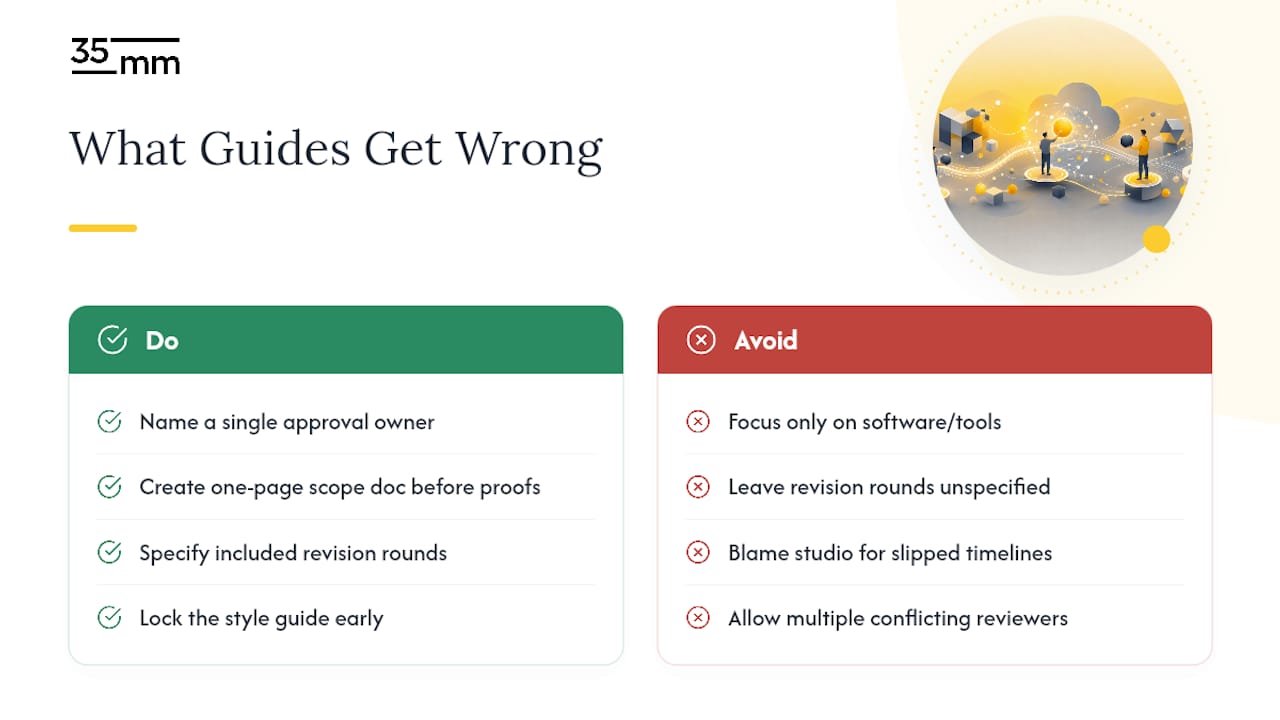
The overlooked variable is scope discipline. Agencies often treat revision rounds as infinite because nobody wrote down the number, and then blame the studio when timelines slip. That is a brief failure, not a delivery failure. The fix isn't better editing software. It's a one-page document, signed off before the first proof goes out, that names who approves, how many rounds are included, and what counts as new scope.
If you take one thing from this checklist, prioritize the approval owner and the style guide before anything else. Everything downstream, revision counts, turnaround, even file naming, gets easier once those two decisions are locked. Studios can absorb ambiguity about software. They cannot absorb ambiguity about who says yes.
— 35mm
Ready to Test a Studio Without Committing to Full Volume?
The lowest-risk way to evaluate any remote post-production partner is a small paid test batch, not a leap of faith on your entire campaign. Send 10 to 20 images with a short brief covering deliverables, crop ratios, and your style reference, then judge the result against your actual standards rather than a portfolio alone.
Before any files move, ask 35milimetre for written confirmation of deliverables, included revision rounds, turnaround SLA, and licensing terms, so nothing gets settled by assumption later. With over two decades handling color-critical retouching, CGI, and compositing for technology and automotive brands, 35milimetre runs this exact intake-to-delivery process daily. Request a test batch and portfolio review to see how your next campaign's assets would actually turn out.