

Project-based creative pricing means charging one fixed fee for a clearly defined set of deliverables, rather than billing by the hour. It works best when you already know the scope: the format, the revisions, the timeline. Skip it for exploratory or open-ended work where the outcome is still being discovered. Once scope is clear, estimate your fee using the formula in the next section.
TL;DR:
- Accurate project pricing relies on precise scope definition, including deliverables, revisions, timeline, and usage rights, to avoid scope creep and unpaid overtime.
- Using a target hourly rate based on actual billable hours, then adding expenses and a 10% to 30% buffer, provides a solid foundation for estimating fixed project fees.
- Combining different pricing models, such as hourly for discovery, fixed fee for production, and retainer for ongoing work, aligns each stage with the appropriate billing approach.
- Clear scope documentation with explicit exclusions, change-control clauses, and licensing terms safeguards margins and minimizes billing disputes.
- Adding a contingency buffer and validating estimates against typical project ranges helps maintain profitability and informs better price setting over time.
Table of Contents
- What Is Project-Based Pricing and When Should You Use It?
- How to Calculate a Project Price: Formula, Buffers, and Worked Examples
- Project, Hourly, Retainer, or Value-Based: Choosing the Right Model
- What Belongs in a Scope Document to Prevent Creep?
- How to Present Your Quote and Negotiate Without Underselling
- Pricing Templates and Mistakes That Quietly Kill Margin
- How 35milimetre Prices High-End Visual Post-Production
- Author Perspective: Practical Next Steps for Confident Project Fees
- How 35milimetre Can Help You Price Your Next Visual Project
- Sources
What Is Project-Based Pricing and When Should You Use It?
A fixed project fee tells the client exactly what they'll pay before a single asset gets delivered. No surprises on the invoice, no watching the clock. For creatives, that predictability is the whole appeal, both for you and the client writing the check.
Project pricing works when the deliverables are known quantities. A logo suite, a set of product renders, a 30-second brand video with a locked script. You can estimate hours because you've done something like it before, or the scope is narrow enough that unknowns stay small. According to a pricing playbook for creative professionals, fixed fees work best when outputs are clear, while hourly billing suits work that's still being figured out as you go.
Here's where the model shines, and where it doesn't:
- Best fit: identity packages, packaging design, a defined CGI product shot, a set number of retouched images, a short explainer video with an approved script.
- Weak fit: open-ended brand strategy, R&D style concepting, ongoing social content with no fixed volume, anything where the client says "let's see where this goes."
- Client benefit: budget certainty. Finance teams and marketing leads can approve a number once and move on.
- Your benefit: you get paid for the value delivered, not the hours logged, so getting faster with experience increases your margin instead of shrinking your invoice.
- The risk: if scope isn't nailed down before you quote, project pricing can turn into unpaid overtime disguised as a "flat rate."
The trade-off is simple. Fixed fees reward precision in scoping and punish vagueness. Get the definition right, and this is the most profitable way to bill creative work.
How to Calculate a Project Price: Formula, Buffers, and Worked Examples
The math behind a solid quote isn't complicated. It's estimate hours, multiply by your target rate, add expenses, then pad for the unknown. Most freelancers skip the last step and pay for it later.
Start with your target hourly equivalent. That's not your dream rate pulled from thin air. It comes from your annual overhead (software, insurance, equipment, subcontractors) plus your desired take-home income, divided by billable hours per year, usually somewhere around 1,000 to 1,200 hours once you subtract admin, pitching, and downtime from a standard work year.
Pro Tip: Track your actual billable hours for two months before you set a target rate. Most creatives overestimate how many hours per week are truly billable, which leads to underpricing every project after.
The core formula:
- Estimate total hours the project will realistically take.
- Multiply hours by your target hourly equivalent.
- Add direct expenses (stock assets, fonts, render farm costs, subcontractor fees).
- Add a contingency buffer, typically 10% to 30% depending on how well-defined the scope is.
- Add licensing or usage fees if the client needs broader rights than standard delivery.
- Round to a clean, presentable number.
A commonly cited worked example: 80 hours at a $105 hourly target rate comes to $8,400. Add a 20% buffer and you land at $10,080, which rounds cleanly to a $10,000 quote. That rounding step matters more than it seems. A number like $10,080 reads like a spreadsheet output. A number like $10,000 reads like a decision.
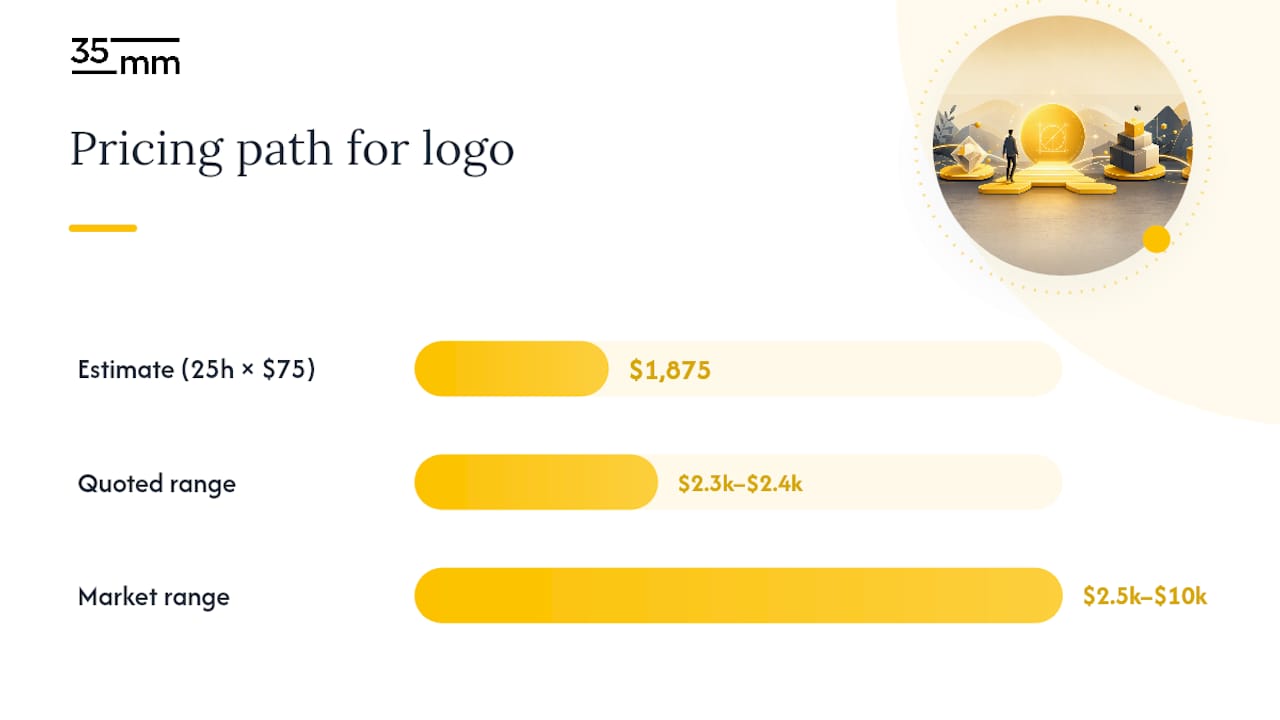
A second example, scaled down: a small business logo and brand mark package. Say you estimate 25 hours at a $75 target rate, giving you $1,875. Round to $2,300 or $2,400 depending on how firm the scope feels.
For context, median project fees for common freelance engagements often land between $2,500 and $10,000, depending on complexity and industry. If your number falls wildly outside that range for comparable work, that's worth a second look, either at your scope assumptions or your rate.
Buffers aren't padding for padding's sake.
Project, Hourly, Retainer, or Value-Based: Choosing the Right Model
No single pricing model covers every job, and pretending otherwise costs you money. Freelancers commonly run two or three pricing models at once, matching the model to the type of work rather than forcing everything into one box.
Here's how the core models stack up for creative work:
- Hourly: best for discovery, exploratory concepting, or anything where scope keeps shifting. Transparent, but clients dislike the open-ended risk.
- Project fee: best when deliverables are locked. Predictable for both sides, rewards efficiency.
- Retainer: best for ongoing relationships, like monthly content production or maintenance work on an existing brand system.
- Per-deliverable: best for high-volume, repeatable outputs, like a fixed price per product photo or per social asset.
- Value-based: best when your work measurably drives revenue, and you can tie your fee to that outcome rather than to hours.
A hybrid approach often works better than picking just one. Bill discovery and strategy hourly since nobody knows the real scope yet. Once the deliverables are defined, switch to a fixed project fee for production. If the relationship continues past the initial deliverable, transition to a retainer for ongoing maintenance or a value-based arrangement if your work is clearly tied to measurable results.
This staged path (hourly, then project, then retainer or value-based) mirrors how many successful creative practices grow client relationships over time. It also solves a common problem: quoting a fixed fee before you understand the work almost always underprices it. Quoting hourly for a long-term maintenance relationship almost always overcomplicates the invoicing. Match the model to the moment.
What Belongs in a Scope Document to Prevent Creep?
Scope creep isn't really about difficult clients. It's about quotes that never defined the boundaries in the first place. Vague scope is the single biggest driver of pricing failures in creative work, and it's almost always fixable with a better document, not a tougher negotiation.
A scope document that actually protects your margin needs to spell out:
- Exact deliverables (file types, sizes, resolutions, formats for web versus print)
- Distribution channels the assets are approved for
- Number of revision rounds included, and what counts as a "round"
- Project timeline with milestone dates
- Who has final sign-off authority (one approver, not a committee that changes its mind)
- What's explicitly excluded, so nobody assumes it's included
Pro Tip: List exclusions as clearly as inclusions. "Does not include additional retouching beyond the two specified rounds" stops more scope-creep conversations before they start than any clause about extra billing.
Change-control language should be built into the contract before you sign, not improvised mid-project. Standard approach: additional revision rounds, new deliverables, or format changes outside the original scope get quoted separately as a change order, priced at your standard hourly equivalent plus a small rush premium if the timeline is tight.
Licensing and usage rights deserve their own line in the quote. A logo delivered for a small business website carries different value than the same logo licensed for a national ad campaign. State the rights included (geography, duration, media type) explicitly, and price broader usage as an add-on rather than assuming it's baked into the base fee.
How to Present Your Quote and Negotiate Without Underselling
A proposal that leads with the price is a proposal that gets negotiated down. A proposal that leads with the outcome gets approved closer to your number.
Structure that works consistently:
- Open with an outcomes-first summary: what the client gets and why it matters to their business, before any numbers appear.
- Show a package view of what's included, described by result rather than just task list.
- Lay out the scope in plain terms, matching the checklist from your contract.
- Present price, ideally in tiers rather than a single number.
- Close with a payment schedule tied to milestones, not just "50% up front."
Tiered pricing, often called good/better/best, gives clients a choice instead of a yes/no decision. Describing each tier by outcome rather than just deliverable count improves conversion, because clients anchor against your highest tier and the middle option starts looking reasonable by comparison. A three-tier structure also works well when you're bundling add-ons like extended licensing or rush turnaround, similar to how tiered subscription models get structured for recurring creative work.
When clients push back on price, resist the instinct to just cut the number. Trade instead: fewer revision rounds for a lower fee, extended timeline for a discount, or reduced usage rights for a smaller budget. Outcome-based pricing conversations, the kind larger agencies use to justify monthly retainers, tend to hold up better under negotiation than pure hourly-rate justifications, because the client is negotiating value, not your time.
Pricing Templates and Mistakes That Quietly Kill Margin
Most pricing mistakes aren't dramatic. They're small, repeated errors that add up over a year of projects.
- Undercounting overhead when calculating your target hourly equivalent, which quietly underprices every project that follows.
- Quoting before the scope document is finalized, then absorbing "small" changes for free.
- Ignoring licensing entirely, leaving revenue on the table for clients who need broader usage rights.
- Skipping buffers on "simple" projects, which are exactly the ones that tend to surprise you.
A quick reference for buffer sizing by project certainty:
| Project certainty | Recommended buffer | Example |
|---|---|---|
| High (returning client, familiar brief) | 10% to 30% | Repeat product photo retouching batch |
| Medium (new client, clear brief) | 10% to 30% | New logo and brand mark package |
| Low (vague brief, first-time client) | 25% to 30% | Exploratory CGI concept with undefined revisions |
Track two numbers after every project: how close your hour estimate came to actual hours worked, and your gross margin. That data lets you tighten buffers over time instead of guessing, and it turns pricing into something you improve with evidence rather than instinct.
How 35milimetre Prices High-End Visual Post-Production
Pricing a CGI render or a compositing job isn't so different from pricing a logo package. The inputs just carry more weight. Artist hours, software and render costs, the complexity of the composite or 3D scene, and the number of revision rounds all factor into the base estimate before a single client conversation happens.
Rush delivery changes the math meaningfully. Compressing a two-week compositing timeline into three days doesn't just add stress, it adds real cost in overtime and rescheduled priorities across a small team.
Rush timelines on complex visual work often carry a premium of 25% to 50% over standard turnaround, reflecting the real cost of compressing artist hours and render time rather than just marking up the invoice.
Licensing works the same way it does for any creative deliverable. A product render built for one e-commerce listing costs less than the same asset licensed for a global ad campaign, because the usage, not just the labor, is part of what's being priced. Readers scoping their own retouching or CGI projects can compare cost drivers in more detail through our breakdowns on photo retouching costs and CGI rendering pricing.
Author Perspective: Practical Next Steps for Confident Project Fees
Pull your last three project invoices and compare the hours you quoted against what the job actually took. Most creatives are off by more than they'd guess, usually underestimating revisions and client feedback loops rather than production time itself.
Write a one-page change-order policy this week. It doesn't need legal language, just a clear line: anything outside the agreed scope gets a separate quote before work starts. Then start tracking gross margin per project, not just revenue. That number tells you faster than any client conversation whether your buffers are sized correctly.
— 35mm
How 35milimetre Can Help You Price Your Next Visual Project
Consider a studio option that provides scoped, fixed-fee quotes for high-end visual work instead of open-ended hourly estimates that leave you guessing at the final invoice. Services include commercial retouching, CGI and 3D rendering, compositing, packaging design, and AI-enhanced imagery, with pricing built around a scope-first approach.
To get an accurate quote, send a brief that covers the deliverables you need, target formats and sizes, the channels the assets will run on, your timeline, and whether you need broader usage rights beyond standard delivery. That level of detail is exactly what turns a rough estimate into a firm number instead of a padded guess. Visit the 35milimetre services page to review the studio's work and start a conversation about your project's scope and timeline.