
Photo retouching cost depends on who does the work and what the images actually require. At the low end, AI editing platforms handle standard adjustments for roughly $0.05–$0.10 per image. Freelance retouchers on open marketplaces typically run $0.50–$5 per image for basic work, while experienced specialists and boutique studios charge $2–$50+ per image for commercial-grade output. The four variables that move any quote the most are image complexity, volume, turnaround speed, and intended usage (personal vs. licensed commercial).
Quick reference:
- AI base edits: $0.05–$0.10 per image
- Freelance basic correction: $0.50–$5 per image
- Portrait/beauty retouch: $10–$50 per image
- Commercial product/composite: $15–$150+ per image
- Hourly (experienced human editor): $30–$150/hour
Key Takeaways
Photo retouching cost scales with complexity, usage, and the experience level of the retoucher, making a clear brief the single most effective cost-control tool available to any buyer.
| Point | Details |
|---|---|
| AI vs. human cost gap | AI edits run $0.05–$0.10 per image; experienced human retouchers charge $30–$150/hour. |
| Billing model matters | Match per-image pricing to predictable batches; use fixed-project fees for campaign work. |
| Hidden fees add up | Rush surcharges, extra revision rounds, and layered PSD delivery are common add-ons to confirm upfront. |
| Job type drives range | Wedding correction starts near $0.50/image; advertising composites reach $150+ per image. |
| 35milimetre's approach | 35milimetre scopes every project with a trial edit and delivers a single all-in project estimate for commercial clients. |
Table of Contents
- What does photo retouching cost at each service level?
- How retouchers bill: per-image, hourly, and project models
- What factors raise or lower a retouching quote?
- What are typical retouching prices by job type?
- How to request an accurate quote
- Sample pricing matrix for quick budgeting
- When does a boutique studio make more sense than a freelancer?
- What we have learned from two decades of quoting retouching work
- High-end post-production, scoped and priced for commercial work
- Sources
What does photo retouching cost at each service level?
Retouching is not a single service. It spans a wide spectrum, from a quick exposure fix to a multi-layer composite built from a dozen source files. Mapping your project to the right tier is the fastest way to get a realistic budget.
Basic color correction and culling covers white balance, exposure, contrast, and minor cropping. This is the bread-and-butter of high-volume wedding and event photography. Per-image rates typically land between $0.50 and $5, and experienced human editors billing by volume often convert this to roughly $0.50–$2.00 per image. AI platforms handle this tier well, which is why many studios now use them for bulk culling before a human touches the selects.
Portrait and beauty retouching adds skin smoothing, blemish removal, frequency separation, hair cleanup, and eye enhancement. This is where the human eye still earns its premium. Per-image rates range from $10 to $50, depending on how many layers of work the brief requires. A clean headshot for LinkedIn sits at the lower end; a full beauty campaign image with complex skin work sits at the top.
Product and e-commerce retouching includes background removal, shadow creation, color accuracy, and ghost mannequin effects for apparel. Rates commonly fall between $5 and $30 per image. Background removal in bulk is often quoted below $1 per image, while object removal runs $5–$15 and full product compositing pushes higher.
High-end composite and manipulation work, such as advertising campaigns, automotive visuals, or CGI-integrated imagery, commands $50–$150+ per image. Specialized retouching for complex creative work can reach $50 per image even from a solo retoucher; studio rates for full campaign composites go well beyond that. For a deeper look at what advanced photo editing actually involves technically, the techniques at this tier explain why the price gap is so wide.
How retouchers bill: per-image, hourly, and project models
Understanding the billing model matters as much as the rate itself, because the same retoucher can look cheap or expensive depending on how you compare them.
Per-image pricing works well when the scope is predictable and the images are similar. It gives you a clean cost-per-deliverable and makes budgeting straightforward. The risk is that a retoucher may rush complex images to protect their margin, so always confirm what "one retouch" actually includes.
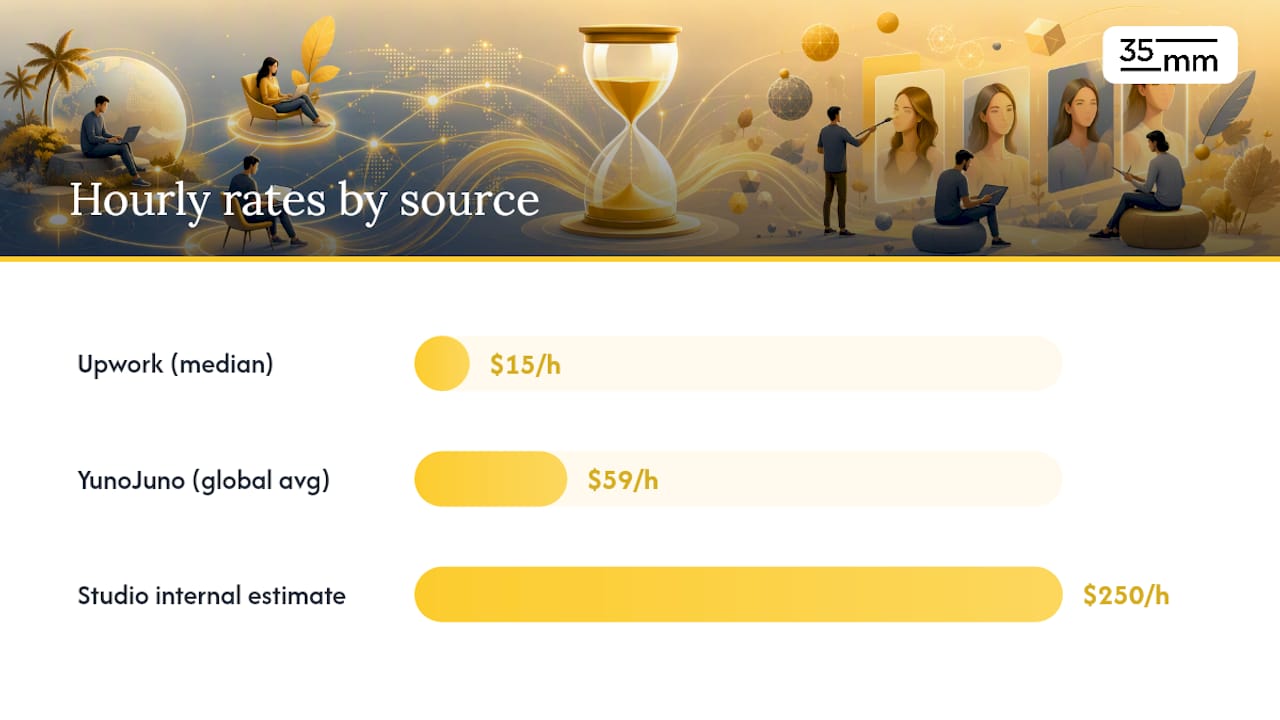
Hourly billing suits open-ended briefs, creative exploration, or jobs where complexity varies widely across the batch. YunoJuno's marketplace data puts the average freelance retoucher rate at $59 per hour globally, while Upwork's platform median sits closer to $15/hour, reflecting the effect of geography and platform competition on rates. Neither figure is wrong; they describe different talent pools.
Fixed-project pricing is common for campaigns with a defined deliverable list. Studios often calculate this internally by time (one practitioner example uses $250/hour as an internal estimating rate) and then present a single project fee to the client. This protects both sides: the client gets cost certainty, and the studio doesn't expose its internal math.
Retainer and subscription models suit brands with recurring monthly volume. AI-platform subscription tiers are the newest variant here, offering a fixed monthly credit pool for automated edits at a fraction of human rates.
Pro Tip: Match the billing model to your project type. Per-image works for predictable batches; hourly or fixed-project works for anything with creative variables. Never compare an hourly rate to a per-image rate without estimating how many images that hour actually produces.
| Billing model | Best for | Watch out for |
|---|---|---|
| Per-image | Predictable, similar images | Scope creep if images vary widely |
| Hourly | Complex or exploratory work | Hard to budget without a time estimate |
| Fixed project | Defined campaign deliverables | Revision rounds may not be included |
| Retainer | Recurring monthly volume | Unused credits rarely roll over |
| AI subscription | High-volume, standardized edits | Limited on creative or complex work |
What factors raise or lower a retouching quote?
Several variables consistently move quotes up or down, and knowing them lets you write a brief that controls cost rather than leaving it to the retoucher's interpretation.
- Image complexity: A clean studio shot on white costs far less to retouch than a lifestyle image with a busy background, multiple subjects, and mixed lighting.
- Volume: Most retouchers offer per-image discounts at 50, 100, or 500-image thresholds. Batching work into larger orders is one of the most reliable ways to reduce per-image cost.
- Turnaround speed: Rush fees of 25–50% above standard rates are common for 24-hour delivery. Build in realistic lead time whenever the brief allows.
- Revision rounds: Many retouchers include one or two rounds in their base price. Additional rounds are typically billed at an hourly rate or a flat fee per round. Always confirm this before signing off.
- Licensing and usage: An image licensed for a national TV campaign costs more to retouch than the same image for an Instagram post. Some retouchers and studios build a usage multiplier into their fee; others invoice it separately.
- File format and RAW handoff: Delivering layered PSD files or retouched RAW files takes more time than a flat JPEG export. Expect a line item for this if it is not explicitly included.
- Retoucher experience and geography: Platform-based hiring flattens rates toward the lower end of the market. A boutique studio with a brand portfolio and QA process charges a premium that reflects overhead, not just skill.
Hidden fees to watch for: rush surcharges, per-revision charges beyond the included rounds, color-profile conversion fees, and licensing uplift clauses buried in contracts.
What are typical retouching prices by job type?
Different job types carry different expectations for retouch intensity, turnaround, and usage, which is why per-image rates vary so much across categories.
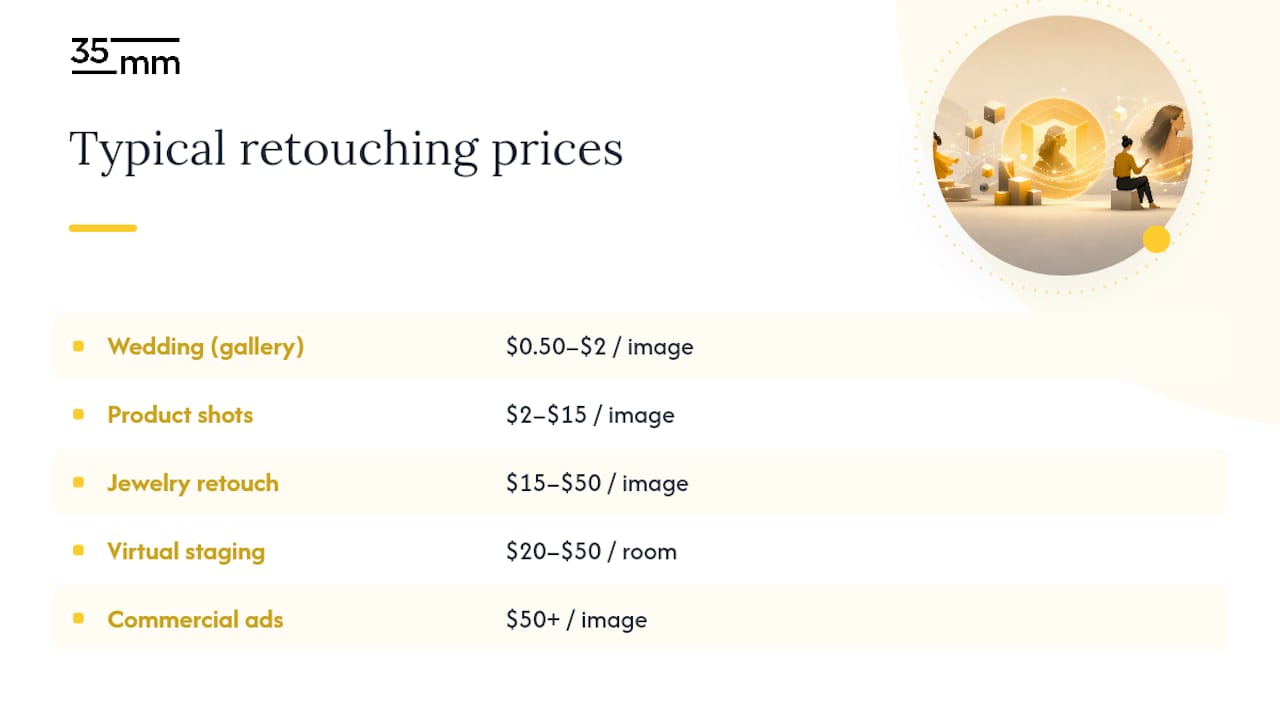
Wedding photography: Basic color correction and culling for a full gallery typically runs $0.50–$2 per image for light editing, with selective beauty retouching on hero shots adding $10–$30 per image. Turnaround expectations are usually 1–3 weeks. Usage is personal, so no licensing uplift applies.
Product and e-commerce: Standard product shots with background removal and color correction land at $2–$15 per image. Jewelry retouching, which requires precise metal and gemstone rendering, sits at $15–$50 per image due to the technical precision involved. Virtual staging for real estate runs $20–$50 per room. Commercial usage is standard here, so confirm whether the retoucher's fee covers it.
Real estate photography: HDR blending, sky replacement, and interior cleanup typically run $1–$5 per image for standard edits. Virtual staging pushes that to $20–$50 per room. Turnaround is usually 24–48 hours, and rush fees apply if the listing goes live the next morning.
Commercial advertising: This is where per-image fees reach $50 and beyond. A single hero image for a print campaign may involve compositing, CGI integration, and multiple rounds of client approval. Usage licensing for national or global campaigns adds a meaningful premium on top of the retouching fee itself.
Individual retouchers commonly publish starting points for manual retouching from around $50 per job upward, which gives you a useful floor when evaluating quotes. Understanding commercial photography usage norms helps you ask the right licensing questions before signing any agreement.
How to request an accurate quote
A vague brief produces a vague quote. The more specific your brief, the more comparable and reliable the quotes you receive will be.
Briefing checklist:
- Image count and file format (JPEG, RAW, TIFF)
- Retouch level per image (basic correction, beauty, composite)
- Reference images showing the desired output style
- Intended usage (personal, e-commerce, national advertising)
- Deadline and whether a rush fee applies
- Number of revision rounds expected
- Deliverable format (flat JPEG, layered PSD, retouched RAW)
- Color profile requirements (sRGB, Adobe RGB, CMYK for print)
Sample brief you can adapt:
Questions to ask every vendor:
- What exactly is included in one "retouch"?
- How do you handle revisions beyond the included rounds?
- Do you deliver layered files, and is that an additional cost?
- What is your color matching standard (monitor calibration, ICC profile)?
- Is commercial usage covered in your base fee?
Pro Tip: Ask for a paid trial edit on two or three of your actual images before committing to a large batch. Most professional retouchers and studios will accommodate this, and it reveals quality, communication style, and turnaround accuracy before any real money is on the line.
Sample pricing matrix for quick budgeting
The figures below are representative estimates based on current market benchmarks. Actual quotes will vary by retoucher experience, geographic market, volume, and usage rights.
Caveats: Rush fees typically add 25–50%. Licensing for national/global campaigns adds a further premium. Layered PSD delivery and RAW handoffs are often billed separately.
When does a boutique studio make more sense than a freelancer?
The honest answer is that a solo freelancer is often the right call for straightforward, single-discipline work. A studio earns its premium when the project has moving parts that a single person cannot manage alone.
Freelancers offer lower overhead, direct communication with the person doing the work, and competitive per-image rates. Marketplace benchmarks show average rates around $59/hour for experienced contractors, with platform-based options available at lower rates. The trade-off is bandwidth: a solo retoucher has a finite daily output, and a large campaign batch can create bottlenecks.
Studios bring team bandwidth, internal QA, project management, and the ability to handle cross-media deliverables (print, digital, video stills) under one contract. They also typically carry NDAs, structured revision workflows, and the capacity to absorb scope changes without derailing a timeline. For complex compositing or campaigns that require a 3D artist, a graphic designer, and a retoucher working in parallel, a studio is the only practical option.
Scenarios where a studio's added cost is justified:
- Multi-image advertising campaigns with strict brand consistency requirements
- Projects combining retouching, CGI, and packaging design
- Work requiring formal licensing documentation and usage tracking
- Tight turnaround on large volumes where a single retoucher would miss the deadline
When evaluating a studio, ask for a portfolio review and a small paid trial task before the main engagement. Studios that specialize in high-end campaigns, as noted in YunoJuno's contractor benchmarking, commonly assess skills in frequency separation, complex compositing, and RAW workflow management before onboarding a retoucher for client work. Apply the same standard when you are the buyer.
Pro Tip: A studio that presents a single project fee (rather than an hourly breakdown) is not hiding anything. It is protecting you from scope anxiety and itself from scope creep. Ask what the project fee includes in terms of revision rounds and deliverable formats, and you will have everything you need.
What we have learned from two decades of quoting retouching work
The single most common mistake buyers make is treating retouching as a commodity and selecting the lowest per-image rate without asking what that rate actually covers. A $2 per-image quote that excludes revisions, layered files, and commercial licensing can end up costing more than a $15 per-image quote that includes all three.
At 35milimetre, we scope every project before quoting. That means understanding the intended usage, the delivery format, and the revision expectations before a number goes on paper. For recurring clients, we often structure a project-based estimate rather than a per-image rate, because it gives both sides clarity and removes the friction of counting images mid-project. One detail that consistently surprises new clients: requesting a layered PSD handoff instead of flat JPEGs can add meaningful time to a project, and that time needs to be in the estimate from the start.
The practical advice we give every client is this: share reference images, not just a description. A retoucher who sees your target output will quote more accurately and deliver more consistently than one working from a paragraph of text.
High-end post-production, scoped and priced for commercial work
For brands and agencies that need retouching to perform commercially, not just look good, 35milimetre offers a structured engagement model built around clarity and output quality.
The process starts with a brief review and reference alignment, followed by a trial edit on a small selection of your actual images. From there, we scope the full project and present a single project estimate that covers retouching, revisions, and deliverable formats. No hidden line items for layered files or color profile conversions. Our team handles everything from beauty retouching and product compositing to CGI integration and professional retouching for brands that need imagery built for advertising, not just social media. If your next campaign requires imagery that holds up at every scale, send us your brief and we will turn around a scoped estimate within one business day.
Sources
The pricing benchmarks in this article draw from the following sources. Each covers a distinct angle on retouching rates and billing practices.