
For most single-SKU product launches, expect to budget between $2,000 and $15,000 for packaging design, depending on how much strategy, structural work, and prepress the project needs. Complex or regulated categories push well past that. Skip the guesswork and request a scoped quote that itemizes concepts, dielines, and print-ready files before you commit to any number.
TL;DR:
- Packaging design costs vary from $200 to $1,500 for simple templates, but complex or regulated categories can exceed $50,000.
- Structural complexity, SKU count, material choices, and rushed timelines significantly influence overall pricing and project scope.
- Quotes should clearly specify concepts, dielines, prepress support, revisions, and who approves final files to prevent costly misunderstandings.
- Smaller projects benefit from freelancers or small studios, while larger or regulated work often requires agency-level expertise with strategic support.
- Budgeting for research and prepress is crucial, as underfunding these stages can lead to costly reprints later in the process.
Table of Contents
- How Much Does Packaging Design Cost at Each Budget Tier?
- What Factors Drive Packaging Design Pricing?
- Who Should You Hire, and How Is Packaging Design Priced?
- How Do You Budget for Packaging Design and Estimate ROI?
- What Deliverables Should Your Packaging Design Quote Include?
- How Long Does a Packaging Design Project Take?
- What Mistakes Increase Your Total Packaging Design Cost?
- Who's Behind This Guide?
- When Should You Spend More on Packaging Design?
- Get a Scoped Packaging Design Quote
- Sources
How Much Does Packaging Design Cost at Each Budget Tier?
Packaging design pricing splits into three rough tiers, and knowing which one you're shopping in prevents two common mistakes: overpaying for a simple SKU or underpaying for something that needs to survive a retail buyer's shelf review.
Budget tier ($200 to $1,500). Template platforms and freelance marketplaces live here. You get a logo drop-in, basic color choices, and a flat mockup. Acceptable for a farmers-market product, a Kickstarter prototype, or anything you're testing before real investment. Not acceptable if you're heading into retail, because these packages rarely include a real dieline (the flat pattern that shows exactly how a box folds and cuts) or any structural engineering.
Mid-range tier ($1,500 to $8,000). This is where most established freelancers and small studios operate. Expect two to four initial concepts, a couple of revision rounds, a working dieline, and print-ready files with color specs. The common pitfall: many mid-range providers quote design only and leave prepress (the technical file prep a printer needs before running plates) as a vague afterthought, which becomes your problem the week before a print deadline.
Strategic or premium tier ($8,000 to $50,000+). Agencies and senior studios in this range bring market research, structural prototyping, CGI mockups for retailer pitch decks, and direct coordination with your printer through proofing. Complex multi-SKU systems or regulated categories, like food, supplements, or cosmetics, can run toward the higher end or beyond. One industry pricing breakdown puts full project fees anywhere from the low thousands for a simple job to $50,000 to $100,000 or more for complex, multi-SKU, or regulated work.
- Budget tier: template or freelance basics, no structural engineering
- Mid-range: real dielines, multiple concepts, limited prepress support
- Premium: strategy, structural prototyping, full print production oversight
Treat every number above as a planning range, not a guarantee. Your actual quote depends on the factors below.
What Factors Drive Packaging Design Pricing?
Two projects that look similar on paper can land $10,000 apart, and the gap almost always traces back to a handful of specific variables.
Structural complexity is the biggest lever. A standard tuck-top box with a template dieline costs far less than custom inserts, unusual folds, or a hinged rigid box that needs physical prototyping before anyone approves a print run.
SKU count and localization multiply costs fast. Five flavors of the same product usually mean five sets of artwork, and if you're selling in Canada or the EU, add bilingual or multilingual label versions plus whatever regulatory copy your category requires.
Material and print method shift both design fees and production costs. Digital printing suits short runs and fast turnarounds; offset printing gets cheaper per unit as volume climbs. Specialty finishes, foil stamping, embossing, soft-touch coatings, add design time because the file setup for each is different from flat color work.
Skipped research and prepress. Founders often cut the strategy phase (competitive shelf audits, structural testing) and the prepress phase (file checks against printer specs) to save money upfront. Both tend to resurface later as reprints or missed retailer requirements.
Timeline pressure adds its own line item. Compressing a six-week schedule into two weeks routinely tacks on a rush fee in the 20% to 50% range, since it forces overtime and cuts down the revision cycles a designer can realistically offer.
Pro Tip: Standardizing your box dimensions across SKUs, rather than custom-sizing every product, is one of the fastest ways to cut tooling and setup costs without touching the creative work.
- Custom structural work (inserts, unusual folds, rigid construction)
- Number of SKUs, flavors, or regional label versions
- Material and print method chosen
- Whether research and prepress are included or skipped
- How compressed your timeline is
Who Should You Hire, and How Is Packaging Design Priced?
Your options break into four categories, each with a different cost profile and a different risk profile.
Freelancers offer the lowest hourly rates and the most flexibility for a single-SKU project, but availability and consistency vary widely from one person to the next. Small studios sit in the middle: typically a tighter team with defined roles, often billing at fixed-fee rates for a full package rather than by the hour. Premium agencies charge the highest fees, generally in the $100 to $200 per hour range for senior talent, but bring strategy, prototyping, and account management that smaller shops often can't staff. In-house hires make sense once you're managing enough SKUs that a dedicated designer's salary beats paying per-project fees.
Pricing models vary by scope. Agencies commonly quote hourly, fixed-fee, or value-based pricing, with value-based fees, priced against your projected sales lift, reserved for high-stakes launches where the packaging carries real revenue risk.
Before you compare quotes, build a short scope checklist so every proposal answers the same questions, helping you understand how to build a brand identity from scratch.
- How many initial concepts, and how many revision rounds are included?
- Does the quote include dielines, or is structural work billed separately?
- Who handles prepress and printer file checks?
- What's the proof approval process, and who signs off before print?
Watch for red flags: a proposal with no dieline mentioned, no proofing plan, or deliverables described only as "final files" with no format specified. Those gaps almost always become expensive surprises after the contract is signed.
How Do You Budget for Packaging Design and Estimate ROI?
A worked example. Say you expect to sell 10,000 units in year one at a $6 gross margin per unit, for $60,000 in total margin.
Design spend tends to pay back fastest when packaging carries the sales conversation directly, on a retail shelf, at a premium price point, or in a regulated category where accurate labeling is non-negotiable. Most Americans report that packaging design often influences their purchase decisions, which is exactly why a shelf-facing SKU justifies a bigger allocation than a subscription box nobody sees until it's already been purchased online.
Split your budget roughly across three buckets: research and strategy, core design and revisions, and prepress plus print management. Underfunding the last bucket is the most common mistake, since it's the phase that actually gets your files onto a press correctly. Sustainability is worth factoring in too: 60% of consumers say they'll pay more for products in sustainable packaging, which can justify a higher material and design spend if it's core to your brand story.
What Deliverables Should Your Packaging Design Quote Include?
A comparable quote spells out exactly what you're paying for at each stage, not just a final flat price. Here's what to expect, in order:
- Initial concepts. Two to four distinct creative directions, typically shown as flat artwork or basic 3D mockups.
- Structural dielines. The technical pattern file showing every fold, score, and cut line, engineered for your specific box or pouch style.
- Revision rounds. Usually two to three rounds built into mid-range and premium quotes; anything below that invites scope disputes later.
- Print-ready files. Final artwork in the correct color space, with PANTONE references specified for any brand-critical colors.
- Prepress coordination. File checks against your printer's actual specs, bleed and trim verification, and a physical or digital proof before the print run.
Each additional SKU, translated label, or packaging format (a pouch version alongside a box, for instance) adds its own set of artboards, which is why per-SKU pricing climbs faster than founders expect. Design fees and production costs are separate line items and should appear as such in your quote, since production pricing depends on run size and print method, not on the design work itself.
How Long Does a Packaging Design Project Take?
A straightforward single-SKU project with a standard box shape typically runs four to six weeks from kickoff to print-ready files. Complex multi-SKU systems, custom structural work, or anything requiring physical prototyping can stretch to three months or more.
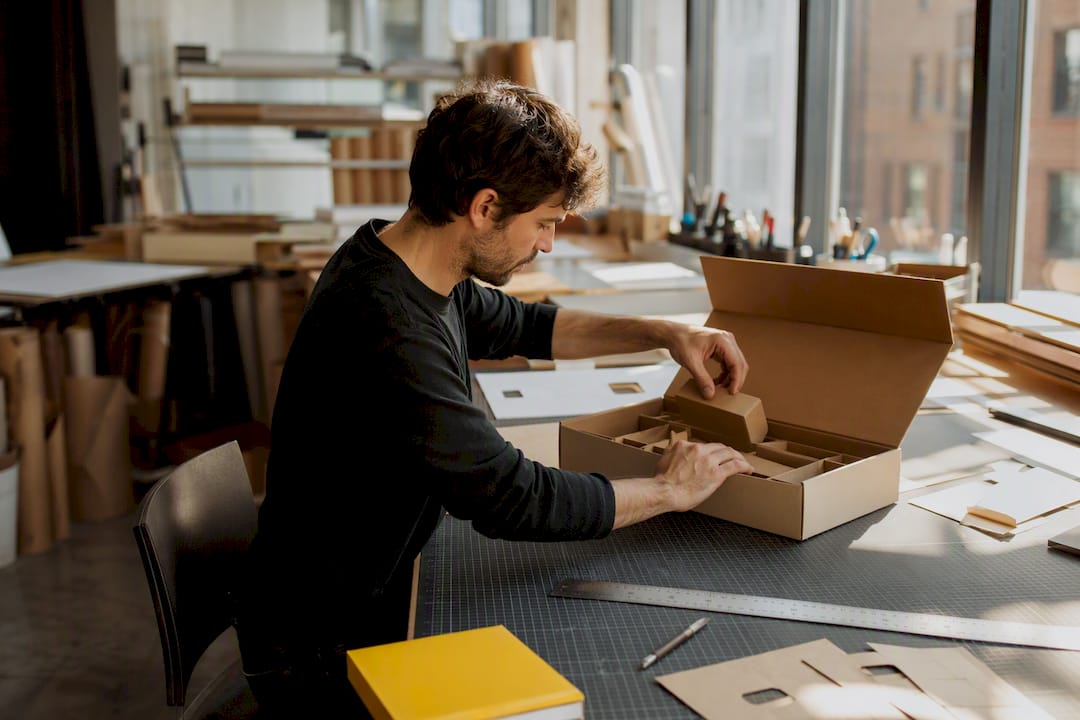
Most of the time gets spent in two places: the concept and revision phase, where feedback cycles between you and the designer, and prepress, where files get checked against your specific printer's technical requirements. Compressing either phase creates the same problem: fewer revision rounds and a rush fee that commonly adds 20% to 50% to the total cost. If your launch date is fixed, build in the full timeline from day one rather than discovering the rush fee later.
What Mistakes Increase Your Total Packaging Design Cost?
The costliest mistakes rarely show up in the initial quote. They show up in reprints.
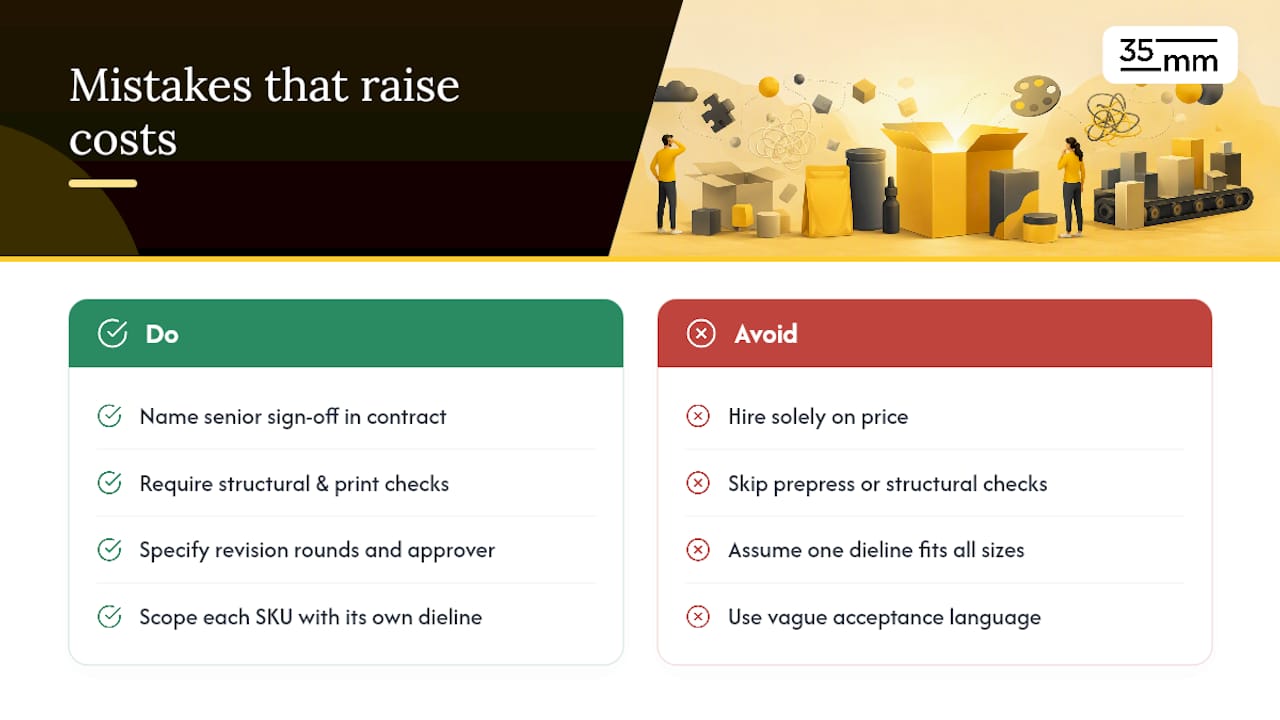
Hiring on price alone often means a junior team member delivers your files with no senior strategic review, an easy problem to prevent by naming the senior lead responsible for sign-off directly in your contract. Skipping structural or print checks to save a few hundred dollars can trigger a full reprint once cartons don't fold correctly or colors shift on press, costing far more than the prepress work would have. Under-scoping variants (assuming one dieline covers three SKU sizes, for example) is another frequent trap that inflates the bill mid-project once the designer realizes each size needs its own file set.
Pro Tip: Before signing anything, confirm your contract specifies the number of revision rounds, who approves the final proof, and what "acceptance" actually means. Vague language here is where most disputes start.
Who's Behind This Guide?
35milimetre is an Istanbul-based post-production and design studio led by Mehmet Turan, with more than two decades of hands-on experience in image manipulation, compositing, and visual storytelling for brands in technology, automotive, and consumer goods. The studio's approach to packaging treats it as a technical project, not a single design task: strategy first, then structural mockups and CGI, then prepress, then direct coordination with your printer through final proofing. That small, high-touch team model is also detailed in how design studios shape brand success.
When Should You Spend More on Packaging Design?
Spend less and move fast when you're validating an idea, testing a market, or running a limited pop-up drop. Spend more when packaging is doing real selling work: a retail shelf placement, a premium price point, or a regulated category where the label itself carries legal weight.
The trade-off isn't really "cheap versus expensive." It's testing versus retail-readiness, and conflating the two is where most founders overspend early or underspend right before the launch that actually matters.
Before you sign anything, run this checklist: get three scoped quotes with identical deliverables listed, request the dieline and prepress plan in writing, and confirm exactly who owns the final proof approval.
— 35mm
Get a Scoped Packaging Design Quote
If you've read this far, you already know the real cost question isn't "what does packaging design cost" in the abstract, it's what a strategy-led process costs versus a template shortcut you'll likely replace within a year. 35milimetre runs packaging projects the same way it approaches CGI and retouching work for automotive and tech clients: strategy first, structural mockups next, then prepress and print coordination handled by the same small team from concept through final proof.
That structure suits SMB founders specifically, because you get senior-level oversight on every file without the account-management layers a large agency adds to the invoice. If you're weighing a template tool against a studio that will actually stand behind the dieline and the proof, start a conversation about your project and ask for a scoped quote broken into concepts, structural work, and print-ready deliverables. Most single-SKU engagements move from kickoff to print-ready files within four to six weeks.