

A key visual is the single image or motif that anchors a campaign or brand across every channel it touches. Marketers reach for one at a campaign launch, a product hero shot, or any recurring brand story that needs a face. Get the visual branding strategy right, and the rest of your creative visuals fall into line behind it.
Key Takeaways
A key visual works only when it is built as a strategic, governed asset, not a single ad, and tested before full production.
| Point | Details |
|---|---|
| Definition matters | A key visual is a repeatable strategic motif, distinct from a logo, icon, or key art. |
| Six traits to check | Effective KVs are unique, versatile, emotional, simple, storytelling, and consistent. |
| Follow the five-step process | Research, ideate, prototype, validate, then produce with governed master files. |
| Test before scaling | Use five-second recognition tests and A/B thumbnails before committing full budget. |
| Specialist production closes the gap | 35milimetre builds modular master files and CGI assets so a validated KV scales across channels without rebuilds. |
Table of Contents
- What Is Key Visual Design and How Does It Differ From a Logo?
- What Traits Make a Key Visual Effective?
- How Do You Develop a High-Impact Key Visual in Five Steps?
- How Do You Adapt a Key Visual Across Channels and Formats?
- What Real Campaigns Show About Key Visual Execution
- How Do You Measure a Key Visual's Impact?
- What Mistakes Undermine Key Visual Projects?
- How Does 35milimetre Approach Key Visual Development?
- Why Disciplined Key Visual Practice Pays Off
- How 35milimetre Supports Your Key Visual Production
- Sources
What Is Key Visual Design and How Does It Differ From a Logo?
A key visual (KV) is the central, iconic, repeatable visual motif that carries a campaign's message and a brand's tone across every touchpoint. It is not one ad. It is the source image that generates the ads.
That distinction gets lost constantly. A logo is a fixed anchor, the same mark on every business card and building sign. An icon is a simplified, often wordless sign that stands in for an action or category. Key art, a term borrowed from entertainment marketing, refers specifically to the poster or thumbnail built to sell a film, show, or game.
- Logo: fixed, unchanging identity mark
- Icon: simplified symbol, usually functional
- Key art: entertainment-specific KV built for quick-scroll decisions
- Key visual: the strategic, repeatable motif that drives an entire campaign's color palette, typography, and imagery
A KV works as the guiding theme and key message, translated into a single symbolic image, not a standalone ad.
What Traits Make a Key Visual Effective?
Six traits separate a working key visual from a pretty picture that fades after one campaign cycle. Brand teams at companies like BASF build their internal KV standards around exactly this list.
- Unique: stands apart from category competitors at a glance.
- Versatile: survives a crop from billboard to Instagram Story without losing meaning.
- Emotional: creates a felt connection, not just recognition.
- Simple: reads clearly quickly, even at thumbnail size.
- Storytelling: implies a narrative beyond the frame, not a static product shot.
- Consistent: reappears across channels long enough to build memory.
Copy this list straight into your creative brief. If a concept fails two or more traits, it is not ready for prototyping yet.
How Do You Develop a High-Impact Key Visual in Five Steps?
Studios and brand portals converge on roughly the same five-stage arc for developing a key visual, from first brief to production handoff.
- Research the brand, product, and audience before a single sketch happens.
- Ideate and concept several visual directions grounded in that research.
- Prototype a moodboard and rough visual storyline for the leading concept.
- Validate the prototype with stakeholders and, ideally, a small audience test.
- Produce and govern, locking master files and setting an update schedule.
Pro Tip: Use low-fidelity moodboards for the first stakeholder round, when you are still testing whether the emotional direction lands. Save high-fidelity comps for the final one or two concepts, once the story and composition are already agreed on. Building polished mockups too early wastes hours on ideas that get killed anyway.
Before you move past validation, confirm sign-off from these voices:
- Brand or marketing lead (message accuracy)
- Creative director or lead designer (visual execution)
- Production or post-production partner (feasibility across formats)
- Legal or compliance, when regulated claims are involved
Skipping any one of these often means rework two weeks later, which costs more than the extra meeting ever would.
How Do You Adapt a Key Visual Across Channels and Formats?
A KV only earns its keep if it survives the jump from a 30-foot billboard to a 40-pixel app icon. That requires building a modular master file rather than one flat image, so elements like the product hero, background, and typography can move independently.
Some elements flex by channel; others cannot move at all.
- Social thumbnails: crop tight on the emotional focal point, keep text minimal or absent.
- Hero banners: widen the frame, allow negative space for headline copy.
- Out-of-home (OOH): simplify further, since viewing distance kills small detail.
- Email headers: prioritize fast load and a clear single subject.
- Packaging: adjust color proofing for print, not screen, calibration.
What has to stay locked regardless of format: the core color-contrast relationship, the primary subject's silhouette, and the typography family. Treat those as your "visual hammer," the recurring detail people recognize even at a glance.
What Real Campaigns Show About Key Visual Execution
Automotive: A brand like Mercedes-Benz builds campaign KVs around a single hero vehicle shot with dramatic lighting and negative space, repeated with only color and setting variation across markets. The lesson: lock the lighting and composition formula, vary the local context.

Consumer packaged goods: Duracell's long-running visual hammer, the bunny character, functions as a KV that survives decades of format change. The lesson: durability beats novelty when a motif is doing brand-recognition work.

Beverage branding: Jägermeister leans on a consistent dark, moody color story and stag emblem across every format, from bottle to event signage. The lesson: consistent color grading can carry as much recognition weight as the central image itself.
Logistics and packaging: DHL's yellow and red visual system turns a simple package graphic into an instantly readable brand cue across trucks, boxes, and digital ads. The lesson: a KV does not need complexity to work at scale, it needs relentless repetition.
Key art in entertainment marketing has to work within roughly 1.8 seconds, the window before a scrolling viewer moves on. Product and packaging KVs face a slower but similarly unforgiving test at shelf or on a feed.
How Do You Measure a Key Visual's Impact?
Treat a KV as a creative hypothesis, not a finished deliverable. Test it the way you would test any variable that affects conversion.
Track these KPIs before and after a KV rolls out:
- Brand recall in post-campaign surveys
- Unaided visual recognition rate
- Click-through or engagement lift on KV-led creative vs. non-KV creative
- Conversion lift attributable to the creative variant, not just the offer
Run these tests before committing budget to full production:
- A five-second recognition test with people outside the project team.
- An A/B thumbnail test across two or three KV directions.
- A controlled click-through comparison between KV-anchored ads and generic stock-led ads.
The Netflix research on key art attention span puts the decision window at about 1.8 seconds, a useful benchmark for judging whether your five-second recognition test is actually generous enough. Tag every creative variant distinctly in your ad platform so lift gets attributed to the visual, not lumped into general campaign performance.
What Mistakes Undermine Key Visual Projects?
Most KV failures trace back to five recurring habits, not a lack of design talent.
- Confusing the KV with a finished ad, then treating every future asset as a copy-paste job.
- Overcomplicating the concept until it fails the two-second read test.
- Skipping stakeholder validation to save a week, then rebuilding in production.
- Ignoring modular file specs, so every new format requires a full rebuild.
- Weak governance, with no single owner for master files or update rules.
Keep a one-page checklist in every brief: defined KV owner, locked master file location, approved format list, and a review date. Handoffs should always include layered source files, not flattened exports.
How Does 35milimetre Approach Key Visual Development?
Building a key visual well is genuinely specialist work, spanning graphic design, 3D rendering, and compositing skill most in-house teams do not keep on staff full time. At 35milimetre, that workflow runs research and concept development first, then prototyping, then full production into governed master files ready for every channel a client needs.
Pro Tip: Build your master CGI or 3D assets with swappable lighting and color layers from day one. It lets you localize or update a product variant without re-rendering the entire scene, and it keeps skin tones and material finishes consistent across every derivative image.
A KV distills a company's message into one symbolic framework, which is exactly why it deserves specialist hands rather than a rushed internal pass.
Why Disciplined Key Visual Practice Pays Off
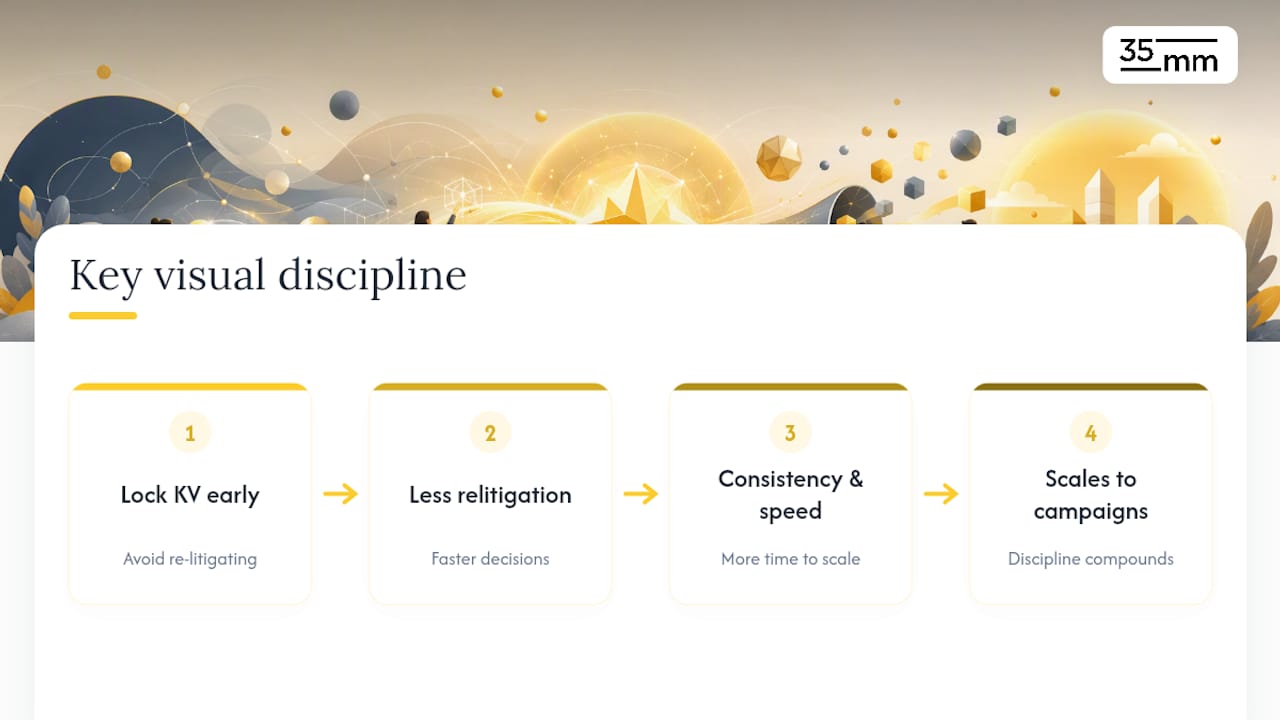
Treating a key visual as a strategic asset, not a one-off graphic, pays for itself in consistency and speed. Teams that lock a KV early spend less time re-litigating creative direction and more time scaling it. That discipline compounds across every campaign that follows.
How 35milimetre Supports Your Key Visual Production
Once your concept is validated, production is where most in-house teams stall, especially on CGI, compositing, and multi-format file governance. 35milimetre handles exactly that gap: commercial retouching, CGI rendering, and full visual storytelling builds, delivered as governed master files your team can scale across every channel without rebuilding from scratch each time.
If you already have a concept and need a production partner to prototype, test, and finalize it, 35milimetre's studio services cover intake through delivery. For teams still refining the underlying visual strategy, our notes on the strategic role of visuals in marketing pair well with the workflow above. Send over your brief and current brand assets, and we will scope what a validated key visual and its channel variants would take to produce.