
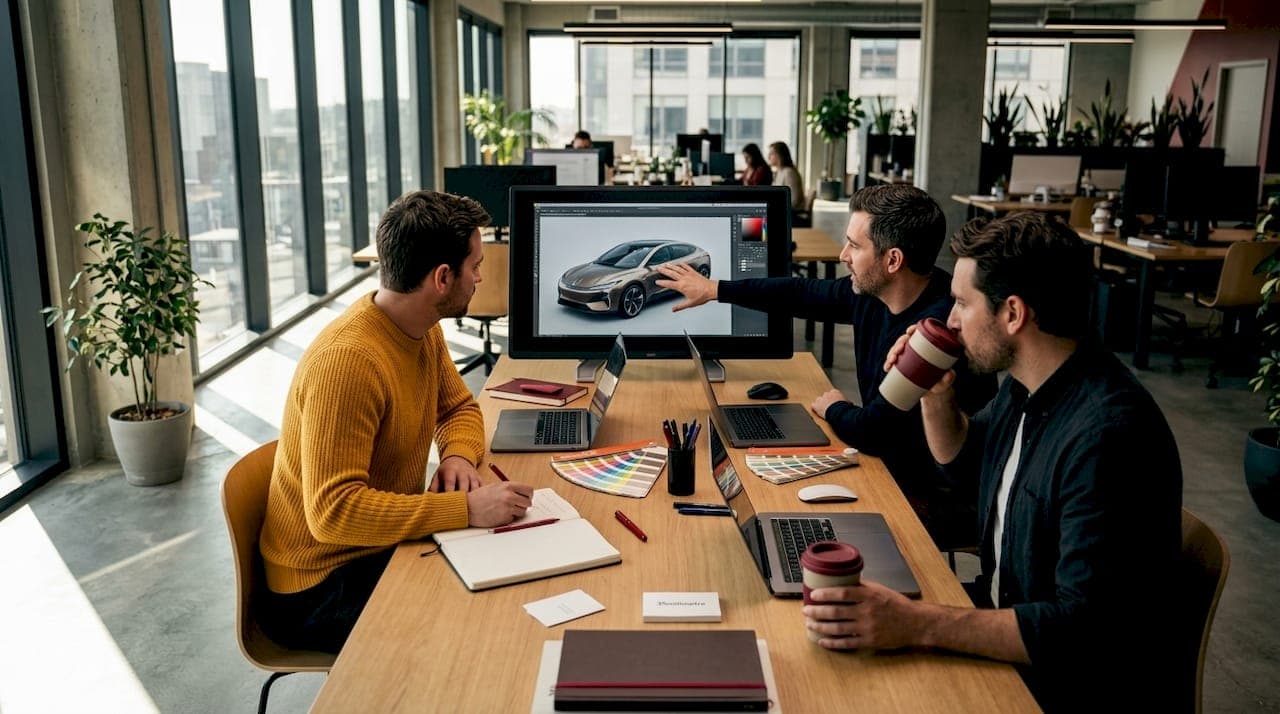
For marketing professionals and brand managers in tech and automotive, finding 3D design examples that demonstrate real, measurable value is harder than it looks. Beautiful renders are everywhere. But stakeholders want numbers, not aesthetics. They want to see how 3D pipelines shorten timelines, multiply creative iterations, and move products from concept to campaign faster. This article breaks down the most credible, metrics-backed case studies available today, gives you a practical framework for evaluating them, and draws out the lessons most relevant to your brand's next visual production decision.
Table of Contents
- How to evaluate 3D design examples for brands
- Shapr3D: Accelerating automotive prototyping and brand visualization
- NVIDIA and BITONE: Turbocharging creative output with accelerated 3D pipelines
- BMW Group: The future of synthetic data and virtual factories for automotive brands
- Comparison of leading 3D design examples for brands
- Our take: The real ROI of 3D design for brands isn't just speed
- Unlock world-class 3D design for your brand
- Frequently asked questions
Key Takeaways
| Point | Details |
|---|---|
| Metrics-driven selection | Evaluate 3D design examples by quantifiable metrics like speed, productivity, and creative flexibility. |
| Rapid prototyping advantages | Tech and automotive brands can shorten prototyping cycles by weeks with modern 3D tools. |
| Creative iteration unlocked | High-performance pipelines enable multiple creative iterations daily for truly optimized brand storytelling. |
| Beyond the numbers | Long-term branding success also depends on team empowerment and internal adoption, not just short-term metrics. |
How to evaluate 3D design examples for brands
With the challenge set, let's establish what makes a 3D example truly valuable for brands.
Not every stunning portfolio piece qualifies as a meaningful case study. The gap between "visually impressive" and "strategically valuable" is exactly where most evaluation frameworks break down. For brand managers making budget and vendor decisions, that gap costs real money and time.
When we review 3D design examples for clients, we look beyond surface aesthetics and focus on documented performance. The most useful case studies report specific throughput metrics: how many iterations were completed per day before and after adopting a 3D pipeline, how render times changed, and how quickly creative teams could respond to stakeholder feedback. For example, benchmark 3D asset creation metrics like BITONE's 18X delivery improvement and reduction in render time from 6 hours to 20 minutes are the kind of data points that make an ROI conversation credible in any boardroom.
Beyond speed, evaluate whether the case study addresses stakeholder alignment. A tool that produces fast renders but generates endless back-and-forth approvals is only solving half the problem. The most impactful examples show that 3D visualizations reduced revision cycles, gave non-technical decision-makers clarity earlier in the process, and shortened the path from concept brief to final asset.
Understanding how 3D artists elevate advertising gives additional context here. Three core criteria matter most: documented speed improvements (render time and iteration rate), evidence of creative flexibility (number of variations produced without additional cost), and measurable business outcomes (time-to-market, campaign launch timelines, or client approval speed).
Pro Tip: When reviewing any 3D case study, ask for the "before" state. A 20-minute render time only means something if you know it previously took 6 hours. Without that baseline, the number floats without context.
Shapr3D: Accelerating automotive prototyping and brand visualization
With our criteria in hand, let's examine how real brands are putting them into action.
One of the most instructive examples in the automotive sector involves the transition from 2D sketching and flat technical drawings to interactive 3D models. Shapr3D's automotive case studies document exactly this shift, including work with German automotive OEM clients where moving to a fully 3D workflow cut prototyping timelines by several weeks per product cycle.
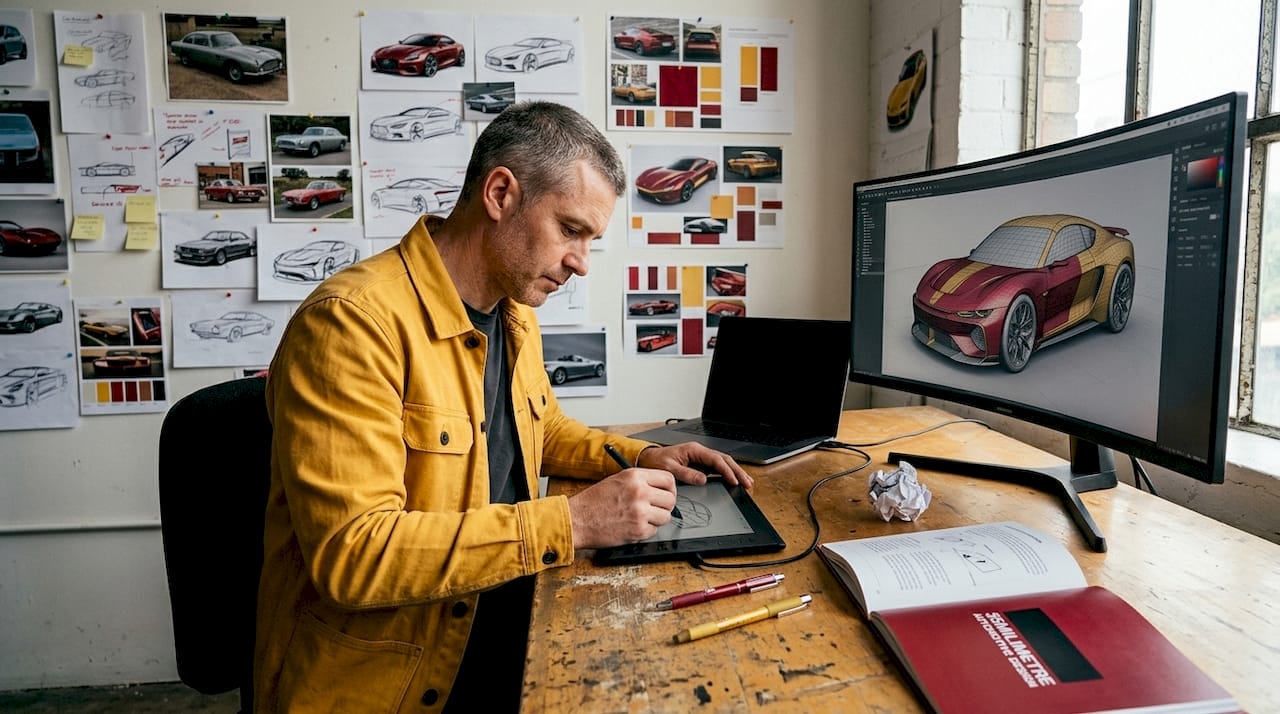
That number is worth sitting with. In automotive product development and brand visualization, a few weeks is not a minor efficiency gain. It can represent the difference between presenting a concept at a major trade event or missing the window entirely. For brand teams working alongside engineering and design departments, the ability to produce photorealistic 3D renders directly from the design tool eliminates an entire translation step where 2D sketches had to be interpreted, redrawn, and then handed off to a separate rendering team.
The creative impact goes further than timeline compression. When a brand's design team can rapidly iterate on color variants, material finishes, and configuration options within a single 3D environment, the storytelling possibilities expand considerably. A single base model can yield dozens of campaign-ready visuals without the cost of reshooting or rebuilding assets from scratch. That kind of flexibility is exactly what brand managers need when adapting campaigns across markets or product lines.
Understanding design's impact on advertising is relevant here because faster iteration doesn't just save time. It opens creative risk-taking that slower pipelines simply discourage. When teams know they can try five color combinations in an afternoon instead of a week, they push further, and the resulting assets tend to be stronger.
This also changes how internal stakeholder pitches work. Rather than presenting flat mood boards or physical prototypes, brand managers can walk leadership through photorealistic 3D renders of exactly what a campaign vehicle, product launch visual, or digital ad will look like. The conversation shifts from "imagine it finished" to "here it is." That shift in how graphic design shapes brand identity is one of the most underrated advantages of 3D workflows.
Pro Tip: When pitching a 3D pipeline investment to internal stakeholders, lead with the time-to-market and flexibility arguments before getting into technical specs. Decision-makers respond to weeks saved and campaign windows hit, not polygon counts.
NVIDIA and BITONE: Turbocharging creative output with accelerated 3D pipelines
Another leader in the space, BITONE, reveals what happens when rendering and iteration speed become supercharged.
BITONE is an automotive digital content agency that adopted NVIDIA Omniverse to overhaul its production pipeline. The results are among the most frequently cited benchmarks in the industry, and for good reason. The NVIDIA BITONE case study documents an 18X improvement in content delivery speed and a 5X increase in the number of creative iterations the team could produce in a single day.
"Render times dropped from six hours to just 20 minutes, and the team could generate five times as many daily creative iterations as before adopting the accelerated pipeline."
For an automotive branding campaign with dozens of model variants, trim levels, and market-specific versions to visualize, that multiplier changes everything. A campaign that once required weeks of render time to produce full asset libraries can now be turned around in days. That's not incremental improvement. That's a structural change in what's possible within a given campaign budget and timeline.
Here's what that means practically for fast-turn automotive and tech branding campaigns:
- Agencies can respond to last-minute client changes without blowing out the production schedule or the budget.
- Campaign launches can be timed more precisely to market events, product announcements, or seasonal windows.
- Creative teams can explore more ambitious visual concepts, knowing that iteration is cheap in time rather than expensive.
- Clients receive a broader range of finished options to choose from, which improves satisfaction and reduces the perception of risk.
- Smaller teams can take on larger campaign scopes without adding headcount, which directly improves margin.
Building a high-efficiency workflow for ad agency visuals is exactly the kind of structural advantage these numbers point to. For brand managers evaluating agency partners, asking whether they use GPU-accelerated rendering environments like NVIDIA Omniverse is a practical screening question that reveals a lot about their production capacity. Staying current with visual content trends for campaign success also shows that accelerated pipelines are not a luxury feature but an increasingly standard competitive requirement.
BMW Group: The future of synthetic data and virtual factories for automotive brands
Beyond content output, let's see how 3D drives transformation at the scale of global automotive leaders.
BMW Group's use of NVIDIA Omniverse and synthetic data represents one of the most forward-looking applications of 3D technology in the automotive industry. Rather than using 3D primarily for marketing visuals, BMW has integrated virtual factory simulations into its core production planning and data science operations. The BMW virtual factory case study documents an 8X boost in data scientists' productivity alongside performance improvements of 4 to 6X compared to their previous legacy systems.
What does this mean for brand managers and marketing teams specifically? On the surface, these numbers belong to operations and engineering. But the implications reach into visual asset creation and brand storytelling in ways that matter for campaign planning.
When a brand can simulate its entire product or factory environment in 3D, it can generate synthetic visual data at scale. This means product imagery, environment renders, and configuration visuals can be produced directly from operational 3D models without requiring separate photography or manual CGI builds. The result is a much shorter path from product update to updated brand asset.
For tech and automotive brands managing large product catalogs or frequent configuration launches, this approach future-proofs the visual asset pipeline in a meaningful way. Consider what it means to add a new color option or trim level to a vehicle lineup. With a traditional approach, that triggers a photography workflow, a retouching workflow, and a distribution workflow. With a synthetic data approach fed by virtual factory models, the update flows directly into the visual library with a fraction of the manual effort.
Understanding the real role of design studios in brand success is relevant here because studios that can work within or alongside these kinds of pipelines become far more valuable partners than those operating in isolation. Brands building a long-term visual identity for tech and automotive sectors should be asking how their visual production partners integrate with evolving 3D infrastructure, not just what their portfolio looks like today.
Comparison of leading 3D design examples for brands
Having explored individual use cases, here's how they stack up for quick reference.
The three case studies covered represent different points on the 3D adoption curve, from prototyping-focused tools to full-scale enterprise rendering pipelines. Each offers distinct advantages depending on where your brand is in its 3D journey.
| Case Study | Key Metric | Primary Benefit | Best Fit For |
|---|---|---|---|
| Shapr3D (Automotive OEM) | Weeks cut from prototyping | Faster stakeholder visualization | Product teams, mid-size brands |
| BITONE + NVIDIA Omniverse | 18X delivery speed, 5X more iterations | High-volume campaign production | Ad agencies, large auto brands |
| BMW Group + NVIDIA | 8X data scientist productivity, 4 to 6X performance | Synthetic data, virtual factories | Enterprise-scale brand operations |
The pattern is clear. Brands at every scale can find a relevant benchmark here. For a marketing team working with an external agency, BITONE's metrics offer the most direct comparison point: how fast can your agency produce finished assets, and how many creative variations can they realistically deliver per campaign cycle? For a brand manager at an OEM or a large tech company, BMW's productivity multipliers point toward longer-term infrastructure investments that compound over time.
The underlying principle across all three is that visual content creation strategies built around documented, measurable 3D workflows consistently outperform those built around ad hoc production approaches. That's not a preference. It's what the data shows.
Our take: The real ROI of 3D design for brands isn't just speed
With numbers in mind, let's reconsider what often gets missed in every case study.
Speed metrics are compelling and necessary for making the business case. But in our experience working on visual production across tech and automotive campaigns, the most lasting value from a strong 3D investment isn't measured in minutes saved per render. It's measured in what creative teams feel empowered to attempt.
When a team knows that iteration is cheap and fast, they take creative risks they would otherwise skip. They present stakeholders with bolder visual concepts because they can actually back them up with finished-quality renders rather than rough approximations. That shift in creative confidence is nearly impossible to quantify, but it shows up in the quality of final campaigns consistently.
There's also a hidden ROI in stakeholder buy-in. When brand managers can walk a CMO or a product director through an accurate 3D visualization of a campaign or a product at an early stage, approval cycles compress. Decisions that used to require multiple rounds of revisions get made in a single review session because everyone is looking at the same clear, detailed visual. That's not just time saved. That's organizational alignment happening earlier in the process, which reduces expensive late-stage changes.
Our advice for brands considering new 3D pipelines: don't select tools or partners based solely on render speed benchmarks. Look for evidence that the workflow enables creative empowerment and generates genuine stakeholder clarity. Ask how teams feel after using the system, not just how fast it processes files. The studios and tools that score well on both dimensions are the ones worth investing in, as our work in creative post-production and visual storytelling consistently confirms.
The brands that will lead in visual storytelling over the next several years aren't just the ones with the fastest render farms. They're the ones that pair technical capability with creative courage, and they look for partners who bring both.
Unlock world-class 3D design for your brand
Ready to apply these lessons to your own brand?
The case studies in this article show what's possible when 3D design is approached with both technical rigor and creative ambition. At 35milimetre, we bring exactly that combination to every project. Our 3D design and post-production services are built for tech and automotive brands that want visuals capable of standing out in competitive markets, whether that means a campaign-ready product render, a full CGI environment, or AI-enhanced imagery that pushes the creative boundary.
If you're exploring what an accelerated, high-quality 3D pipeline could look like for your brand, we'd welcome the conversation. Our team has worked across the full spectrum of visual production, and we understand how 3D artists drive advertising success at a practical, campaign level. Reach out through our website to discuss your next project.
Frequently asked questions
What brand sectors benefit the most from 3D design examples?
Automotive and technology brands see the greatest impact due to complex products, the constant need for speed to market, and the premium placed on visual storytelling innovation in both sectors.
How much time can you really save using advanced 3D pipelines?
Render times dropped from six hours to just 20 minutes for BITONE using NVIDIA Omniverse, while Shapr3D's automotive OEM clients cut weeks from prototyping cycles by moving from 2D to fully interactive 3D workflows.
Which metrics matter most when picking 3D design case studies?
Empirical production and workflow metrics are key: prioritize workflow speed improvements, daily creative iteration rates, time-to-market reductions, and documented productivity gains over subjective visual quality assessments.
How does 3D design influence brand identity?
Effective 3D design creates immersive, photorealistic visuals that communicate a brand's precision and technological sophistication in ways that flat photography or illustration rarely achieve, reinforcing a consistent and forward-looking brand image.