

Creative bottlenecks are quietly draining FMCG brand budgets. When artwork approvals stall, campaign assets miss launch windows, and visual messaging loses consistency across channels, the ripple effects reach far beyond the marketing department. Every delayed product visual is a missed shelf moment, a weakened consumer impression, and a gap your competitors are ready to fill. This guide walks through how to rethink your creative workflow from the ground up, covering the right process structure, the tools that actually move the needle, and how data-driven testing keeps your visuals performing long after launch. The goal is a faster, more reliable pipeline that still leaves room for genuine creative impact.
Table of Contents
- Understanding the creative workflow landscape for FMCG brands
- Essential tools and technologies for high-velocity creative teams
- Step-by-step: Designing your optimized creative workflow
- Leveraging data and creative testing for continuous improvement
- Rethinking creativity: The balance between automation and artistry
- Get expert support for your FMCG creative workflow
- Frequently asked questions
Key Takeaways
| Point | Details |
|---|---|
| Hybrid workflow is critical | Blending agile and waterfall methods boosts FMCG creative speed, flexibility, and quality. |
| Digital tools maximize efficiency | Adopting centralized platforms and automation leads to drastic reductions in turnaround times. |
| Continuous testing drives ROI | Regular variant testing and data-driven feedback sustain engagement and improve campaign outcomes. |
| Preserve creative uniqueness | Combining master templates with visual variability ensures your brand stands out in a crowded market. |
Understanding the creative workflow landscape for FMCG brands
Most FMCG creative teams are working with a process that was designed for a slower era. The classic FMCG workflow moves through four core phases: Diagnosis and Strategy, Creative Concepting, Testing and Optimization, and Finalization and Execution. On paper, this looks clean. In practice, each phase can become a holding pattern, where assets sit waiting for sign-off while campaign windows shrink.
The modern answer is a hybrid approach. Hybrid agile and waterfall workflows blend the structured milestones of traditional production with the flexibility of iterative sprints. In practical terms, this means strategy and briefing remain fixed and linear, while concepting and revision cycles operate in shorter, faster loops. The result is a process that moves with market timing rather than against it.
The pain points are consistent across brands of all sizes. Stage-gates that require full-team alignment before any creative can progress. Approval chains that loop back on themselves. Creative fatigue that sets in when the same team is asked to produce high volumes of assets without a clear system for refreshing ideas. And scalability problems that emerge the moment a campaign needs to run across six markets instead of two.
Here is a quick comparison of what separates traditional from hybrid workflows:
| Dimension | Traditional workflow | Hybrid workflow |
|---|---|---|
| Structure | Linear, sequential | Modular, iterative |
| Approval speed | Slow, multi-gate | Faster, parallel review |
| Scalability | Limited | Built for volume |
| Creative flexibility | Rigid | Adaptive |
| Error correction | Late-stage | Continuous |
The common challenges FMCG creative teams face include prolonged approval cycles that push assets past their relevance window, misalignment between brand, marketing, and agency stakeholders, difficulty scaling assets for multiple SKUs or regional variants, and inconsistent visual standards across channels. Investing in visual post production for FMCG at the right stage of this process can prevent many of these issues before they compound.
"The brands that win at shelf and on screen are the ones that have made their internal creative process as sharp as the work itself."
Essential tools and technologies for high-velocity creative teams
Once you understand where your workflow breaks down, the next step is equipping your team with the right digital infrastructure. The foundation of any high-velocity creative operation is a Digital Asset Management (DAM) system. A DAM centralizes all brand assets, approved imagery, and production files in one searchable, permission-controlled environment. This alone eliminates the version-confusion that plagues email-based workflows.
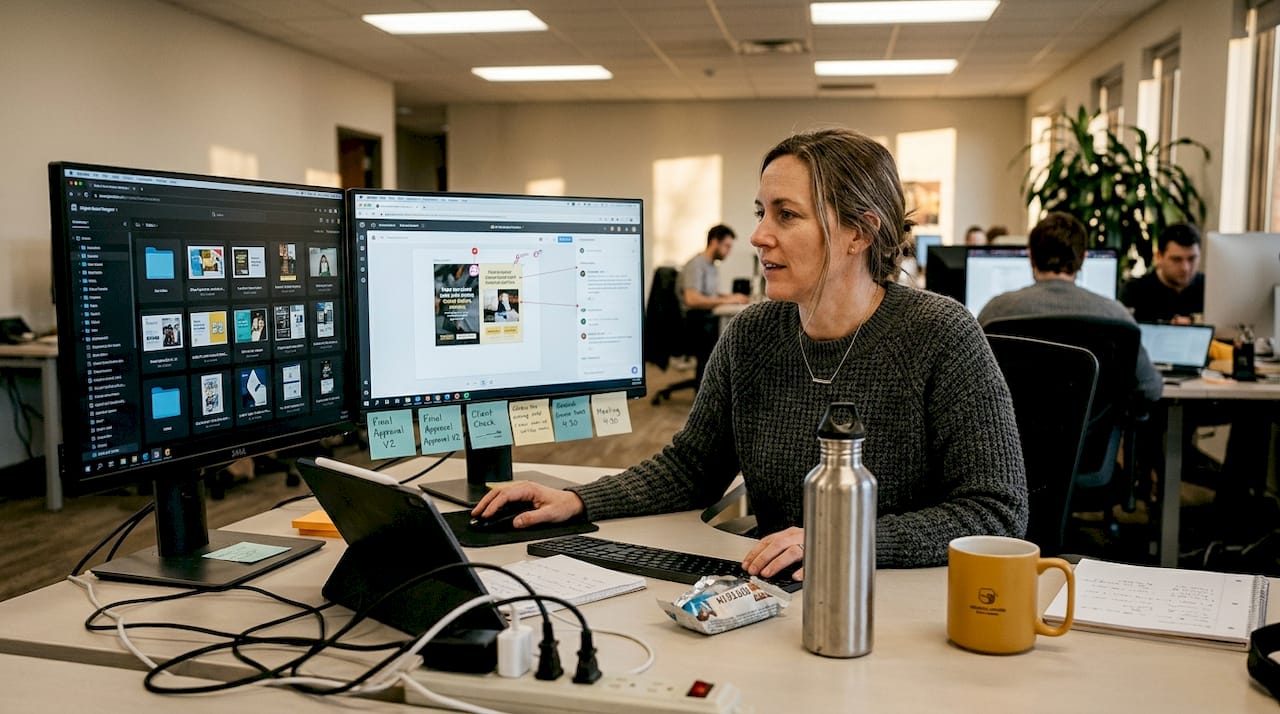
Layered on top of DAM, creative review platforms like Frame.io allow stakeholders to annotate directly on video or image files, cutting the back-and-forth that typically inflates revision cycles. Dynamic template systems let production teams generate hundreds of asset variants from a single master file, adapting copy, imagery, and format specifications automatically for different channels and markets.
Best practices for creative automation include conducting a thorough audit of your current process before introducing any new tool, building dynamic templates that preserve brand integrity, integrating a DAM from the start, and rolling out new platforms in phases so teams can adapt without disruption.
The business case is concrete. Jones Dairy Farm replaced email with a centralized artwork management platform and improved production efficiency by 75%. That kind of gain does not come from working harder. It comes from removing friction at every handoff point.
Here is a practical look at the tool categories every FMCG creative team should evaluate:
| Tool type | Primary function | Business impact |
|---|---|---|
| DAM system | Asset storage and retrieval | Reduces duplication and version errors |
| Creative review platform | Stakeholder annotation and approval | Cuts revision cycles significantly |
| Dynamic template engine | Automated asset variant generation | Scales output without scaling headcount |
| Project management software | Timeline and task visibility | Keeps cross-functional teams aligned |
| AI proofing tools | Automated compliance checking | Reduces first-pass errors |
Before adopting any platform, audit your current process honestly. Identify where assets stall, who holds approval authority, and which file formats create compatibility problems. Then match tools to those specific friction points rather than adopting technology for its own sake. Effective creative automation tools should reduce cognitive load, not add to it.
Pro Tip: Roll out new tools in phases, starting with one team or one campaign type. This preserves creative momentum while allowing your team to build confidence with the new system before it becomes the standard.
Step-by-step: Designing your optimized creative workflow
With the right tools in place, the real work is redesigning the process itself. Here is a five-phase approach that works for FMCG brands managing complex, multi-channel campaigns.
Phase 1: Audit and diagnose. Map every step of your current workflow, from initial brief to final delivery. Identify where time is lost, who causes bottlenecks (often unintentionally), and which asset types require the most revision cycles. This baseline is essential before any change is made.
Phase 2: Build a precise creative brief. A weak brief is the single most common cause of wasted creative cycles. Your brief should define the target audience, channel specifications, brand guidelines, key visual requirements, and approval stakeholders before a single concept is developed.
Phase 3: Structured concepting with defined review gates. Limit concepting to two or three directions maximum. Build in a single structured review gate at this stage, not an open-ended feedback loop. This keeps creative energy focused and prevents the "design by committee" problem that dilutes strong ideas.
Phase 4: AI-assisted proofing and compliance checking. Before assets move to final production, run them through automated proofing tools that check for regulatory compliance, brand guideline adherence, and technical specifications. This is where significant time savings live.
Phase 5: Delivery and performance tracking. Deliver assets with clear metadata tagging so they are findable in your DAM. Immediately begin tracking performance metrics so the next creative cycle benefits from real data.
The results of this kind of structured redesign can be dramatic. CavinKare reduced its creative cycle from 79 days to just 12 days and improved its first-time-right rate from 20% to 60% after implementing digital workflow management and AI-assisted proofing. That is not a marginal improvement. It is a fundamental shift in how a brand operates.
Pro Tip: Integrate a short feedback loop after every campaign delivery. Ask your creative team, agency partners, and internal stakeholders what slowed the process down. Even one insight per cycle compounds into major efficiency gains over a year. This is also the right moment to evaluate whether you need to streamline artwork production with external specialist support.
Leveraging data and creative testing for continuous improvement
A well-designed workflow gets your assets out the door faster. But speed without direction is just noise. The brands that consistently outperform their category are the ones treating creative performance as a measurable discipline, not a gut-feel exercise.
Marketing Mix Modeling (MMM) is the gold standard for understanding which creative investments are driving real sales outcomes. Combined with AI-powered creative scoring tools, MMM helps you identify not just what performed, but why. Data-driven creative strategies that integrate MMM and AI feedback loops measurably reduce wasted spend by connecting visual decisions to revenue outcomes.
The metrics worth tracking go well beyond impressions and click-through rates. Focus on variant performance across audience segments, creative fatigue onset timing, engagement depth (scroll depth, video completion rates), and first-time-right rates within your production process. These give you a complete picture of both output quality and workflow health.
Here is the reality of FMCG creative fatigue: assets lose effectiveness within 10 to 18 days, and best practice is to allocate 10 to 20% of your creative budget specifically to testing and to produce three to five new creative variants every week. This is not a luxury. It is a structural requirement for staying visible in a crowded category.
The practical approach is a rapid test-learn-adapt cycle. Launch three to five variants simultaneously, measure performance at the 7-day mark, retire underperforming assets, and brief replacements immediately. This keeps your creative pipeline moving and prevents the stagnation that lets competitors gain ground. Tracking visual cues for brand impact across variants also reveals which design elements are doing the heaviest lifting for recognition and recall.
Building this cadence into your workflow, rather than treating testing as a separate initiative, is what separates brands that grow from brands that plateau.
Rethinking creativity: The balance between automation and artistry
Here is something we have observed consistently in our own work: the brands most at risk from workflow automation are not the slow ones. They are the ones that automate too aggressively and end up with creative that is technically efficient but visually indistinguishable from their competitors.
Full automation without creative governance produces brand sameness. When every asset is generated from a single master template with minimal variation, the visual language flattens. Consumers stop noticing. And in FMCG, where shelf presence and scroll-stopping imagery are everything, invisibility is the worst possible outcome.
The better model is a hybrid system. Using multiple master templates with built-in variability allows automation to handle volume while creative teams focus on the storytelling decisions that machines cannot make: emotional resonance, cultural relevance, and the subtle visual choices that make a product feel desirable.
"Automation should handle the repetitive. Artistry should handle the irreplaceable."
We encourage teams to treat automation as infrastructure and creativity as strategy. Draw from real product insights, consumer behavior data, and genuine brand character when briefing creative work. The workflow is the vehicle. The balance between automation and creativity is what determines whether that vehicle takes you somewhere worth going.
Get expert support for your FMCG creative workflow
Modernizing a creative workflow is one thing. Ensuring the visual assets at the center of that workflow are genuinely campaign-ready is another. At 35milimetre, we work alongside FMCG brands and their agency partners to deliver the kind of high-end commercial retouching and visual post production that makes every asset worth producing in the first place.
From compositing and color grading to CGI and AI-enhanced imagery, our studio handles the visual complexity that internal teams often lack the time or specialist skill to execute at the required level. If your brand is running multi-channel campaigns across international markets, the quality of your production partner matters as much as the quality of your process. Explore our FMCG creative innovation insights to see how we approach visual storytelling for brands that demand more.
Frequently asked questions
What is a creative workflow for FMCG brands?
A creative workflow for FMCG brands is a structured process for designing, reviewing, and deploying brand visuals and messaging efficiently and consistently. FMCG creative workflows move through defined stages from strategy to execution, with built-in review and approval steps at each phase.
How can automation improve FMCG creative workflows?
Automation reduces manual steps, accelerates approvals, and maintains brand consistency across high-volume assets. Templates, DAM systems, and review tools work together to cut cycle times without sacrificing brand standards.
What's the ROI for using a creative workflow platform?
FMCG brands have seen dramatic returns from digital workflow platforms. CavinKare cut cycle time from 79 to 12 days and raised first-time-right rates from 20% to 60%, while Jones Dairy Farm gained 75% efficiency by replacing email with centralized technology.
How often should FMCG brands refresh creative assets?
Creative fatigue sets in as quickly as 10 to 18 days for FMCG assets, so producing new variants on a weekly basis is the recommended standard for maintaining performance.