
A simple composite, like swapping a background or masking out a distracting object, typically runs within a moderate per-image price range. Move into moderate territory, where you're blending multiple sources into a photorealistic hero shot, and pricing shifts to $150 to $800 per image, or $40 to $150 an hour if you're billing by time. High-end commercial work and VFX-scale composites for advertising or film involve substantially higher per-image or per-shot costs, reflecting the complexity and motion involved.
Here's the quick breakdown:
- Simple composites (background swaps, basic masking, single-layer cleanup): $20–$150 per image, usually priced per piece since the work is repeatable.
- Moderate composites (multi-source blending, photorealistic retouching, brand hero images): $150–$800 per image or $40–$150 per hour.
- High-end/commercial or VFX composites (CGI integration, motion tracking, cinematic realism): $800–$5,000+ per image or per shot.
That range is wide on purpose. The number you actually pay depends on layer complexity, source quality, and how much realism the brief demands, all of which we break down next.
TL;DR:
- Composite costs range from $20 to over $5,000 depending on layer complexity, source quality, and realism requirements, with simple work at the low end and high-end VFX at the top.
- Pricing models vary: fixed per-image for repeatable product work, hourly for exploratory or creative projects, and per-shot for motion-based composites.
- Clear briefs with reference images, deliverables, licensing terms, and deadlines significantly reduce unexpected costs and revisions.
- High-end work involving CGI or 3D integration can dramatically increase the price, often requiring specialized software and longer turnaround times.
- Locking project scope beforehand and understanding technology overhead helps ensure accurate, manageable budgets.
Table of Contents
- What Drives Image Compositing Cost and Pricing Models
- The Real Cost Drivers Behind Every Compositing Quote
- Compositing Pricing Benchmarks by Project Type
- What to Include When Requesting a Compositing Quote
- Building a Budget and Timeline That Actually Holds
- Software and Technology Costs Baked Into Your Quote
- Contract Terms and Who Owns the Final Composite
- What We've Learned Pricing Hundreds of Composites
- Get a Straight Answer on Your Compositing Quote
- Key Takeaways
- Sources
What Drives Image Compositing Cost and Pricing Models
Vendors rarely charge one flat way. Understanding the model behind a quote tells you almost as much as the number itself, because the same $300 composite might mean something completely different depending on how it's structured.
Per-image pricing works best for repeatable jobs: product shots, catalog images, batch retouching where the scope barely changes from one file to the next. Per-hour pricing suits exploratory or creative work where the brief evolves as the compositor experiments, like a lifestyle hero image that needs several rounds of art direction. Per-shot pricing is the standard for anything involving motion, since a "shot" in VFX terms bundles frame count, tracking, and rendering into one line item. Fixed-project pricing locks in a total for a defined scope, which protects your budget but only works if the brief is genuinely locked before work starts.
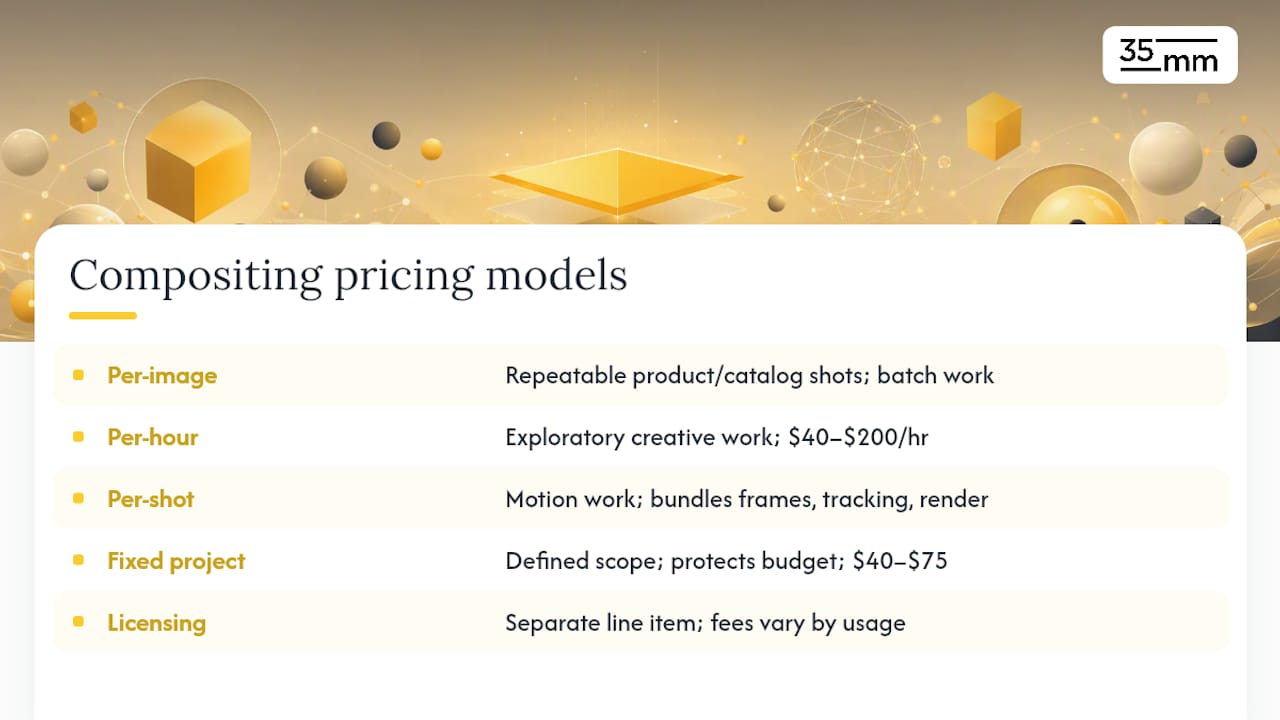
Marketplace data on Photoshop and compositing services shows hourly rates typically span $40 to $200, with fixed pricing for standard work usually landing between $40 and $75. Complex composites, the kind involving several source images and heavy retouching, can run into the hundreds or thousands depending on how much creative problem-solving is required.
Packaged tiers, often labeled basic, standard, and premium, map directly to deliverable count and revision allowance. A basic tier might cover one composite with one revision round. A premium tier could include multiple final crops, layered source files, and three or more revision passes. Independent sellers frequently structure tiered compositing packages this way, with layer count and source integration determining which tier a project falls into.
One line item people forget to budget separately: licensing. If your composite will run in a national ad campaign versus a single social post, usage rights change the math. A non-exclusive, limited-run license costs less than a buyout, and that distinction should be negotiated before work begins, not after delivery.
The Real Cost Drivers Behind Every Compositing Quote
Price differences between two seemingly similar composites almost always trace back to a handful of concrete factors. Knowing which ones you control changes how you brief a project.
- Layer and masking complexity. Clean edges around a solid object take minutes. Foliage, hair, glass, and transparency multiply the labor because each requires manual refinement that automated selection tools can't handle reliably.
- Number and quality of source plates. If existing photography doesn't cover the angle or lighting you need, the compositor either shoots new reference or builds it in 3D, and both add real hours.
- Photorealism and CGI/3D integration. Blending a rendered object into a photograph means matching lighting, shadow direction, and material behavior. This is where a $200 job becomes an $800 job.
- Rotoscoping, motion tracking, and stitching for video. Moving plates need frame-by-frame masking or automated tracking with manual cleanup, which is a different skill set and pricing tier than static image work.
- Resolution and delivery format. A composite destined for a billboard needs different resolution handling than one for Instagram, and color management for print (CMYK, specific color profiles) adds a technical step web delivery skips.
- Turnaround and revisions. Compressed timelines and open-ended revision policies both push price up, since they force the compositor to either rush other work or hold capacity in reserve.
Software licensing itself factors into the equation, too. Studios running high-end pipelines absorb the cost of tools like Nuke and Maya along with render time, and that overhead shows up in per-shot rates for cinematic-grade work.
Pro Tip: Send your compositor a locked shot list before the quote stage. Half of all "surprise" cost increases come from scope that grew after work started, not from the technical difficulty of the original brief.
Compositing Pricing Benchmarks by Project Type
Different industries lean on compositing for different reasons, and the price bands reflect that. Here's how the numbers actually break down by use case.
E-commerce and product imagery is the most price-sensitive category, largely because volume is high and the work is repeatable. Background removal and basic multi-image compositing for a product catalog often starts around $1 to $15 per image, with meaningful bulk discounts once you're ordering in batches of fifty or more. If you're commissioning three product shots a month, expect a different per-unit rate than if you're commissioning three hundred.
Lifestyle and hero marketing images sit in the moderate to high range, typically $150 to $800 per finished image. These composites usually blend a product shot with a background environment, add retouching, and require color grading to make the whole thing feel like one cohesive photograph rather than a collage. Expect the price to climb further if a 3D-rendered element needs to sit convincingly inside the frame.
Editorial and stock composites run mid-range because licensing needs are lighter and the visual complexity tends to be lower than a branded ad campaign. Think illustrative concept images for articles or reports, priced closer to $100 to $400 per image depending on how many source elements are involved.
Advertising and cinematic VFX work is where costs scale fastest. Per-shot pricing for simple compositing tasks runs $100 to $1,000, mid-level VFX work sits between $1,000 and $5,000 per shot, and high-end cinematic realism can exceed that substantially. The jump happens because motion adds tracking, frame consistency, and render time that static images never require.
Social content and short-form video composites usually price per second or per shot rather than per hour, since brands need fast turnaround on a high volume of short clips. Rates here vary widely based on how much retouching and tracking each clip needs, but they tend to sit closer to the simple end of the VFX range unless the client wants cinematic polish.
Adding even one photorealistic 3D object to a hero image can move a mid-range quote into a high-end band almost overnight, since realism is the single biggest cost multiplier across every category above.
What to Include When Requesting a Compositing Quote
Vendors can only give you an accurate number when you give them a complete picture. A vague brief gets a vague, inflated estimate, because the compositor has to price in uncertainty.
Send these five things every time:
- Reference images and source plates. Show exactly what you're starting with and what the final look should resemble.
- Target resolution, aspect ratio, and color space. Print and web have different technical requirements, and mismatches here cause expensive rework.
- Deliverable count and file formats. Specify how many final images you need, whether you need alternate crops, and whether you require layered PSDs or flattened TIFFs.
- Licensing and usage terms. State whether the image needs exclusive or non-exclusive rights, and for how long and in what markets it will run.
- Deadline and revision rounds. Name your final delivery date and how many revision passes are included before additional rounds incur extra charges.
A few smaller details matter too:
- Note any brand guidelines or existing style references the compositor should match.
- Flag whether the project is part of a larger campaign, since that context affects consistency requirements.
- Ask how the vendor itemizes the estimate, since a line-item breakdown lets you compare quotes fairly instead of comparing two black-box totals.
Studios that specialize in this work often explain their own compositing workflow publicly, which is worth reading if you want to understand what happens between your brief and the final file.
Building a Budget and Timeline That Actually Holds
Turnaround expectations should match project complexity, not the other way around. Simple composites typically deliver in one to three business days. Moderate composites, especially ones involving multiple rounds of art direction, often need five to ten business days. High-end commercial or VFX work can take two to six weeks depending on shot count and how many stakeholders need to sign off.
A few habits keep both cost and timeline under control:
- Lock the brief before requesting a quote, not during production.
- Define acceptance criteria upfront (what makes a composite "done") to avoid endless revision loops.
- Structure payment in stages: a deposit to start, a milestone payment at first draft, and final payment on delivery with licensing handoff.
Pro Tip: Ask your vendor how many revision rounds are included in the base price before you sign off. "Unlimited revisions" sounds generous but often means the compositor has priced in extra hours you're paying for whether you use them or not.
Software and Technology Costs Baked Into Your Quote
Most compositing quotes already include software overhead, even when the line item never appears on your invoice. Professional compositors work in tools like Adobe Photoshop, Nuke, or After Effects for 2D work, and Maya or Cinema 4D when 3D integration is involved. Licensing for these tools isn't cheap, and studios running high-end pipelines factor that cost, along with render farm time and storage for large project files, into their hourly or per-shot rates.
This is one reason a freelancer's quote and a studio's quote for what looks like the same job can differ so much. A studio maintaining licensed compositing and rendering software year-round, plus the infrastructure to handle large render queues, is pricing in overhead a single freelancer working on a personal license simply doesn't carry.
Color management tools and calibrated monitors matter more than people expect, too. A composite that looks perfect on an uncalibrated screen can shift noticeably when printed or viewed on a different display, and studios that invest in proper color pipelines are protecting you from that risk, not padding their invoice for no reason.
When you're comparing a $200 quote against an $800 quote for what seems like similar work, technology overhead is often where the gap comes from. Cheaper quotes sometimes mean the vendor is working without proper color-managed monitors or without licensed rendering capacity, and that shows up in the final file even when it's not obvious at first glance.
Contract Terms and Who Owns the Final Composite
Ownership of the final composite artwork should be explicit in writing before the project starts, not assumed. In most commercial arrangements, the client owns the final delivered composite once payment clears, but the compositor retains ownership of any proprietary tools, brushes, or 3D assets built along the way unless the contract states otherwise.
Watch for a few specific terms:
- Usage rights versus ownership. Owning the final file doesn't automatically mean unlimited usage rights if source images were licensed stock, since that underlying license still applies.
- Source file handoff. Clarify whether you receive layered PSDs, project files, and 3D assets, or only the flattened final image. This matters if you'll need edits down the road without going back to the original compositor.
- Revision cutoff. Contracts should state exactly when the project is considered "delivered" and revisions move from included to billable.
- Payment triggers for ownership transfer. Some contracts transfer ownership only on final payment, which protects the vendor if a client stalls mid-project.
None of this is adversarial. It's just the kind of detail that prevents a disagreement six months later when someone on the client side wants to reuse an asset in a way the original license didn't cover.
What We've Learned Pricing Hundreds of Composites
Scoping a composite honestly starts before we ever quote a number. We ask for the reference images, the deadline, and whether the client needs layered files, then decide fixed pricing versus hourly based on how locked the creative direction already is. Exploratory hero shots get hourly quotes. Repeatable product work gets fixed per-image pricing.
The most reliable way to cut cost without cutting impact is trimming ambiguity, not trimming quality. A locked brief with clear references almost always costs less than an open one, because we're not pricing in guesswork.
We typically respond to a complete brief within one business day.
— 35mm
Get a Straight Answer on Your Compositing Quote
If you've read this far, you already know that a real quote depends on layer complexity, source quality, and how photorealistic the final image needs to look, not a generic per-image rate card. 35milimetre has spent over two decades handling exactly that kind of scoping for advertising, automotive, and technology brands, which means the estimate you get back reflects the actual job, not a padded worst-case number.
Send over your reference images, target deliverable count, and deadline, and the team will return a scoped estimate rather than a vague hourly guess. Projects that need CGI integration or 3D asset work get folded into the same quote instead of a surprise add-on later. For a deeper look at how the studio approaches complex jobs, the photorealistic CGI guide breaks down when that level of realism is actually worth the investment.
Ready to see what your project would run? Request a quote from 35milimetre and get a scoped estimate back instead of a guess.
Key Takeaways
Image compositing cost scales with layer complexity, source quality, and realism demands far more than with image count alone.
| Point | Details |
|---|---|
| Simple composites cost the least | Background swaps and basic masking run $20–$150 per image, priced per piece. |
| Realism drives the biggest jumps | Adding CGI or 3D integration can push a mid-range quote into the $800–$5,000+ band. |
| Pricing models vary by project type | Per-image suits repeatable work; hourly or per-shot fits exploratory and motion-based jobs. |
| A locked brief lowers your quote | Reference images, deliverable counts, and licensing terms upfront prevent costly revision loops. |
| 35milimetre scopes before quoting | The studio decides fixed versus hourly pricing based on how locked the creative direction already is. |
Sources
The pricing bands in this guide draw on three primary sources worth bookmarking if you want deeper vendor-rate detail:
- 2026 Adobe Photoshop Hiring Costs | Fiverr
- Photo Editing Pricing Guide 2026: How Much Should You Pay Per Image? | Photodotedit
- VFX Cost Guide 2026: Cost Per Shot, Second & Minute
Each source maintains its own detailed vendor-rate tables, worth a direct look if you're pricing a specific edge case this guide doesn't cover.