

Every marketing manager has felt it: you hand off a creative brief, the studio delivers something that feels completely off-brand, and suddenly you're juggling three rounds of costly revisions while your campaign deadline closes in. Poor briefs are a top roadblock for 57% of clients and 52% of agencies, and vague direction remains the single most frequent complaint studios raise about their clients. This guide gives you a concrete, experience-tested framework for writing and delivering briefs that keep technology and automotive visual projects aligned, on budget, and genuinely impressive from the first deliverable.
Table of Contents
- Why briefs make or break visual projects
- Core elements of an effective creative brief
- Step-by-step: How to brief a creative studio
- Common mistakes and troubleshooting your brief
- A fresh perspective on creative briefing: Collaboration over perfection
- How 35milimetre helps you brief for impact
- Frequently asked questions
Key Takeaways
| Point | Details |
|---|---|
| Clarity drives success | A detailed and focused brief sets the stage for impactful and efficient visual projects. |
| Collaboration cuts revisions | Involving your creative studio early reduces costly rework and misaligned expectations. |
| Templates improve consistency | Using structured templates ensures every project brief covers what matters most. |
| Avoid common pitfalls | Steering clear of vague specs or objectives keeps visual projects on time and budget. |
Why briefs make or break visual projects
To fully grasp the value of mastering creative briefs, let's look at why they have such a dramatic impact on visual projects.
A brief is not just a formality. It is the single document that aligns your creative director, your post-production artist, your 3D artist, and your agency account team around one shared vision before a single pixel is touched. When that document is clear, the project has a foundation. When it is vague, every stakeholder fills in the gaps with their own assumptions, and those assumptions rarely match.
The data on this is striking. Tight briefs with clear objectives enable great work according to 82% of clients and 79% of agencies surveyed, yet the briefing process remains consistently undervalued in marketing workflows. More consequentially, poor briefs waste roughly a third of total project budgets, and structured briefs have been shown to reduce revision cycles by up to 60%. For a mid-sized technology company spending $80,000 on a product launch campaign, that wasted third translates directly into missed opportunities.
"The brief is where strategy becomes visual. If the strategy is blurry on paper, the imagery will be blurry on screen."
Consider what a high-end automotive CGI campaign involves: precise lighting rigs, photorealistic paint finishes, composited environments that need to match location photography, and color grading that must align with the brand's global style guide. A single misunderstanding about whether the hero car should communicate "performance" or "luxury" can send an entire render pipeline in the wrong direction for days. Building efficient visual workflows starts at the briefing stage, not the delivery stage.
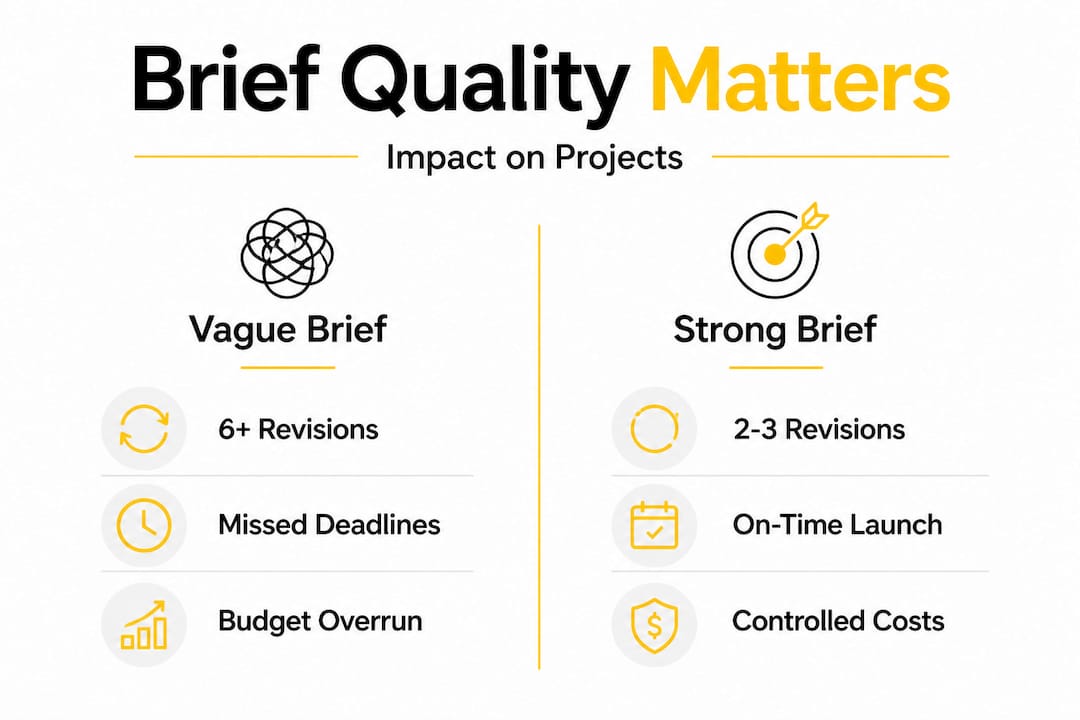
| Brief quality | Average revision rounds | Budget overrun | Timeline slip |
|---|---|---|---|
| Vague or incomplete | 6 to 8 rounds | 25 to 40% | 2 to 4 weeks |
| Structured and specific | 2 to 3 rounds | Under 10% | Under 1 week |
| Co-created with studio | 1 to 2 rounds | Minimal | Rare |
The gap between a vague and a structured brief is not subtle. It is the difference between a project that runs on creative momentum and one that stalls in endless back-and-forth. Investing an extra two hours in a proper brief almost always saves two weeks of revision time downstream. Strong creative visual direction depends entirely on how well the brief communicates intent before creative work begins.
Core elements of an effective creative brief
Knowing why briefs matter, let's break down exactly what you must include for maximum clarity.
A strong creative brief for visual projects is not a lengthy document. It is a precise one. Core elements include business context, problem definition, brand truth, audience insight, category truth, cultural lever, and strategic proposition, each of which gives your studio a different lens through which to interpret the visual challenge. Skipping any of these forces the studio to guess, and guessing costs money.
Business context explains why this project matters right now. Is it a product launch? A platform rebrand? A campaign responding to a competitor's new positioning? Your studio needs to understand the commercial stakes, not just the aesthetic ones.
Problem definition answers the question: what does this image or visual sequence need to solve? For a technology brand launching an AI-powered device, the problem might be "we need imagery that feels human and approachable, not cold and robotic." That one sentence shapes every lighting choice, color decision, and compositional angle.
Brand and product truth is where you share what is genuinely distinctive about the product. In automotive, this might be a specific aerodynamic feature that deserves visual emphasis. In technology, it could be the tactile quality of the hardware finish that compositing needs to preserve.
Audience insight tells the studio who is actually looking at the final image. A B2B technology campaign targeting procurement managers requires a very different visual tone than a D2C automotive accessories campaign targeting enthusiasts. The same product can be shot, graded, and composited in completely different ways depending on who needs to feel something when they see it.
Strategic proposition brings everything together into one clear creative direction: the single idea the image must communicate. Not three ideas. One. This is the most challenging element to write, but it is also the most valuable one. Think of it as the sentence a viewer should carry with them after seeing the visual, even if they cannot articulate why.
Pro Tip: For automotive and technology clients, include a reference board of no more than 12 images alongside your written brief. Do not just include images you love; annotate each one with a note explaining what specifically you want the studio to take from it, whether that is the color temperature, the depth of field, the background treatment, or the product angle.
| Element | Typical brief | Best-practice brief |
|---|---|---|
| Business context | "Campaign for Q3 launch" | "Repositioning product X as premium in a market shifting toward value" |
| Audience | "Tech buyers, 25 to 45" | "CTO-level buyers who distrust marketing language and respond to precision" |
| Visual direction | "Modern and clean" | "High-contrast, desaturated palette with single warm accent; no lifestyle distractions" |
| Deliverables | "6 images" | "6 retouched stills: 2 hero shots at 16:9, 4 detail crops at 1:1, all at 300 dpi" |
| Success metric | Not mentioned | "Image passes global brand audit and requires zero revisions at regional level" |
Gathering essential design assets before you write the brief also saves significant time. Brand guidelines, approved product photography, 3D model files, and approved color palettes should all be packaged with your brief document, not requested after the fact.
Step-by-step: How to brief a creative studio
With elements in mind, here's how to turn them into a brief that sets your creative team up for success.

The briefing process is a workflow, not a single event. Treating it as one document tossed over a wall is the root cause of most client-studio misalignment. Here is the sequence that consistently produces better outcomes.
Step 1: Internal alignment first. Before you brief any external studio, align your own team. Confirm the campaign objective, the approved messaging hierarchy, and the final delivery specs with your brand team, your legal team if applicable, and your media buyer. Briefing a studio before internal stakeholders agree on the direction is one of the most expensive mistakes a marketing manager can make.
Step 2: Write the brief using a structured template. Best practice is to keep briefs concise at 1 to 3 pages, using specific rather than general language. "Cinematic" is not specific. "Anamorphic lens flare with a warm 5600K key light and deep shadow fill" is specific. The more precisely you describe the visual outcome, the less room there is for creative drift.
Step 3: Share a draft with the studio before the kickoff call. Send the brief 48 hours ahead of your kickoff meeting. This gives the studio time to identify gaps and prepare informed questions, which makes the kickoff meeting far more productive. Agencies should co-write the brief or at minimum contribute to refining it, so giving them time to review is not a courtesy; it is a structural best practice.
Step 4: Run a focused kickoff meeting. The kickoff call is where written direction becomes shared understanding. Walk through the brief section by section, confirm the deliverables list, and establish revision protocols upfront. How many rounds of feedback are included? What triggers a scope change? Agreeing on these parameters before work starts protects both sides.
Step 5: Get written sign-off before work begins. This is non-negotiable. A brief that has not been formally approved can be reinterpreted or quietly ignored under creative pressure. Written sign-off creates a shared reference point that you can return to if the project drifts.
Step 6: Check in at milestone stages. For complex visual projects like a visual strategies for campaigns with multiple composited deliverables, build checkpoint reviews into the schedule. Review the rough comp before final retouching. Approve the color grade direction before full execution. These gates catch misalignment early, when corrections are fast and cheap rather than slow and expensive.
Pro Tip: Use a shared digital template hosted in a tool like Notion, Google Docs, or a purpose-built platform. Consistent brief structure across projects means your studio partners learn exactly where to look for the information they need, which speeds up every future engagement. Explore innovative brief workflows to find structures that scale across multiple projects and studio relationships.
| Stage | Owner | Tool | Milestone |
|---|---|---|---|
| Internal alignment | Marketing manager | Internal meeting | Approved creative direction |
| Brief drafting | Marketing manager | Shared template | Draft sent to studio |
| Brief refinement | Joint: client and studio | Kickoff call | Signed-off brief |
| Milestone review | Both | Review call + annotated PDF | Approved comp or color grade |
| Final delivery | Studio | Asset delivery system | Brand audit passed |
Common mistakes and troubleshooting your brief
Even the best plans can go off track; here's how to avoid the most common briefing pitfalls.
Here is a sobering reality check: 79% of marketers rate their own briefs as good, but only 6% of agencies agree with that assessment. That gap is where budget goes to die. And it gets more challenging: 90% of briefs change after initial briefing, which is a strong signal that most briefs are not actually complete when they are delivered.
"Most clients think they're writing a brief. Most studios think they're receiving a suggestion."
The most common briefing mistakes are also the most preventable. Vague objectives like "make it look premium" give a studio nowhere to go. A specific objective like "the image must read as aspirational to a European automotive audience without relying on luxury clichés" gives the creative team something concrete to work against. The difference between those two statements is the difference between four revision rounds and one.
Unclear technical specifications cause an enormous amount of unnecessary rework. Stating "we need social images" when you actually need 15 unique crops across 6 platform formats with specific safe zones for overlaid text is a missed specification that will not surface until delivery day. Revision cycles average five rounds for projects with poor briefs, each of which introduces scope creep, delays, and eroding trust between client and studio.
A lack of collaboration is the most systemic mistake. Too many marketers write the brief in isolation and treat studio feedback as pushback rather than input. Studios bring technical knowledge about what is achievable in compositing, what CGI rendering can realistically deliver on a given timeline, and what visual language is currently resonating in the market. Ignoring that knowledge is expensive. Before you finalize any brief, your visual content strategy should already be locked, because briefs that are written without a strategic foundation tend to shift the most.
Troubleshoot your brief by running it through three questions before sign-off: Does it explain why this project matters? Does it describe exactly what success looks like visually? And could a skilled studio artist who has never spoken to you produce something on-brand from this document alone? If the answer to any of those is no, the brief is not ready.
A fresh perspective on creative briefing: Collaboration over perfection
Having covered the practical steps, let's step back: what is everyone still getting wrong about briefing creative partners?
After two decades of working with brands across technology and automotive, we have seen one pattern repeat itself more than any other. Clients spend enormous energy trying to write the perfect brief, one that anticipates every question and leaves nothing open to interpretation. The intention is correct. The execution often backfires.
A brief that is written to eliminate all ambiguity often eliminates creative latitude as well. The best visual work we have been part of at 35milimetre has almost always come from briefs that were specific about outcomes but intentional about leaving space in the method. Telling a studio exactly which f-stop to use is different from telling them the mood you need the image to carry. One constraint closes creative thinking; the other opens it.
Client-agency collaboration in briefing is consistently shown to minimize revisions and align on success, yet the industry still defaults to a one-way model where the client writes and the studio executes. The real value is in the conversation between the brief draft and the kickoff call, the moment where a studio's technical knowledge meets a client's strategic intent and something genuinely better than either could have produced alone starts to take shape.
We often tell clients that a brief is not a contract. It is a starting position. The studio brings expertise about what is achievable in post-production, compositing, and CGI. The client brings knowledge of their audience and brand. When both sides contribute to shaping the brief, the work reflects both forms of knowledge, and that is when you see imagery that does not just look good but actually moves people.
Consider the design studio's impact on brand outcomes. Studios that are brought in as creative partners rather than production vendors consistently deliver stronger first drafts, fewer revisions, and more distinctive visual outcomes. The brief is the invitation to that kind of partnership. Write it like one.
How 35milimetre helps you brief for impact
If you're ready to put these principles into action and want specialists who get your world, here's how 35milimetre can help.
At 35milimetre, we have spent over two decades working through exactly these challenges alongside technology and automotive brands who need visuals that perform, not just look good. We understand the pressure of campaign deadlines, the precision demanded by global brand guidelines, and the technical complexity of automotive CGI and product compositing at scale. Our team engages with your brief from day one as a collaborative partner, asking the right questions early so the creative process moves forward with confidence rather than guesswork.
Whether you need a single hero image or a full campaign suite with 3D renders, retouching, and color grading, our visual post-production services are built to support brands that take visual quality seriously. We would love to walk through your next project brief together and show you what a well-aligned creative process can deliver.
Frequently asked questions
How long should a creative brief be for visual projects?
Aim for a concise brief of 1 to 3 pages maximum so it covers every essential element without burying the studio in detail that slows down the creative process.
Who should write the creative brief?
Ideally the client and the studio co-write the brief together, because that collaboration surfaces technical constraints and strategic priorities before work begins rather than after.
What are the biggest mistakes in creative briefing?
Vague briefs are the top complaint agencies raise about clients, alongside unclear technical specs and failing to secure internal alignment before the studio kickoff.
How can revisions be minimized during visual projects?
Collaboratively drafting a structured brief and getting sign-off before any creative work starts can reduce revisions by up to 60%, making that upfront investment in the brief one of the highest-return activities in any campaign.