

AI in advertising is not simply a faster way to make creative assets. It is a structural shift in how campaigns are built, measured, and optimized. Agencies that treat it as a shortcut are missing the larger picture, while those that treat it as a complete replacement for human judgment are running into performance walls they did not expect. The evidence from large-scale campaign data, industry surveys, and creative benchmarks tells a more nuanced story, and that is exactly what this guide covers.
Table of Contents
- How AI reshapes advertising strategies
- Performance metrics: AI vs human vs hybrid ads
- Creative risks and challenges with AI
- Data quality, governance, and consumer acceptance
- Why hybrid AI-human workflows are the future of advertising
- Expert support for hybrid creative and AI ad strategies
- Frequently asked questions
Key Takeaways
| Point | Details |
|---|---|
| AI powers system-level ad optimization | AI enables flexible, real-time adjustment across creative, targeting, and bidding variables for greater campaign efficiency. |
| Hybrid workflows outperform fully automated or human-only | Combining AI speed and scale with human strategy delivers the best balance of performance, creative quality, and brand trust. |
| Risks require human oversight | AI-generated ads can fatigue faster, amplify data flaws, and erode trust, making governance and hybrid models essential. |
| Consumer trust is a challenge | Most consumers remain wary of AI-driven ads, highlighting the importance of transparency and disclosure in campaigns. |
How AI reshapes advertising strategies
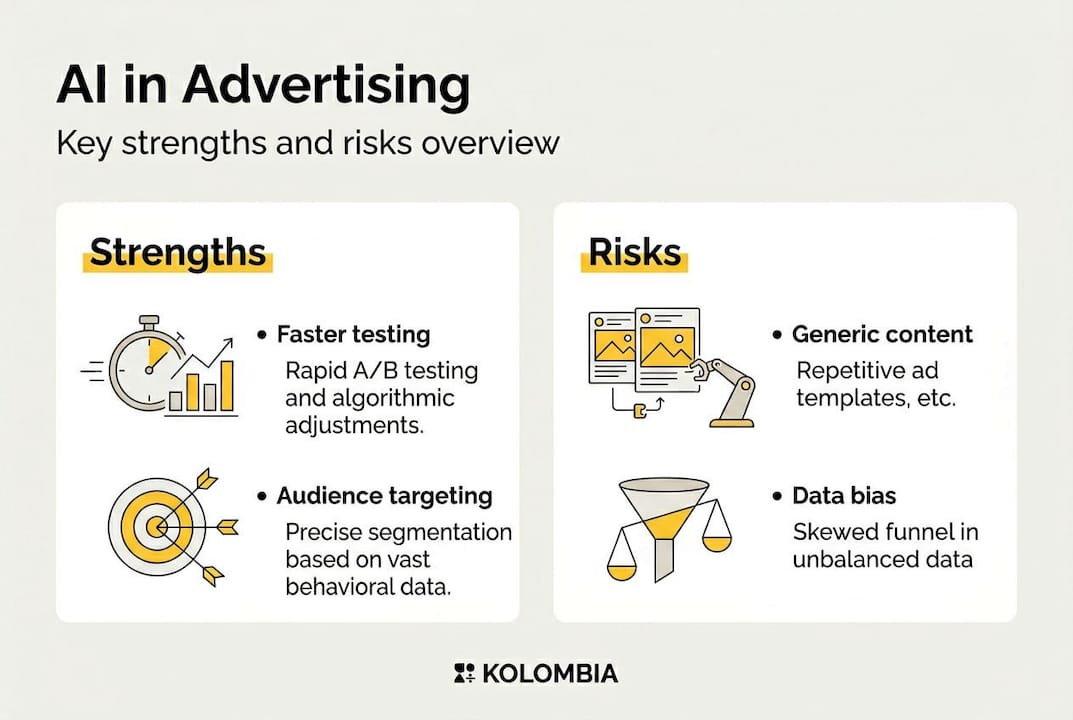
Building on the introduction, let's analyze how AI fundamentally changes the DNA of advertising strategy. Traditional advertising placed creative excellence at the center. A strong concept, a compelling visual, a sharp headline. These were the primary levers. AI does not eliminate those levers, but it adds an entirely new layer: system-level optimization, where the campaign itself becomes a living, self-adjusting structure.
System-level optimization means that instead of betting on one great ad, you are running a multivariate system where multiple advertising variables including audience targeting, creative elements, offers, placement, timing, and bidding are all being tested and adjusted in real time. The creative is no longer the sole driver of performance. It is one input among many, and AI is managing the interactions between all of them simultaneously.
| Dimension | Traditional approach | AI-driven approach |
|---|---|---|
| Creative strategy | Single hero concept | Multivariate creative testing |
| Audience targeting | Demographic segments | Behavioral and predictive signals |
| Optimization timing | Manual, periodic | Continuous, real-time |
| Performance driver | Creative quality | System-wide variable interaction |
| Scale of variants | 3 to 10 per campaign | Hundreds to thousands |
This shift has real implications for how agencies structure their workflows. The role of the creative director does not disappear, but it evolves. Instead of approving one campaign concept, the creative team is now responsible for building a library of modular assets that the AI can recombine and test. Effective brand storytelling with creative production becomes even more important in this context, because each modular asset still needs to carry authentic brand meaning.
The variables AI manages most effectively include audience segmentation, bid adjustments, ad placement across platforms, creative rotation, and offer testing. For FMCG brands in particular, a well-structured creative workflow for FMCG brands is essential before AI optimization can deliver meaningful results. You cannot feed a poorly structured creative library into an AI system and expect it to produce strong outcomes.
Pro Tip: The single biggest mistake agencies make when adopting AI optimization is assuming the technology will compensate for weak creative. It will not. AI amplifies what is already there. Start with a strong, modular creative foundation before scaling with AI.
Performance metrics: AI vs human vs hybrid ads
Now that we've established AI's strategic framework, let's examine tangible performance outcomes across different approaches. The data here is worth reading carefully, because it challenges assumptions on both sides of the debate.
AI-generated ads show 12% higher CTR on Meta compared to human-created ads across more than 50,000 variations. That sounds like a clear win for AI. But the same data shows an 8% lower conversion rate for purchases above $100 average order value (AOV), and that gap widens to 14% for purchases above $500. ROAS parity exists only under the $100 AOV threshold. The implication is significant: AI creative performs well at volume and at lower price points, but it struggles to close the deal when the purchase requires more emotional investment from the buyer.
| Metric | AI-only | Human-only | Hybrid AI+human |
|---|---|---|---|
| CTR (vs human baseline) | +12% | Baseline | +23% |
| Conversion rate (high AOV) | -8% to -14% | Baseline | Improved |
| CPA | -11% (ecom) | Baseline | -35% |
| ROAS | +6% (ecom) | Baseline | 4.1x |
| Creative fatigue onset | Day 12 | Day 18 | Extended |
| Weekly variant output | 10x | Standard | High |
A separate analysis of $1.2M in ad spend across eight accounts and six verticals confirms the pattern. AI ads delivered an 11% lower CPA and 6% higher ROAS in e-commerce, and they produced ten times more creative variants per week. But CTR was actually 7% lower, and creative fatigue set in at day 12 compared to day 18 for human-made ads. The speed advantage is real. The quality ceiling is also real.
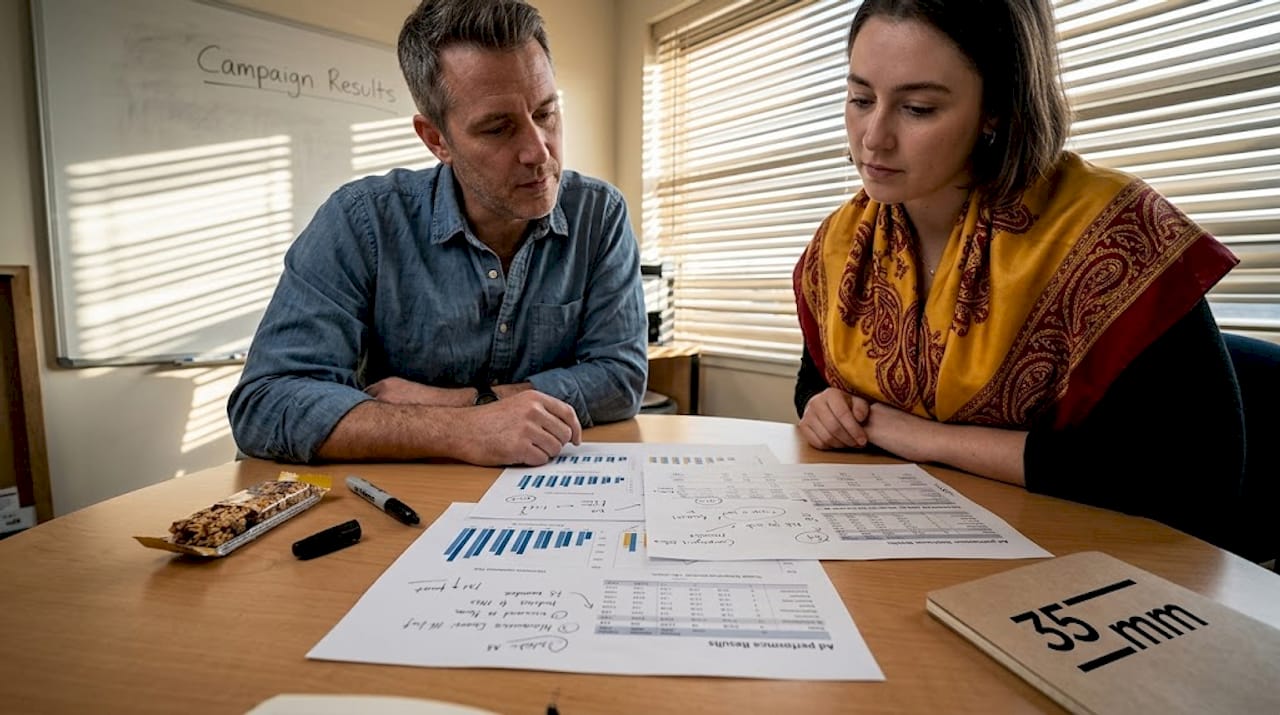
The most compelling finding comes from hybrid AI and human campaigns, which outperformed human-only campaigns by 23% on CTR and reduced CPA by 35%, with a 4.1x ROAS across 10,000 campaigns analyzed. Hybrid is not a compromise. It is the highest-performing model in the data.
The hybrid workflow that produces these results generally follows this structure. First, human creatives develop the strategic concept, core visuals, and brand-aligned messaging. Second, AI generates variations at scale, testing different headlines, formats, color treatments, and audience pairings. Third, human reviewers assess the top performers for brand integrity and emotional resonance. Fourth, AI continues optimizing the approved variants in live campaigns. This cycle, when managed well, captures the speed and scale of AI while preserving the depth and nuance that human creative brings.
Understanding design's impact in advertising is critical here. The visual quality of the original human-made assets directly determines the ceiling of what the hybrid system can achieve. Garbage in, garbage out applies just as much to hybrid workflows as to fully automated ones.
Creative risks and challenges with AI
Performance isn't the only consideration. Creative risks can undermine campaign success if not properly managed, and they tend to surface in ways that are harder to measure than CTR or CPA.
The most documented risk is accelerated creative fatigue. Because AI generates high volumes of variations using pattern-based models, those variations often share underlying structural similarities that audiences recognize and tune out faster than they would with more diverse human-created work. The day-12 fatigue onset versus day-18 for human ads is a measurable consequence of this pattern dependency.
Beyond fatigue, the risks include model bias, where AI systems trained on historical performance data tend to replicate what worked before rather than innovate. This creates a feedback loop that narrows creative range over time. There is also the issue of brand recall. Research shows that human-created ads outperform AI ads on brand recall by 41%. That is a substantial gap, and it matters most for brands in competitive categories where recognition drives repeat purchase.
"Human-created ads outperform AI ads on brand recall by 41%, with AI creative showing particular gaps in high-AOV and B2B campaigns where emotional resonance and trust are primary purchase drivers."
Sentiment is another area where AI creative shows consistent limitations. AI-generated copy and visuals tend toward the functional and literal. They can communicate a product benefit clearly, but they often miss the tonal nuance that makes an ad feel genuinely on-brand. For design assets for advertising impact, this distinction between functional communication and emotionally resonant communication is where human expertise remains irreplaceable.
The campaign types most vulnerable to these risks are high-consideration purchases, B2B lead generation, luxury and lifestyle brands, and any category where brand trust is a primary conversion driver. Low-consideration, high-frequency consumer goods are where AI creative performs most reliably without significant human oversight.
Pro Tip: For campaigns targeting high-AOV products or B2B audiences, deploy a hybrid oversight model where every AI-generated creative asset passes through a human review stage before going live. The performance data justifies the added step.
Data quality, governance, and consumer acceptance
Beyond creative and performance considerations, sustainable AI integration relies on data integrity and stakeholder trust. These are the structural foundations that determine whether AI optimization delivers consistent results or gradually erodes campaign quality.
The advertising industry remains cautious about granting full AI autonomy over ad spend, and for good reason. The core concerns include last-click attribution bias, where AI systems optimize toward the most easily measured conversion signal rather than the most accurate one. Siloed metrics across platforms create incomplete data pictures. Liability questions around AI-driven spend decisions remain legally unresolved. And governance frameworks for AI in advertising are still immature across most organizations. The current industry consensus is that large language models (LLMs) are well-suited for campaign orchestration and creative generation, but direct bidding and budget allocation decisions still require human oversight.
The data quality risks worth monitoring include attribution model flaws that skew optimization signals, platform-specific data silos that prevent holistic campaign views, training data biases that favor certain audience segments over others, and the compounding effect of small data errors at scale.
The consumer trust dimension adds another layer of complexity. There is a striking gap between how executives perceive consumer sentiment and what consumers actually report.
"82% of executives believe GenZ and millennial consumers are positive about AI-generated ads, but only 45% of those consumers actually agree. Disclosure of AI use increases or maintains purchase likelihood for 73% of consumers surveyed."
This consumer backlash is already influencing brand strategy. Some brands, including Aerie, have made public commitments to avoid AI-generated imagery in their advertising. The brands seeing the best outcomes are those that treat transparency not as a legal obligation but as a trust-building opportunity. Disclosing AI involvement, when done thoughtfully, tends to maintain or improve consumer acceptance rather than damage it.
The practical implication for agencies is that governance needs to be built into AI workflows from the start, not added after a problem surfaces. That means clear ownership of AI-generated content decisions, defined review checkpoints, and transparent communication policies for clients and consumers alike.
Why hybrid AI-human workflows are the future of advertising
We have worked closely enough with large-scale visual production to know that the conversation about AI in advertising often gets polarized in ways that are not useful. The "AI will replace everything" camp ignores the brand recall gap, the high-AOV conversion drop, and the accelerating fatigue problem. The "AI is just a gimmick" camp ignores the 10x variant output, the CPA reductions, and the real efficiency gains that free up human creatives for higher-order thinking.
Full AI autonomy is not a realistic goal for most brands right now. The data does not support it, and the governance infrastructure does not exist to manage it responsibly. What the data does support, consistently across multiple large-scale studies, is the hybrid model. Not as a transitional phase on the way to full automation, but as a genuinely superior operating model in its own right.
The reason hybrid outperforms both extremes is structural. AI is exceptionally good at scale, speed, pattern recognition, and real-time optimization. Humans are exceptionally good at brand intuition, emotional nuance, cultural context, and strategic judgment. These capabilities are not competing. They are complementary, and the best hybrid storytelling strategies treat them that way.
The agencies that will lead in the next three to five years are not the ones that automate the most. They are the ones that build the most effective human-AI collaboration frameworks. That means investing in creative quality at the input stage, building modular asset libraries that AI can work with effectively, establishing clear governance checkpoints, and developing the internal expertise to interpret AI performance data with genuine strategic insight.
Starting with hybrid before scaling AI is the right sequence. Prove the model at a smaller scale, understand where human oversight adds the most value, and then expand AI's role in areas where it has demonstrated consistent performance. This approach reduces risk, builds internal confidence, and produces better outcomes than jumping straight to full automation.
Expert support for hybrid creative and AI ad strategies
If you're aiming to balance creative excellence with AI-driven optimization, the quality of your visual assets is the variable that most agencies underestimate.

At 35milimetre, we have spent over two decades building the kind of high-end visual production work that performs at every stage of the funnel, from compositing and retouching to CGI and AI-enhanced imagery. Our visual post-production services are built specifically for agencies and brands that need creative assets strong enough to anchor a hybrid AI workflow. Whether you are building a modular asset library for AI testing or need campaign-ready visuals that carry genuine brand weight, we bring the technical depth and creative judgment to make it work. Reach out to discuss how we can support your next campaign.
Frequently asked questions
How does AI optimize multiple ad variables at once?
AI leverages algorithms to test and refine variables like targeting, creative, placement, and bidding in real time, with real-time optimization across all dimensions happening simultaneously rather than sequentially.
Is AI best for high-ticket or low-ticket ad campaigns?
AI excels at lower-ticket campaigns, but 8% to 14% lower conversions for purchases above $100 to $500 AOV show that human input remains vital where emotional trust drives the decision.
What are the risks of full AI autonomy in advertising?
Full AI autonomy can amplify flawed data and governance gaps, including last-click bias and siloed metrics, making governed hybrid models the safer and better-performing choice for most agencies.
Do consumers trust AI-powered ads more?
Most consumers are skeptical, with only 45% of GenZ and millennials viewing AI ads positively despite 82% of executives assuming otherwise. Transparent disclosure meaningfully improves acceptance.
How can agencies use hybrid AI-human ad workflows successfully?
Hybrid workflows that combine AI scale with human creative oversight deliver +23% CTR and 4.1x ROAS compared to human-only campaigns, making them the highest-performing model across large-scale campaign data.