
AI image editing is defined as the use of learned computational models to automate, enhance, and generate visual content that previously required manual expert work. 81% of professional photographers now report improved work-life balance directly tied to AI-driven workflow efficiency. That number signals a structural shift, not a minor upgrade. Equally striking: 64% of clients cannot distinguish AI-enhanced imagery from traditional manual retouching. Understanding how AI changes image editing means understanding why these two facts are now the baseline for every serious creative professional.
How AI changes image editing at the model level
The core of AI-powered editing is the shift from deterministic algorithms to learned models. Traditional editing software followed fixed rules: brighten by X, sharpen by Y. AI models, by contrast, learn from millions of images and apply probabilistic reasoning to each edit.
Three technologies drive most of what you see today:
- Diffusion models power inpainting and outpainting, filling in missing areas or extending image borders with contextually accurate content. These models generate plausible pixel data rather than copying from existing regions, which is why results look natural rather than cloned.
- Segmentation models, including Meta's Segment Anything Model (SAM), automate object and background selection with a single click or prompt. Tasks that once required careful manual masking in compositing workflows now take seconds.
- Multimodal models interpret natural language to execute complex edits. Multimodal models now understand prompts like "remove the shadow behind the subject and warm the skin tone" and translate them directly into pixel-level changes.
These technologies do not simply speed up old methods. They replace the underlying logic of how editing decisions get made. A retouching artist using diffusion-based inpainting is no longer painting pixels manually. They are directing a model that has internalized the visual grammar of thousands of similar images.
Pro Tip: When working with segmentation models, always review the mask edges at 100% zoom before applying any compositing. AI selections are fast, but fine hair and translucent fabric still need a human eye for final approval.
How has AI improved speed, cost, and accessibility?
The efficiency gains from AI are not incremental. AI inference time for a typical photo edit dropped from 8–15 seconds in 2024 to 0.5–2 seconds in 2026. That is a compression of time that changes how you think about iteration entirely.

Cost reductions follow the same curve. The cost per edit has fallen by 5x to 10x, making high-quality processing affordable for small studios and individual photographers who previously could not justify the expense. Background removal, once a task that took 5–7 minutes of manual work, now completes in under 30 seconds. For an e-commerce brand processing hundreds of product images weekly, that difference is the gap between a two-person team and a ten-person team.
| Task | Before AI | With AI |
|---|---|---|
| Background removal | 5–7 minutes per image | Under 30 seconds |
| Inference time per edit | 8–15 seconds | 0.5–2 seconds |
| Cost per edit | Baseline | 5x–10x reduction |
| Object selection | Manual masking | Single click or prompt |
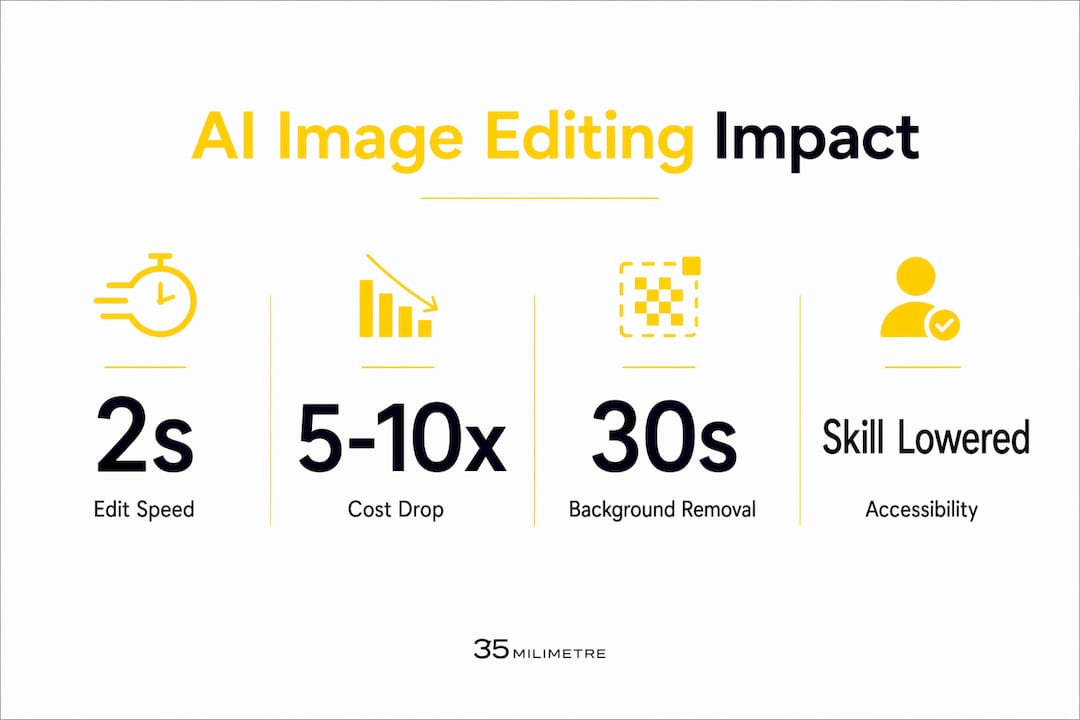
Accessibility is the less-discussed benefit. AI tools for image enhancement have lowered the skill floor for basic retouching, meaning a startup founder can produce clean product imagery without hiring a specialist for every shot. That said, the skill ceiling has not dropped. The professionals who understand both the tools and the underlying craft are producing work that was simply not possible before. For a deeper look at how these techniques apply in practice, the 2026 AI enhancement techniques breakdown covers the specifics.
Pro Tip: Batch processing with AI works best when you establish a consistent base edit first. Run your AI corrections on a single image, approve the result, then apply the same model settings across the full set. This keeps color grading and tone consistent without manual intervention on every file.
What practical impacts does AI have on creative workflows?
AI changes the rhythm of creative work more than it changes the final output. Near-instant AI feedback enables rapid iteration, so a photographer or designer can test five different retouching directions in the time it previously took to complete one. That speed-feedback loop is qualitatively different from anything that came before.
Professionals have developed clear preferences about where AI fits. Photographers show strong acceptance of AI for technical corrections:
- Noise reduction and sharpening are widely trusted to AI models.
- Color grading adjustments and exposure corrections are commonly automated.
- Sky replacement and lighting alteration generate significant skepticism among working photographers.
- Fundamental content changes, such as adding or removing subjects, remain contested territory.
The distinction matters because it reflects a real difference in what AI does well. Technical corrections operate within narrow, well-defined parameters. Content alteration requires judgment about what the image is supposed to mean, and that judgment still belongs to the human.
AI's probabilistic nature creates a specific challenge for precision work. AI editing produces varying results for the same prompt, which means color matching for brand assets or forensic editing for legal purposes still demands manual review and final approval. The most effective workflows treat AI as the engine for bulk processing and reserve manual tools for the finishing layer where consistency is non-negotiable.
For creative studios, this changes the role of the retouching artist. Bulk corrections that once consumed the majority of a project timeline now happen in the background. The artist's attention shifts to the 10% of decisions that require genuine creative judgment: the color grade that matches a brand's visual identity, the composite that needs to feel physically plausible, the skin retouch that preserves texture while meeting a client's brief. This is explored further in the role of AI in creative studios in 2026.
What emerging trends should creatives expect from AI image editing?
The next phase of AI in photography and graphic design is already visible in the tools shipping today. Four trends define where the industry is heading.
-
Editing and generation will converge. The distinction between editing existing images and generating new content is dissolving. By 2028–2030, the boundary between retouching a photograph and generating a new visual from a prompt will be largely semantic. Creatives who understand both sides of that line will have a significant advantage.
-
Conversational editing interfaces are replacing panel-based controls. Natural language photo editing, where you describe the change you want rather than adjusting sliders, is moving from experimental to standard. This shift in natural language photo editing is already reshaping how designers interact with editing software at a fundamental level.
-
On-device processing is growing. Privacy concerns and latency requirements are pushing AI inference onto local hardware. On-device editing means your raw files and client assets never leave your machine, which matters for commercial work under NDA and for photographers in markets with strict data regulations.
-
Regulatory frameworks are arriving. The EU AI Act, effective from august 2025, requires AI-generated or significantly modified content to carry machine-readable metadata disclosing AI involvement. This applies to images distributed in EU markets and sets a precedent that other jurisdictions are likely to follow. For studios working with international brands, AI disclosure is now a compliance requirement, not a stylistic choice.
The industry is at a structural inflection point. New skills like AI fluency and regulatory awareness are becoming as important as traditional retouching technique. The creatives who treat AI as a craft to master, rather than a button to press, will define the next decade of visual production.
Key Takeaways
AI image editing delivers the greatest value when human creative judgment directs the process and AI handles the volume, speed, and technical consistency.
| Point | Details |
|---|---|
| Speed has transformed iteration | AI inference time dropped to under 2 seconds, enabling multiple creative directions per session. |
| Cost reduction is real and significant | Cost per edit fell 5x–10x, making professional-quality processing accessible to smaller studios. |
| Probabilistic output requires oversight | AI results vary per prompt, so manual review remains non-negotiable for color-critical and commercial work. |
| Regulatory compliance is now required | The EU AI Act mandates machine-readable AI disclosure metadata on modified images distributed in EU markets. |
| Editing and generation are converging | By 2028–2030, the line between retouching a photo and generating one will largely disappear. |
What two decades of retouching taught us about AI
At 35milimetre, we have spent over 20 years working through every major shift in post-production: the move from film to digital, from CD delivery to cloud, from hand-painted masks to automated selections. AI is the most significant of these shifts, and it is also the most misunderstood.
The honest truth is that AI does not make creative decisions better. It makes the mechanical parts of the job faster, and that frees us to spend more time on the decisions that actually matter. When we run AI-assisted background removal on a 200-image automotive shoot, we are not replacing craft. We are buying back the hours that used to disappear into repetitive masking so we can spend them on color grading, compositing, and the fine retouching that defines the final image.
What we have also learned is that AI's probabilistic nature is not a flaw to work around. It is a feature to direct. Running multiple AI variations on a single edit and selecting the best result is a legitimate creative technique. The editor's role shifts from executing every pixel to curating the best output from a fast, capable model.
The caution we carry is about authenticity. Clients trust us to tell them when an image has been significantly altered. That transparency is not just an ethical position. With the EU AI Act now in force, it is a legal one. We treat AI disclosure as part of our standard delivery process, not an afterthought.
— 35mm
Professional post-production that puts AI to work
35milimetre integrates AI tools into every stage of post-production, from bulk background removal on e-commerce catalogs to AI-assisted compositing for automotive and technology campaigns.
The studio's approach combines the speed of AI processing with the precision of two decades of hands-on retouching experience. Whether you need marketplace-ready product imagery, high-end CGI composites, or campaign visuals that meet international brand standards, 35milimetre delivers work that holds up at every scale. Visit the professional retouching services page to see how the studio approaches visual post-production for brands that cannot afford to look ordinary.
FAQ
What is AI image editing?
AI image editing is the use of learned computational models, including diffusion models and segmentation networks, to automate and enhance visual content. These models replace fixed algorithmic rules with probabilistic reasoning trained on large image datasets.
How does AI improve photo quality?
AI improves photo quality by automating noise reduction, sharpening, color correction, and background removal with results that match or exceed manual retouching. 64% of clients cannot distinguish AI-enhanced images from traditionally retouched ones.
Is AI editing reliable enough for commercial work?
AI editing is reliable for bulk technical corrections but requires manual review for color-critical and brand-specific work. AI's probabilistic output means results vary per prompt, making human oversight non-negotiable for commercial and forensic applications.
What is the EU AI Act's impact on image editing?
The EU AI Act, effective from august 2025, requires machine-readable metadata disclosing AI involvement on any AI-generated or significantly modified image distributed in EU markets. Studios working with international brands must treat AI disclosure as a standard delivery requirement.
Will AI replace professional retouching artists?
AI automates the mechanical volume of retouching but does not replace the creative judgment required for color grading, compositing, and brand-specific finishing. The editor's role is shifting from pixel-level execution to creative direction of AI-assisted workflows.