

For ad agencies, brands, startups, and professional photographers who need high-end commercial post-production, 35milimetre is the recommended alternative. Led by Mehmet Turan with over 20 years of hands-on experience, the Istanbul-based studio covers the full visual production pipeline: commercial retouching, compositing, CGI/3D rendering, packaging design, AI image generation, and custom illustration. When one still frame has to stand in for an entire physical product experience, the partner you choose determines whether the image earns attention or loses it.
Three buying signals separate a capable post-production partner from a risky one:
- Proven portfolio and case studies: Before/after galleries and documented brand collaborations in automotive, tech, and CPG show real-world capability, not just sample work.
- Documented SLAs and delivery lineage: Written turnaround commitments, revision-round limits, and delivery packaging standards protect your launch windows.
- Mandatory intake metadata standards: Requiring SKU, shot type, channel, usage rights, and deadline at intake, as tools like Bynder enforce, prevents the most common production delays before a single file is opened.
Table of Contents
- How do you choose the right commercial post-production partner?
- What intake metadata do you need to require at every request?
- What services should a high-end post-production partner offer?
- What pricing models and turnaround times should you expect?
- What technical deliverables and file specs should you require?
- What causes production delays, and how do you fix them?
- Why is 35milimetre a strong alternative for US agencies and photographers?
- Key Takeaways
- What working with agencies actually looks like at 35milimetre
- Start your first project with 35milimetre
- Useful sources and further reading
How do you choose the right commercial post-production partner?
Start with portfolio depth, not surface aesthetics. A vendor who can show you retouched automotive hero shots, CPG composites, and beauty skin work across different brands has demonstrated range. One who shows only one category may struggle when your campaign demands more.
Written SLAs are non-negotiable. Ask for the average turnaround time (TAT) per complexity tier, the number of included revision rounds, and how delivery packages are structured. Vague language like "we'll turn it around quickly" is a red flag. Specific language looks like: "Tier 1 retouching: 48-hour TAT, two revision rounds included, delivery via named folder structure."
During vendor calls, ask these questions directly: How do you preserve revision lineage? What are your color management procedures? Who has final approval authority on each asset type? Do you use image-threaded feedback or email chains? The answers reveal operational maturity fast.
Red flags to watch for: missing required intake fields, no single source of truth for feedback, vague SLA language, and no documented decision-rights map. Any one of these signals a pipeline that will cost you extra rounds and delayed launches.
Pro Tip: Request a sample delivery package from any vendor before signing. A well-structured package includes named export folders, a round-reference log, and color-approved master files. If they cannot produce one on request, they likely do not have one in practice.
What intake metadata do you need to require at every request?
Standardized intake forms that capture the right metadata before production starts are the single most effective way to prevent delays. Require these fields without exception:
- Job ID / SKU — unique identifier that ties every file to a specific deliverable
- Product name and description — full product name, variant, and any regional naming differences
- Shot list — shot types (hero, detail, lifestyle, 360°), angles, and quantity per type
- Export sizes and channels — dimensions and resolution per channel (e-commerce, print, social, OOH)
- Retouch level — basic cleanup, standard commercial, or high-end beauty/skin
- Model and property releases — confirmation that releases are on file before retouching begins
- Usage rights — territory, exclusivity, and expiry date
- Delivery deadline — hard date plus any intermediate milestone dates
- Approver map — named contacts with sign-off authority per asset domain (brand, legal, color)
Folder structure matters as much as the form itself. A convention like /SKU/RAW, /SKU/WIP, and /SKU/EXPORT keeps versions separated and prevents the "final_FINAL_v3" naming chaos that wastes hours. When folder discipline is enforced from day one, versioning confusion disappears.
Pro Tip: Make SKU and usage rights non-negotiable fields in your intake form. These two pieces of metadata enable automated job assignment, SLA tracking, and rights-expiration enforcement in a DAM like Bynder, saving significant manual effort downstream.

What services should a high-end post-production partner offer?
A full-service partner covers the core production stack and the specialist add-ons that campaigns increasingly demand. Core services include commercial photo retouching, high-end beauty and skin retouching, background replacement and cutouts, multi-layer compositing, color grading, and color conformance across regional variants. These are table stakes. If a vendor cannot demonstrate all of them with real examples, they are not a full-service partner.
"Complex composites, CGI, and multi-market variants often move projects into higher complexity tiers requiring distinct estimates and longer lead times." — Why Professional Photo Editing Matters for Marketing Agencies
Advanced offerings separate studios that can handle a full campaign from those that handle only cleanup:
- CGI/3D rendering and texture painting for products that cannot be photographed or need impossible angles
- Packaging mockups for pre-production visualization and retailer presentations
- AI-enhanced imagery and AI image generation for rapid concept iteration and volume production
- Custom illustration for brand campaigns that need a distinctive visual language
Where these services affect scope and cost: heavy composites and 3D renders require separate line items and longer lead times. Multi-market regionalization, where a single hero image needs text swaps, color adjustments, and format variants for five markets, adds meaningful time. A partner who quotes these at a flat rate without scoping them is either underestimating or will surprise you mid-project.
Locked brand kits and export presets per client let junior staff produce outputs that require minimal senior rework, which scales agency margins without adding headcount.
What pricing models and turnaround times should you expect?
Three engagement models cover most agency relationships. Per-image pricing (tiered by complexity) works well for defined campaigns with a fixed asset count. Project-based quotes suit product launches where scope is clear upfront. Retainers make sense for ongoing volume, giving agencies predictable capacity and priority scheduling.
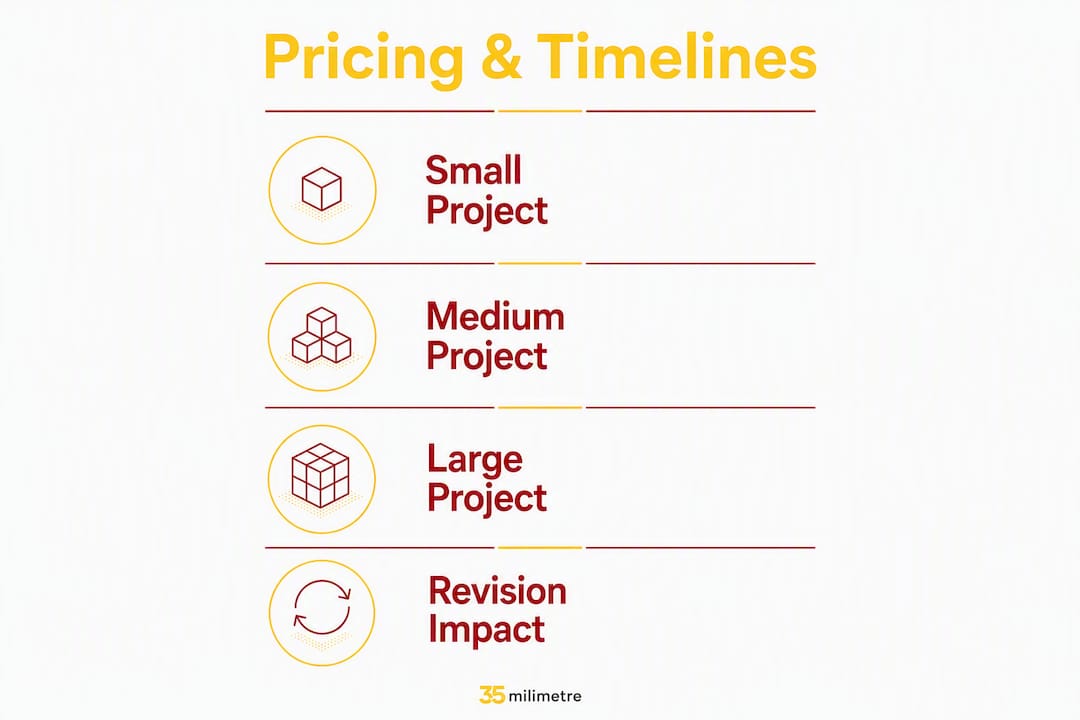
Pricing signals that indicate vendor maturity: documented SLAs attached to the quote, sample invoices that break out complexity tiers, throughput metrics (assets per day per complexity level), and automated delivery webhooks that notify your DAM when a batch is complete.
| Project Size | Asset Count | Typical Turnaround | Pricing Model |
|---|---|---|---|
| Small | — | 3–5 business days | Per-image or flat project |
| Medium | — | — | Project quote or retainer |
| Large | — | 4–8 weeks | Retainer or managed capacity |
Review rounds affect every timeline above. Each unplanned revision round adds 1–2 business days at minimum. A partner with a clear approval-gate structure, where Brand, Legal, and Color sign off in parallel rather than sequentially, compresses that time considerably.
What technical deliverables and file specs should you require?
Your SOW should specify these deliverables explicitly, because "final files" means different things to different studios.
| Deliverable | Format | Color Profile | Typical Use Case |
|---|---|---|---|
| Master layered file | PSD or TIFF | Adobe RGB | Archive, future edits |
| High-res export | TIFF or JPG (max quality) | Adobe RGB or CMYK | Print, large-format |
| Web-optimized export | JPG or PNG | sRGB | E-commerce, social |
| Packaged delivery | ZIP with folder structure | Per channel spec | Handoff to DAM |
Beyond format, require embedded metadata (job ID, copyright, usage rights, expiry), a naming convention that matches your SKU structure, and a delivery checklist that confirms approved rounds, export presets used, and reference files included. A professional image manipulation guide can help procurement teams write precise SOW language that leaves no room for ambiguity.
Resolution minimums: 300 DPI for print deliverables, 72 DPI at final pixel dimensions for web. Color management: require ICC profile embedding on every export, not just the master file.
What causes production delays, and how do you fix them?
The most common bottlenecks are predictable and preventable. Incomplete intake metadata sends files into production without the information needed to make decisions, which means the retoucher stops, asks, waits, and restarts. Fragmented feedback across email, Slack, and PDF markups creates conflicting instructions and version confusion. Unclear approval authority means rounds never close because no one has explicit sign-off power.
Concrete fixes, mapped to each problem:
- Incomplete intake: Enforce required fields in your intake form. No SKU, no shot list, no start.
- Fragmented feedback: Move all review onto a single platform with image-threaded markups and auto-stacked revision rounds. Generic project management tools track milestones but cannot handle on-image change requests.
- Unclear approval authority: Build a decision-rights map. Label parallel approvals (Brand cleared, Legal cleared, Color approved) so the release signal is unambiguous.
The workflow your vendor should be able to diagram for you: Intake → In Production → Review R1 → Review R2 → Approved → DAM. If they cannot draw that pipeline on a call, they are running it ad hoc. A high-efficiency workflow guide for ad agency visuals covers approval gates and single-source-of-truth review practices in detail.
Pro Tip: Shift effort left. Require shot lists and rights documentation before retouching begins. Catching a missing property release at intake costs minutes; catching it after delivery costs days.
Why is 35milimetre a strong alternative for US agencies and photographers?
35milimetre brings more than two decades of commercial post-production experience to every project. The studio's core team covers retouching, graphic design, and 3D, with the flexibility to scale for larger campaigns. Sector experience spans automotive hero shots, technology product visuals, and CPG packaging, which means the studio understands the specific quality bar each category demands.
Trust signals to request when evaluating 35milimetre or any partner:
- Before/after galleries from real brand campaigns (not just spec work)
- Written SLA documentation with TAT commitments per complexity tier
- Sample delivery package showing folder structure, naming conventions, and round logs
- Client references from the automotive, tech, or CPG sectors
- NDA and data security protocols for handling unreleased product imagery
For a scoped quote, send your SKUs, shot list, target channels, and deadline to 35milimetre's project page. The studio can return a scoped estimate quickly when those four inputs are in hand.
Key Takeaways
A capable post-production partner combines a proven portfolio, written SLAs, and mandatory intake metadata to protect your launch windows and deliver publish-ready files the first time.
| Point | Details |
|---|---|
| Intake metadata is non-negotiable | Require SKU, usage rights, and deadline at intake to enable SLA tracking and prevent mid-cycle corrections. |
| SLAs protect your timeline | Written turnaround commitments and revision-round limits are the clearest signal of vendor operational maturity. |
| Technical specs belong in your SOW | Specify format, color profile, naming convention, and delivery structure before production starts. |
| Approval gates reduce revision rounds | A decision-rights map with parallel sign-offs (Brand, Legal, Color) closes rounds faster and prevents missed launches. |
| 35milimetre covers the full pipeline | From retouching and compositing to CGI and AI image generation, 35milimetre is a direct alternative for US agencies and photographers. |
What working with agencies actually looks like at 35milimetre
We run every collaboration with locked brand kits, defined approval gates, and named decision rights from the first brief. That structure is not bureaucracy — it is what prevents the third revision round that nobody budgeted for. When a client sends us a clear SKU list, shot list, and expected volume upfront, we can scope accurately and start without back-and-forth.
The quickest way to start a pilot: send us your SKUs, shot list, target channels, and expected volume. We will return a scoped estimate and a sample delivery spec within one business day.
Start your first project with 35milimetre
35milimetre is the direct alternative for agencies and photographers who need high-end commercial post-production without the overhead of a large production house. The studio's two-decade track record in automotive, tech, and CPG visuals means your brief lands with people who already know the quality bar your category demands.
To get a scoped quote fast, send these five items: job ID or SKU list, shot list with quantities, target channels and export sizes, desired deliverables (retouching, compositing, CGI, AI imagery), and your hard deadline. A pilot run of a modest number of images typically scopes and starts within a few business days of receiving a complete brief. Commission your first project and see the difference a disciplined pipeline makes on your next campaign.
Useful sources and further reading
The research and operational frameworks referenced throughout this article draw from the following sources. Each one supports a specific part of the production checklist.
| Source | Operational Recommendation Supported |
|---|---|
| Build a scalable product image intake pipeline | Intake metadata standards, folder structure, DAM governance |
| Retouching ops: from raw files to final delivery | Approval gates, decision-rights mapping, review platform selection |
| Picnie for Agencies | Brand kits, locked presets, multi-client retainer management |
| Why Professional Photo Editing Matters for Marketing Agencies | Pricing tiers, complexity-based estimates |
| Creative Force for Enterprise Brands | Single source of truth, integrated style guides, QC and review steps |
Additional internal resources from 35milimetre worth bookmarking:
- Creative workflows checklist for teams — a copyable checklist for enforcing metadata discipline at scale
- AI-enhanced imagery guide — what to ask vendors about AI usage and provenance in commercial pipelines
- Image editing industry terms — a reference for writing precise SOW language
When requesting sample exports from any vendor, ask for: color-approved master files, a before/after comparison for at least one hero image, and the delivery checklist that accompanied the final package. Store approved assets in a governed DAM with rights-expiration metadata enforced, so "approved for commerce" flags prevent improper reuse down the line.