

Substantiated sustainability paired with digital enhanced packaging are the two defining forces shaping FMCG packaging trends in 2026. For procurement, design, and brand teams making material and supplier decisions right now, the strategic priorities break down into five areas: verified sustainability claims and circularity; mono-material simplification and paperization; refillable and lightweight formats with eco-luxury finishes; smart digital features including QR, AR, and Digital Product Passports; and accessibility-first, health-forward design.
The materials to watch this quarter:
- Kraft paper — preferred for its natural aesthetic and strong recyclability story when FSC-certified
- Recycled board — cost-effective, widely available, and increasingly required by retailer compliance programs
- Barrier folding board — the right call when shelf life demands it, but specify mono-coat over laminate wherever possible
- Post-consumer recycled (PCR) content — now a procurement requirement, not a marketing option, as state-level recycled-content laws tighten
- Aluminum — making a comeback in refillable and reusable formats for personal care and premium food categories
One-line priority for this quarter: verify your sustainability claims with third-party documentation, audit your top three SKUs for Digital Product Passport readiness, and pilot at least one mono-material redesign before the next retailer line review.
Key Takeaways
Substantiated sustainability and digital-enhanced packaging are the two non-negotiable priorities for FMCG packaging in 2026, and the brands acting on both this quarter will be better positioned for retailer compliance, consumer trust, and logistics efficiency.
| Point | Details |
|---|---|
| Verify before you claim | Require FSC, PCR lab verification, and third-party carbon label backing in every supplier contract. |
| Prioritize mono-materials | Favor kraft, recycled board, and mono-coat barrier board; use APR guidance for flexible film substitutions. |
| Build digital features into the brief | Specify GS1 Digital Link QR codes, DPP data fields, and AR asset formats before dieline approval. |
| 98% of brand owners rate packaging as critical | Per L.E.K.'s survey of 450 U.S. CPG and foodservice brand owners, nearly all plan packaging changes in the next three years. |
| 35milimetre for visual execution | The studio delivers specification-matched 3D renders, retouching, and AR assets for 2026-ready packaging briefs. |
Table of Contents
- What's actually driving packaging change in 2026
- 1. Substantiated sustainability: what verification actually looks like
- 2. Mono-material simplification and the materials to prioritize
- 3. Refillable systems, lightweighting, and the eco-luxury comeback
- 4. Smart and digital-enhanced packaging: from optional to infrastructure
- 5. Accessibility and inclusive packaging: what actually counts
- 6. Health-forward convenience: portioning, on-the-go, and nutrition-first formats
- 7. Design signals in 2026: authenticity, minimalism, and eco-luxury finishes
- 8. How to brief packaging design and visual production teams for 2026
- A studio perspective on what 2026 briefs actually require
- Packaging visuals that match the claims your brand is making
- Sources
What's actually driving packaging change in 2026
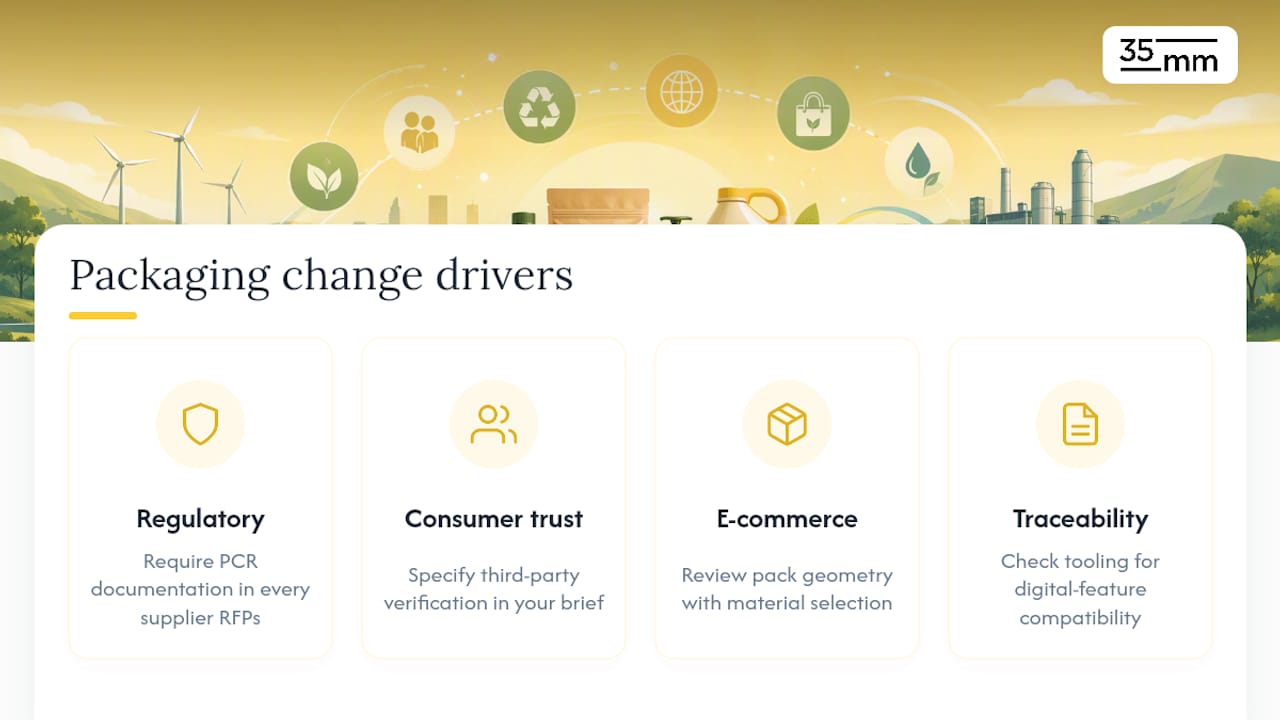
The pressure on packaging teams is coming from four directions at once, and understanding which driver is hitting your category hardest determines where to focus first.
Regulatory tightening is the most immediate force. State-level mandatory recycled-content laws are already reshaping sourcing decisions across California, Oregon, and Washington, and the 2026 Sustainable Packaging Trends Report warns that packaging regulations and EPR-style fees are likely to remain strict or increase. Brands that haven't mapped their PCR content by SKU are already behind.
Consumer skepticism is the second driver, and it's more nuanced than it looks. According to Innova Market Insights, a significant share of global consumers report that current food and beverage sustainability guidelines are unclear. That confusion doesn't make consumers ignore sustainability — it makes them distrust unverified claims. The practical implication: a carbon label without third-party backing can hurt a brand more than no label at all.
E-commerce and dimensional-weight pressure is forcing a rethink of pack geometry and material weight. Reducing void space and SKU complexity yields measurable shipping and inventory savings, and brands using AI for dimensional optimization are finding real cost reductions before a single material change. The L.E.K. Consulting 2026 CPG and Foodservice Brand Owner Packaging Study surveyed 450 U.S. CPG and foodservice brand owners and found that nearly all rated packaging as highly important — a signal that the industry has moved well past treating packaging as a cost center.
Stat to know: nearly all U.S. CPG and foodservice brand owners rate packaging as highly important, and nearly all expect to change packaging in the next three years.
Traceability technology is the fourth driver. GS1 Digital Link integration and early Digital Product Passport requirements are moving from pilot programs into retailer and procurement specifications. Design teams that treat QR codes as an afterthought are already creating rework cycles. The operational fix is straightforward: map each driver to a concrete action. Regulatory tightening means requiring PCR documentation in every supplier RFP. Consumer skepticism means specifying third-party verification in your brief. Dimensional-weight pressure means reviewing pack geometry alongside material selection. Traceability requirements mean checking tooling for digital feature compatibility before artwork is finalized.
1. Substantiated sustainability: what verification actually looks like
Substantiated sustainability is the single biggest design constraint in 2026. The shift is from marketing language to verifiable evidence, and the brands that get this right are building it into their briefs and supplier contracts from day one, not retrofitting claims after artwork is approved.
The credible trust signals that matter to retailers, procurement RFPs, and US state compliance programs are specific. FSC certification is the recognized standard for responsibly sourced paper-based packaging, covering kraft and recycled board. BPI certification applies when compostable films or inks are in scope. PCR content requires documented chain-of-custody from the resin supplier, not just a supplier attestation. Carbon labels need third-party verification to carry weight — a self-declared carbon footprint on pack is increasingly treated as a red flag by sophisticated retail buyers. The U.S. EPA's Sustainable Materials Management guidance frames material selection, lightweighting, and recovery strategies as interconnected decisions, which is a useful frame for briefing cross-functional teams.
Pro Tip: Run a low-cost verification pilot before committing to a full SKU rollout. Request chain-of-custody documents from your top two paper suppliers, send one PCR resin sample to a third-party lab for content verification, and compare the supplier's attestation against the lab result. The gap between claimed and verified PCR content is often where greenwashing risk lives.
The practical checklist for specifying verification in briefs and contracts:
- Require FSC or equivalent chain-of-custody documentation for all paper-based substrates
- Specify minimum PCR content percentage and require third-party lab verification, not self-certification
- Define the carbon label standard (e.g., Carbon Trust, PCF) and require the verification body's name on pack
- Include a clause requiring suppliers to update documentation if their source materials change mid-run
- For compostable claims, require BPI certification and confirm the relevant composting infrastructure exists in your target market
The cost and lead-time tradeoffs are real but manageable. FSC-certified board typically carries a modest premium over uncertified stock, and third-party PCR verification adds two to four weeks to the supplier qualification process. Both are far less expensive than a greenwashing complaint or a retailer delisting. Brands that treat sustainability as a design constraint rather than a marketing claim are finding that verification-first briefs actually reduce late-stage rework.
2. Mono-material simplification and the materials to prioritize
The case for mono-materials is straightforward: mixed-material packaging is increasingly difficult to recycle, and retailer compliance programs are beginning to penalize it. Paperization — replacing multi-layer laminates with paper-based alternatives — is the dominant direction for rigid and folding carton formats. For flexible films, mono-polymer polyethylene (PE) structures are the preferred substitute where collection infrastructure supports them, guided by APR's design-for-recycling standards.
Here's how the four key material families compare across the dimensions that matter most to procurement and design:
| Material | Sustainability | Cost and logistics | Premium feel | Manufacturability | Regulatory readiness | Consumer convenience |
|---|---|---|---|---|---|---|
| Kraft paper | High recyclability; FSC-certifiable; strong end-of-life story | Low-to-mid cost; lightweight reduces dimensional weight | Natural, artisan aesthetic; strong in food and wellness | Runs on standard flexo/offset lines; minimal tooling changes | FSC covers chain-of-custody; aligns with state recycled-content goals | Easy to open; printable; limited moisture barrier |
| Recycled board | High recyclability; PCR content verifiable; widely collected | Competitive cost; broad supplier base in the US | Clean, versatile; accepts premium finishes | Compatible with most existing folding carton lines | PCR documentation required; aligns with retailer compliance programs | Standard carton usability; good for shelf-ready formats |
| Barrier folding board | Recyclability depends on coating type; mono-coat preferred | Mid-to-high cost; heavier than uncoated board | Premium shelf presence; supports high-quality print | Requires compatible coating line; check supplier tooling | Recyclability claims need APR or How2Recycle validation | Protects product integrity; critical for shelf-life-sensitive SKUs |
| Aluminum (refillable) | High recyclability; infinite loop when collected; low lifecycle footprint in reuse models | Higher upfront cost; logistics savings in refill models offset over time | Strong eco-luxury signal; premium tactile quality | Requires dedicated forming and filling lines | No specific recycled-content law applies; strong end-of-life story | Durable; refill-friendly; heavier than paper alternatives |
Stat to know: Reducing void space and SKU complexity through material and geometry changes yields measurable shipping and inventory savings — packaging is now a strategic logistics asset, not just a brand vehicle.
Pro Tip: Before switching a top-selling SKU to a mono-material, run a quick supplier tooling audit. Ask three questions: Does your current line support the new substrate without a die change? What is the minimum order quantity for the new material? Can the supplier provide a sample run for barrier and print quality testing? Those three answers will tell you whether a retrofit is a two-week project or a six-month capital decision.
Barrier folding board deserves a specific note. It remains the right call for products with demanding shelf-life requirements — chilled foods, moisture-sensitive snacks, certain personal care formats. The key specification decision is mono-coat versus laminated barrier. A mono-coated barrier board can often be recycled through standard paper streams; a laminated structure typically cannot. When shelf life allows it, specifying mono-coat and validating recyclability through How2Recycle or APR guidance is the cleaner path.
3. Refillable systems, lightweighting, and the eco-luxury comeback
Refill and lightweight formats are delivering something that used to seem contradictory: a premium brand experience with a lower lifecycle footprint. The mechanism is simple. When the primary container is designed for reuse and the refill unit is concentrated or minimal-material, the per-use environmental cost drops sharply while the consumer's tactile experience with the primary pack stays high.
The practical format options for FMCG brands right now:
- Refill pouches — flexible, lightweight, and compatible with existing filling lines; work well for home care, personal care, and food condiments
- Aluminum refill canisters — premium feel, infinitely recyclable, and increasingly used in prestige personal care and beverage categories
- Concentrated liquid refills — reduce pack volume and weight significantly; require clear consumer communication on dilution ratios
- Reusable primary containers with retail takeback — higher upfront investment but strong brand loyalty signal; works best where the retail footprint supports collection
- Direct-to-consumer refill subscriptions — remove retail logistics complexity and give brands direct data on refill frequency
The logistics benefits are concrete. SKU simplification follows naturally when a single primary container supports multiple refill SKUs. For brands selling through e-commerce channels, the dimensional-weight and void-fill implications of switching to refill formats can reduce per-unit shipping costs meaningfully.
Pro Tip: When piloting a refill format, track three metrics from the first run: material weight saved per unit versus the replaced format, shipping cost per unit at your actual carrier rate, and consumer return rate for the primary container if a takeback program is involved. Those three numbers will tell you whether the format works economically before you commit to a full range rollout.

The eco-luxury angle is worth taking seriously. Aluminum in particular carries strong premium cues — the weight, the tactile finish, the association with prestige categories — while also being one of the most recyclable materials in the US collection system. Brands in personal care and premium food are using aluminum refill canisters not despite the sustainability story but because of it, positioning the refill ritual as part of the brand experience rather than a compromise.
4. Smart and digital-enhanced packaging: from optional to infrastructure
Digital features on packaging have crossed the line from nice-to-have to operational requirement. Innova Market Insights identifies "Digital-Enhanced Design" as a top 2026 packaging trend, with QR codes, AR, and Digital Product Passports moving from early-adopter pilots into standard procurement and retailer specifications. The right frame for your team: digital features are infrastructure. Plan for them in the brief, not after the dieline is approved.
The standard digital building blocks for 2026:
- GS1 Digital Link QR code — replaces the legacy barcode and links to a dynamic URL that can serve regulatory data, sustainability claims, DPP content, and consumer engagement from a single printed element. Specify this in every new brief.
- NFC tags — used for authentication and anti-counterfeiting in premium categories; also supports tap-to-engage consumer experiences without requiring a camera scan.
- AR triggers — printed markers or image-recognition targets that launch augmented reality experiences; most effective for premium launches and seasonal campaigns where engagement justifies the asset investment.
- Digital Product Passport (DPP) compatibility — requires that the pack carries a unique identifier linked to a data record covering material composition, recycled content, carbon footprint, and end-of-life guidance. Early US retailer requirements are emerging; EU requirements are further along and relevant for any brand with export ambitions.
The implementation checklist for product teams adding digital features:
- Confirm data sources: identify which internal systems hold the material, sustainability, and product data the DPP or QR destination will need to display.
- Map IT integration points: the QR destination URL must be dynamic and updateable without reprinting; confirm your content management system can serve this.
- Define label and print requirements: GS1 Digital Link QR codes have minimum size and quiet-zone specifications; confirm these with your printer before artwork is finalized.
- Test scanning reliability across retail environments: test the printed code under store lighting, on curved surfaces, and at the minimum specified size before approving the press proof.
- Address privacy and consent: in the US, if the QR destination collects consumer data, ensure the landing page includes a clear privacy notice and opt-in mechanism aligned with applicable state privacy laws (CCPA and equivalents).
For teams building AR and QR assets into visual workflows, the key discipline is treating the digital asset as part of the packaging specification from day one, not a post-launch addition. That means including AR asset file formats, QR destination URLs, and DPP data fields in the brief template alongside dieline dimensions and finish specifications.
5. Accessibility and inclusive packaging: what actually counts
Accessibility has moved from a compliance checkbox to a mainstream design expectation, and the business case is straightforward: packages that more people can open, read, and use generate fewer returns and reach a broader market. For FMCG brands, the practical accessibility features that matter most in 2026 are:
- Legible contrast — minimum 4.5:1 contrast ratio between text and background on nutrition panels and ingredient lists, per WCAG guidance adapted for print
- Large, simplified nutrition panels — front-of-pack nutrition labeling with clear hierarchy; the FDA's updated nutrition facts panel requirements are the baseline, not the ceiling
- Easy-open features — tear notches, perforations, and resealable closures that work with reduced hand strength; specify test protocols (e.g., force-to-open measurements) in supplier RFPs
- Tactile cues — embossed indicators, raised text, or Braille for low-vision consumers; particularly relevant in personal care and pharmaceutical-adjacent categories
- Single-handed dispensing — pump formats, flip-top closures, and squeeze pouches that don't require two hands to operate; increasingly expected in food service and on-the-go formats
When writing supplier RFPs, include specific questions: What usability testing protocols do you apply to easy-open features? Can you provide force-to-open data for your closure options? Have your designs been tested with low-vision or reduced-dexterity consumer panels? These questions separate suppliers with genuine capability from those with marketing language.
Pro Tip: Run a rapid usability check with a panel of eight to ten consumers that includes at least two participants over 65 and one with reduced hand strength. Test three things: time to open from cold start, ability to reseal without visual confirmation, and legibility of the nutrition panel under standard kitchen lighting. If any participant fails on two of three, the pack needs redesign before launch.
The role of packaging in branded merchandise contexts follows similar accessibility principles — legibility, ease of opening, and tactile quality signal brand care regardless of the channel.
6. Health-forward convenience: portioning, on-the-go, and nutrition-first formats
Health-forward packaging is not a trend in the abstract — it's a specific set of format and label decisions that respond to how consumers are actually shopping and eating. According to Innova Market Insights, a notable share of consumers now identify nutrition labels and health-focused packaging messaging as influential factors in their purchase decisions. For a category where shelf presence is measured in seconds, that's a significant lever.
The format and label tactics that deliver on health-forward positioning:
- Single-serve pouches — portion control built into the format; reduces overconsumption cues and supports premium per-unit pricing
- Portion cups and snap-apart formats — particularly effective in snack and condiment categories; allow consumers to take what they need without resealing
- Resealable single-serve sachets — combine convenience with waste reduction; work well for protein powders, supplements, and on-the-go condiments
- Nutrition-first front-of-pack messaging — lead with the most positive nutritional claim (protein content, calorie count, clean ingredients) in the largest type on the front panel; secondary claims follow
Stat to know: a notable share of consumers report that nutrition labels and health-focused packaging messaging influence their purchase decisions, making label hierarchy a direct revenue lever.
The operational implications of moving to smaller packs deserve attention. Smaller formats mean more packaging material per unit of product, which can work against sustainability goals unless the substrate is optimized. Barrier requirements also change: a single-serve pouch for a moisture-sensitive product needs the same barrier performance as a full-size pack, often in a thinner gauge. Specifying the right mono-layer or mono-coat barrier film from the start avoids costly reformulation later.
7. Design signals in 2026: authenticity, minimalism, and eco-luxury finishes
Premium and sustainable are no longer in tension when the sustainability story is transparently verified. Eco-luxury is a real positioning — and it works because the materials themselves carry the aesthetic. Kraft texture, visible recycled board fiber, and restrained tactile finishes communicate authenticity in a way that high-gloss laminate increasingly cannot.
The visual approaches that convey authenticity by category:
Kraft texture works hardest in food, wellness, and artisan personal care. The natural color variation and surface texture of unbleached kraft signal provenance and minimal processing. When paired with FSC certification on pack, the claim is substantiated rather than decorative.
Visible recycled board fiber is gaining traction in premium household and personal care. The flecked, slightly irregular surface of post-consumer recycled board is being used as a design feature rather than hidden under heavy coating. It's an honest material signal that sophisticated consumers recognize.
Restrained foil and blind embossing can coexist with recyclability when applied correctly. A small foil stamp on an otherwise uncoated kraft carton doesn't compromise recyclability if the foil area is below the threshold specified in How2Recycle or APR guidance. Blind embossing adds tactile premium without any material addition. Both are appropriate for premium food, spirits, and personal care.
Pro Tip: When specifying premium finishes in your art file brief, include a recyclability compatibility note for each finish element. State the substrate, the finish type, the coverage area as a percentage of total pack surface, and the recycling stream it targets. This single addition to your print spec prevents the most common late-stage conflict between the design team's premium intent and the sustainability team's recyclability requirements.
Where to avoid premium finishes: window cartons with plastic film inserts are increasingly problematic for recyclability and should be replaced with no-window designs or die-cut windows in the board itself where product visibility is required. Sustainable merchandise packaging follows the same principle — the finish should reinforce the sustainability claim, not contradict it.
8. How to brief packaging design and visual production teams for 2026
The most common failure point in 2026 packaging projects is a brief that treats sustainability verification, digital features, and accessibility as afterthoughts. The fix is to include all three from day one, alongside the standard dieline and finish specifications. A brief that arrives at a visual studio or supplier without PCR documentation requirements, DPP data fields, or accessibility test protocols will generate rework cycles that cost more than the time saved by skipping them upfront.
A compact brief template for 2026-ready packaging projects:
| Field | What to specify |
|---|---|
| SKU and target lifecycle | Product name, format, expected shelf life, and reuse/refill intent |
| Required certifications | FSC, BPI, PCR content %, How2Recycle or APR recyclability validation |
| DPP data points | Material composition, recycled content %, carbon footprint figure, end-of-life guidance |
| AR/QR assets | GS1 Digital Link URL, AR trigger file format, minimum print size for QR |
| Print proofs | Color proof standard, finish sample, barrier test result |
| Finish tolerances | Foil coverage %, emboss depth, coating type and recyclability compatibility note |
| Accessibility requirements | Contrast ratio, easy-open test protocol, tactile cue specification |
Essential questions to ask suppliers and visual studios before briefing:
- What file formats do you accept for dieline validation, and what is your tolerance for finish bleed?
- Can you confirm finish compatibility with the target recycling stream, and do you have How2Recycle or APR validation for this substrate and finish combination?
- What is your minimum order quantity for the specified PCR content grade, and can you provide chain-of-custody documentation at order?
- What lead time do you require for a barrier folding board sample run, and what print quality test do you apply?
- Do you have experience integrating GS1 Digital Link QR codes into dielines, and can you provide a scanning reliability test report?
Red flags to watch for: a supplier who cannot provide chain-of-custody documents for paper substrates, a PCR claim backed only by a self-signed attestation with no lab verification, and single-supplier dependency for a critical substrate like barrier folding board. The packaging design brief process is where most of these risks surface — and where they're cheapest to resolve.
A studio perspective on what 2026 briefs actually require
The most consistent gap we see in 2026 packaging briefs is the disconnect between the sustainability story a brand wants to tell and the visual assets that need to carry it. A verified PCR claim or a carbon label is only as credible as the way it's rendered on pack — and that rendering decision happens in the visual production workflow, not in the sustainability audit.
Two things have changed in how we approach briefs this year. First, digital assets for QR and AR features now need to be scoped alongside the dieline, not after it. A GS1 Digital Link QR code placed as an afterthought in the artwork often fails scanning reliability tests under retail lighting, which means a reprint. Building the QR specification into the initial brief — size, quiet zone, contrast against the substrate — eliminates that cycle. Second, sustainability verification documents are now part of the visual brief package. When a brand provides FSC chain-of-custody documentation and a verified carbon figure alongside the artwork brief, the studio can render those claims accurately and consistently across 3D mockups, retouched photography, and marketplace-ready imagery. Without that documentation, the visual team is guessing at claim language, which creates legal exposure.
What a studio like 35milimetre can deliver in this context: retouching, dieline mockups, 3D CGI renders, and AR-ready asset packages that reflect verified sustainability claims and digital feature specifications. What falls outside scope: raw material sourcing, physical package manufacturing, and regulatory compliance sign-off. The visual production work is most effective when the brief arrives with the compliance and verification decisions already made.
Packaging visuals that match the claims your brand is making
Brands investing in substantiated sustainability and digital-enhanced packaging need visual assets that reflect those claims accurately — across retail photography, e-commerce listings, 3D renders, and AR experiences. That's the specific gap 35milimetre fills.

The studio delivers retouching, dieline mockups, CGI renders, and AR-ready asset packages built to the specifications in your packaging brief. If your brief includes verified PCR content, a carbon label, and a GS1 Digital Link QR code, the visual output reflects all three accurately — not as decorative elements but as functional, specification-matched assets. The post-production work that supports FMCG packaging launches covers everything from initial concept renders through marketplace-ready imagery, with the flexibility to bring in 3D and AI-generation capabilities when the project demands them.
To request a packaging visual pilot for a 2026 SKU, reach out directly through the 35milimetre website. Bring your brief, your dieline, and your verification documents — the studio works fastest when the compliance decisions are already made.
Sources
The sources below support the claims and guidance throughout this article. Each adds a distinct layer of authority for teams going deeper on specific topics.