

Creative direction is one of the most misunderstood roles in the creative industry. Ask ten marketing managers to define it, and most will describe something closer to art direction, graphic design, or brand management. That confusion costs teams real money and real time. When the strategic layer of a campaign is missing or muddled, visuals may look polished but fail to connect, convert, or communicate anything meaningful. Understanding what creative direction actually is, how it differs from execution-focused roles, and how it shapes the entire arc of a visual project is essential knowledge for anyone leading campaigns, building brands, or managing creative teams in 2026.
Table of Contents
- Defining creative direction: Strategy, vision, and value
- Core responsibilities and roles in creative direction
- Creative direction vs. art direction: Strategy vs. execution
- Modern creative direction: Trends, AI, and hybrid roles
- Creative direction in practice: Impact on visual storytelling
- Why most creative teams get creative direction wrong—and how to fix it
- Elevate your next campaign with expert creative direction
- Frequently asked questions
Key Takeaways
| Point | Details |
|---|---|
| Strategic leadership | Creative direction shapes vision and drives campaigns toward clear business goals. |
| Distinct roles | Creative direction and art direction differ—one leads vision, the other delivers visuals. |
| Modern evolution | AI-powered tools and hybrid teams redefine how creative direction delivers impact. |
| Business benefits | Design-led teams guided by strong creative direction achieve higher revenue and brand growth. |
| Practical application | Effective creative direction means consistent messaging, emotional impact, and measurable results. |
Defining creative direction: Strategy, vision, and value
Creative direction is not about picking fonts or approving color palettes. According to Indeed's career guidance, creative direction is the strategic leadership that defines the overarching vision, narrative, and conceptual framework for creative projects, particularly in visual storytelling for brands, campaigns, and products. That definition matters because it positions creative direction squarely in the realm of strategy, not execution.
Think of it this way: if a campaign were a film, the creative director would be the director, not the cinematographer. The creative director decides what story is being told, why it matters, and what emotional response it should trigger. Everything else, the visuals, the copy, the production choices, flows from that foundation.
"Vision without strategy is just decoration. Creative direction is the bridge between what a brand stands for and what audiences actually feel when they encounter it."
For agencies, startups, and tech companies, this distinction is especially critical. A startup launching a new product needs its campaign to communicate trust, innovation, and relevance simultaneously. Without a clear creative direction, those three messages compete rather than reinforce each other. Strong creative direction ensures that every visual asset, from a hero image to a social media carousel, serves a unified narrative. The work we do at 35milimetre around elevating brand storytelling consistently shows that projects with a defined creative vision outperform those built purely on aesthetic instinct.
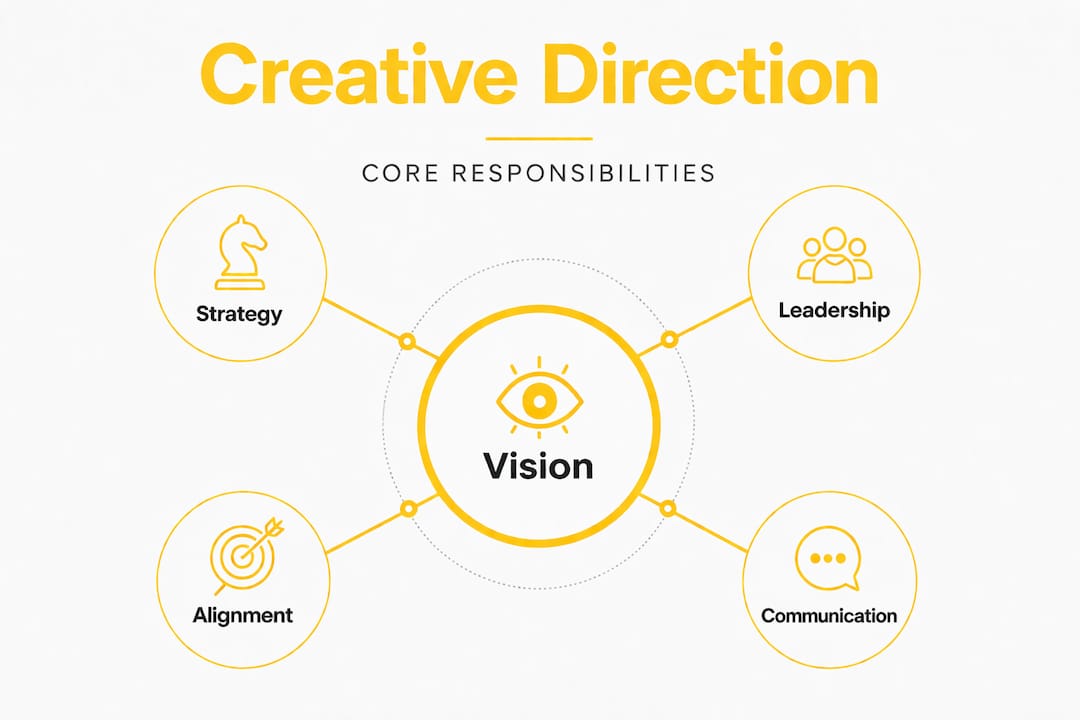
Understanding day-to-day creative direction also reveals how much of the role involves communication, alignment, and decision-making rather than hands-on design work. The creative director is the person in the room who keeps asking "why?" until the answer is solid enough to build a campaign on.
Core responsibilities and roles in creative direction
With a solid grasp of what creative direction is, let's explore its day-to-day responsibilities and tangible value.
Key responsibilities include developing high-level strategies, leading multidisciplinary teams of copywriters, designers, and art directors, providing structured feedback, managing timelines and budgets, presenting to stakeholders, and overseeing projects from ideation all the way through to delivery. That is a wide scope, and it requires a rare combination of creative intuition and operational discipline.
In practical terms, a creative director at an ad agency might start a campaign by facilitating a strategy session to define the target audience's emotional triggers, then translate those insights into a creative brief that guides the entire team. At a tech startup, the same role might involve defining the visual language for a product launch, ensuring that every touchpoint from the app interface to the press kit feels coherent and intentional. The design impact in campaigns is directly tied to how clearly that initial creative direction is set.

The financial data behind creative leadership is compelling. US Creative Directors earn an average salary of $143,782, with top performers reaching $177,000 or more. That investment reflects the measurable commercial value strong creative leadership delivers. Design-led companies grow revenue at twice the rate of their competitors, according to McKinsey research, and high-performing creative teams consistently use data-optimized creative strategies to achieve those results.
| Responsibility | Focus area | Outcome |
|---|---|---|
| Strategy development | Campaign and brand vision | Aligned messaging across channels |
| Team leadership | Designers, copywriters, art directors | Cohesive, high-quality creative output |
| Budget and timeline management | Project operations | On-time, on-budget delivery |
| Stakeholder presentation | Client and executive alignment | Buy-in and approval efficiency |
| Feedback and iteration | Quality control | Stronger final assets |
Pro Tip: When briefing a creative team, document the "why" behind every major creative decision. Teams that understand the reasoning behind a direction make better judgment calls independently, which saves revision cycles and speeds up delivery.
Reviewing innovative creative workflows reveals that the most effective creative directors build repeatable systems, not just one-off campaigns. Those systems are what allow teams to scale quality without losing consistency.
Creative direction vs. art direction: Strategy vs. execution
To understand creative direction's unique value, it is critical to distinguish it from art direction, two roles that are often confused but are fundamentally different.
Creative direction is big-picture strategy, focused on the "why" and "what" of a project. Art direction is visual execution, the "how," covering layouts, color choices, typography, and the specific visual language that brings the strategy to life. Creative directors oversee art directors, not the other way around.
Here is a practical comparison:
| Dimension | Creative direction | Art direction |
|---|---|---|
| Primary focus | Vision, narrative, strategy | Visual execution, design details |
| Key question | Why are we making this? | How should this look? |
| Deliverables | Creative briefs, campaign concepts | Layouts, mood boards, visual assets |
| Team relationship | Leads and aligns the full team | Executes within the defined vision |
| Decision scope | Brand-level, campaign-level | Asset-level, project-level |
The confusion between these roles is understandable. In a large agency, a creative director might never open Photoshop, while an art director lives in it. But in a smaller studio or startup environment, one person often wears both hats. That is not inherently a problem, but it requires conscious mental shifting between strategic thinking and execution thinking. Mixing them up in the same breath, treating a layout decision as a strategic one, is where teams lose clarity.
"The creative director asks what the campaign needs to say. The art director figures out how to say it visually. Both roles are essential, but they operate at different altitudes."
For essential agency design assets to perform at their best, the strategy behind them needs to be locked in before the visual work begins. Jumping straight to execution without that foundation is one of the most common and costly mistakes we see. Strong web storytelling best practices reinforce this point: the narrative architecture has to come before the visual architecture.
Modern creative direction: Trends, AI, and hybrid roles
As creative direction evolves, technology, AI, and flexible team models are reshaping the landscape and opening new possibilities for agencies and studios alike.
The most significant shift right now is the integration of AI into the ideation and production pipeline. In the age of AI, AI accelerates creative tasks, but human judgment still selects the winning ideas. That is a nuance worth sitting with. AI can generate hundreds of visual concepts in minutes. But without a creative director's trained eye and strategic understanding, those concepts are just noise. The human role shifts from production to curation and judgment, which actually raises the bar for strategic thinking rather than lowering it.
In small teams and startups, one person often handles both creative and art direction, and in the tech and AI era, roles are evolving toward data-driven, hybrid models that use AI tools for ideation and production. Some tech firms are moving away from full-time creative directors in favor of flexible agencies that can provide that strategic layer on demand. This shift favors studios and partners who understand both the creative and the commercial dimensions of a project.
Several key trends are defining modern creative direction right now:
- AI-assisted ideation is compressing concept development timelines from weeks to days, but the quality of the prompt and the judgment applied to the output still depend entirely on human expertise.
- Hybrid roles are becoming the norm in startups and mid-size tech companies, where creative directors often double as brand strategists or content leads.
- Data-informed creativity is replacing gut-feel decision-making, with creative directors using performance analytics to refine visual strategies in real time.
- Flexible agency partnerships are allowing brands to access senior creative direction without the overhead of a full-time hire.
At 35milimetre, we have been actively expanding our AI image generation capabilities over the past year, and the lesson is consistent: AI is a powerful tool, but it needs a clear creative direction to produce anything worth using. The creative production trends we are seeing confirm that the studios and teams who thrive are those who use AI to amplify their vision, not replace it.
Pro Tip: Build a team culture that rewards creative risk-taking within defined strategic boundaries. When team members understand the "why" behind a campaign, they make bolder and better creative decisions without needing constant approval.
Creative direction in practice: Impact on visual storytelling
To make this actionable, let's look at how creative direction actually drives visual storytelling and business success, connecting all the strategic elements covered so far.
Strong creative direction ensures brand consistency, emotional resonance, and measurable impact in ads, campaigns, and multi-channel experiences for ad agencies, startups, and tech companies. That is not a soft benefit. It translates directly into campaign performance, customer trust, and revenue.
Consider a tech company launching a new software product. Without creative direction, the marketing team might produce a polished product demo video, a visually striking set of social ads, and a clean landing page, all of which look professional but feel disconnected. Each asset was made by a talented person doing their job well. But without a unifying vision, the audience experiences three different stories instead of one compelling one.
With strong creative direction, those same assets share a visual language, a tonal consistency, and a narrative thread that builds recognition and trust across every touchpoint. The product demo video sets up the problem. The social ads dramatize the solution. The landing page closes the loop with proof and a clear call to action. That is creative direction working as it should.
The revenue impact is real and documented. Design-led companies grow revenue at twice the rate of competitors, a figure that reflects the compounding effect of consistent, strategically directed creative work. For startups especially, where every marketing dollar needs to work harder, that multiplier is significant. A story-driven brand narrative built on solid creative direction gives campaigns the structural integrity to perform across channels and over time.
For ad agencies, creative direction is also a competitive differentiator. Clients do not just want beautiful work. They want work that solves business problems. A creative director who can articulate how a visual strategy connects to a client's revenue goals is far more valuable than one who simply produces stunning imagery. The brand storytelling in practice approach we take at 35milimetre is built on exactly that principle: visuals serve strategy, and strategy serves business outcomes.
Why most creative teams get creative direction wrong—and how to fix it
Here is an uncomfortable truth we have observed across years of working with agencies, startups, and tech brands: most creative teams treat creative direction as a title, not a practice. They hire a creative director, give them a desk, and expect the work to improve. But creative direction is not a person. It is a process, a discipline, and a culture.
The most common mistake is focusing too much on visuals and not enough on vision. Teams spend hours debating color palettes and layout options while the fundamental question of "what are we trying to make people feel, and why?" goes unanswered. That is not a design problem. It is a leadership problem.
True leadership shapes team culture and environment beyond just project vision. AI accelerates creative tasks, but human judgment selects the winners. That means the most important thing a creative director can do right now is not learn every AI tool on the market. It is build a team environment where strategic thinking is valued, where creative risk-taking is rewarded, and where feedback is structured around the vision rather than personal preference.
The future of creative direction points toward more hybrid, more data-informed, and more AI-assisted workflows. But the core of the role remains unchanged: someone has to hold the vision, protect it from dilution, and make the calls that keep a project true to its purpose. That requires judgment, experience, and the kind of leadership that cannot be automated.
For teams looking to strengthen their creative direction practice, the fix starts with process. Build feedback loops that reference the original creative brief. Set clear creative objectives before any visual work begins. And treat the must-have agency assets as outputs of a strategic process, not inputs to one.
Elevate your next campaign with expert creative direction
Understanding creative direction at this level is one thing. Applying it consistently across campaigns, clients, and channels is another challenge entirely, and it is one where the right creative partner makes a measurable difference.

At 35milimetre, we bring over two decades of post-production and visual storytelling expertise to every project we touch. Whether you are an ad agency looking for a reliable creative production partner, a startup building your brand's visual identity from the ground up, or a tech company that needs campaign imagery that actually converts, we work alongside your team to ensure the creative vision is not just defined but executed with precision. Explore what we offer at 35milimetre and see how expert-led creative direction can transform your next campaign from visually polished to strategically powerful.
Frequently asked questions
What makes creative direction essential for marketing teams?
Creative direction ensures brand consistency, emotional resonance, and measurable impact across all channels, giving campaigns a unified vision that individual design decisions alone cannot provide.
How does creative direction differ from art direction?
Creative direction sets the strategy and narrative vision, while art direction executes that vision through specific visual choices like layouts, typography, and color.
What skills are most important for a creative director?
Beyond design sensibility, the most critical skills are strategic thinking, team leadership, and communication, because key responsibilities center on aligning teams and stakeholders around a shared creative vision rather than producing assets directly.
How is AI changing the role of creative direction?
AI accelerates creative tasks like ideation and production, but creative directors remain essential for applying strategic judgment, selecting winning concepts, and maintaining brand coherence across outputs.
Can creative direction be handled by one person in a startup?
Yes, and it often is. In small teams and startups, one person frequently manages both creative and art direction, though the key is staying conscious of when you are thinking strategically versus executing visually.