
Automotive CGI cost typically ranges from a basic catalog still at the lower end of the price spectrum to several thousands for a photoreal advertising animation. The single biggest factor is how much asset and scene work the project requires: a supplied CAD model with a simple studio backdrop sits at the low end, while bespoke modeling, custom shaders, and a full CGI environment push you toward the top. Before you request quotes, decide your deliverables, resolution, and whether you can supply existing 3D models.
TL;DR:
- Using supplied CAD models or stock assets can significantly reduce costs, especially for simple catalog images, which often cost under $800 per image.
- More complex advertising visuals with custom shaders, environments, and layered compositing can reach or exceed $7,000 per image, depending on requirements.
- Animation and configurator projects scale with realism and shot length, with prices starting around $3,000 and potentially exceeding $20,000 for lengthy, highly detailed sequences.
- Clear scope definitions in briefs, including deliverables, model readiness, and usage rights, are crucial to avoid budget overruns caused by scope creep or ambiguous specifications.
- Reusing a master asset across multiple angles or outputs reduces costs, and detailed planning upfront can prevent costly reworks after the project begins.
Table of Contents
- Pricing at a Glance: What Automotive CGI Actually Costs
- What Drives Price: The Technical and Creative Cost Levers
- Cost Breakdown by Deliverable: Stills, Animation, and Configurators
- How to Brief and Budget: What Belongs in Your RFP
- Timelines: How Deadlines Shape Automotive CGI Pricing
- Where to Save Money Without Losing Visual Impact
- How 35milimetre Budgets Automotive CGI Projects
- Why Most CGI Budgets Go Wrong Before the First Render
- Get a Quote From 35milimetre for Your Automotive CGI Project
- Sources
- FAQ
Pricing at a Glance: What Automotive CGI Actually Costs
Quotes for automotive CGI vary by an order of magnitude depending on what you're actually asking for, so a single "average price" is close to meaningless. What matters is which band your project falls into and why.
Basic and catalog-style CGI, the kind used for e-commerce or spec-sheet imagery, generally costs a few hundred dollars per image. Marketing-grade stills with more attention to lighting and composition run higher, and photoreal advertising stills, the kind you'd see in a hero banner or a print campaign, often reach $2,500 to $7,000 or more per image according to industry pricing benchmarks. Animation increases costs significantly due to additional render time and compositing work required per second of footage.
| Tier | Typical range | What's usually included |
|---|---|---|
| Basic / catalog still | $150–$800 | Stock or supplied model, plain studio backdrop, single angle, minimal retouching |
| Marketing still | $800–$2,500 | Custom lighting setup, HDRI environment, moderate revision rounds |
| Photoreal advertising still | $2,500–$7,000+ | Bespoke or heavily reworked model, full material/shader pass, layered compositing, extended usage rights |
| Short animation / configurator base | $3,000–$20,000+ | Rigged camera moves, multiple render passes, sound-safe motion, optimization for delivery format |
Two examples make the bands concrete. A CPG accessory brand needing three studio angles of a supplied vehicle model for an e-commerce listing typically sits in the basic tier, since the model already exists and the environment is a flat backdrop. An automotive OEM launching a new trim with a 15-second hero animation for a paid social campaign is a different animal entirely, closer to the top of the animation band, because it needs custom lighting, camera choreography, and multiple rounds of client review before it airs.
What separates these bands isn't really the software or the studio's hourly rate. It's how much of the car has to be built, dressed, and lit from scratch versus how much already exists and just needs to be rendered.
What Drives Price: The Technical and Creative Cost Levers
The starting point for almost every quote is model status. If you can supply CAD data or a clean, presentation-ready 3D model, you skip the most labor-intensive part of the job. If you're buying a stock model, you're paying a license fee instead of artist hours. If the car needs to be modeled from scratch or a rough CAD file needs topology repair, you're paying for days of dedicated work before a single frame renders, since engineering CAD is rarely presentation-ready out of the box.
Beyond the model itself, several levers move price up or down:
- Scene complexity and lighting: A simple HDRI environment is far cheaper than a fully modeled CGI set with custom props, floors, and background geometry.
- Materials and shaders: Multi-layer automotive paint, glass with correct refraction, brushed metal, and realistic tire tread all require dedicated shader work that eats hours.
- Render settings and passes: Higher resolution, multiple render passes (beauty, specular, reflection, ambient occlusion), and EXR output for post-production flexibility all add render-farm time and cost.
- Post-production and revisions: Compositing, color grading, and retouching happen after the render, and every extra revision round outside the agreed scope adds billable time.
- Rights and licensing: Broader usage, more media, longer duration, wider geography, all typically carry a premium over single-use, limited-run imagery.
Hourly rates back this up directly. Freelance CGI artists commonly bill $25 to $75 an hour, small and mid-size studios land around $80 to $150, and high-end studios doing advertising-grade work often charge $150 to $200 or more. A photoreal still that looks deceptively simple can represent 15 to 30 hours of combined modeling, lighting, and compositing work, which is exactly why the price tag surprises marketers who expect a flat per-image rate.
Pro Tip: Ask every studio you quote to break their number into modeling, lighting/rendering, and post-production line items. If a bid is unusually low, it's often because one of those three phases has been quietly compressed, and that's where reshoots and rework requests come from later.
Where clients most often get caught off guard is scope creep after the brief is locked. A request to "just add one more angle" or "make the paint pop a bit more in post" sounds small, but it can trigger a full re-render and a new compositing pass if it wasn't planned for.
Cost Breakdown by Deliverable: Stills, Animation, and Configurators
Different output types carry fundamentally different cost structures, and understanding which one you actually need keeps you from over-buying or under-scoping.
- Catalog and basic stills ($150–$800): Built from a supplied or stock model, shot on a plain backdrop, minimal lighting design. This is the right tier for e-commerce listings, spec sheets, and internal reference imagery where photorealism matters less than accuracy.
- Marketing hero stills ($800–$2,500): Custom lighting, an HDRI or lightly built environment, and enough post-production polish to hold up in a social ad or landing page.
- Photoreal advertising stills ($2,500–$7,000+): Full material and shader work, a bespoke or fully dressed environment, and layered compositing that supports print-scale output. This is the tier for hero campaign imagery and print placements.
- Animation, turntables, and short films ($3,000–$20,000+): A basic 360-degree turntable sits at the lower end; a 10 to 15 second cinematic driving sequence with camera choreography and environmental effects sits much higher, since animation cost scales directly with realism and shot count.
- Configurators and AR experiences (variable, often $5,000+ base): Cost here is driven less by polygon count and more by optimization work, since real-time engines require LOD creation and interactivity testing that a static render never needs.
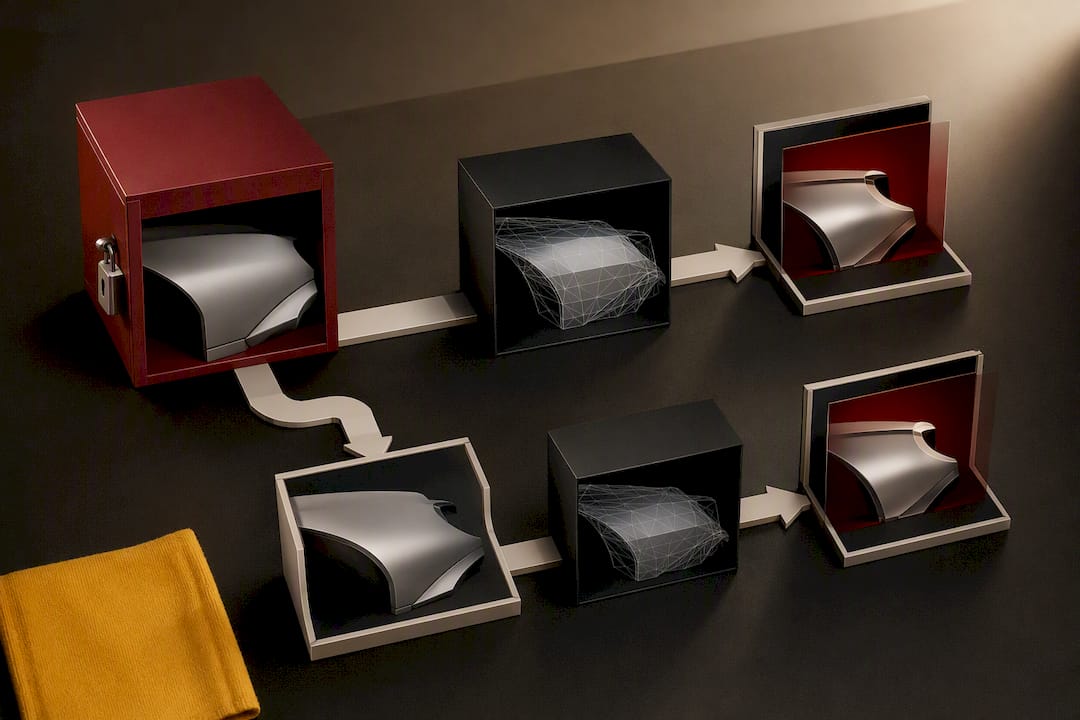
Multi-angle packages are where budgeting logic gets interesting. Lighting and shader setup is the expensive upfront cost; once that's built, additional camera angles of the same scene are considerably cheaper to produce, which is why most studios offer volume pricing on angle packages rather than charging per-image from scratch. A realistic line-item estimate for a 3-angle hero shoot using a supplied model might land around $1,200 to $2,500 total: roughly $700 to $1,200 for the first angle's lighting and shader setup, then $250 to $650 for each additional angle. One master asset built well can also power stills, a short animation, and a configurator without re-modeling the car each time, which is a meaningful efficiency if you know you'll need multiple deliverables from the same vehicle.
How to Brief and Budget: What Belongs in Your RFP
The single biggest reason quotes vary wildly for what seems like "the same job" is a vague brief. Studios quote against ambiguity by padding for risk, so tightening your brief tightens your price range.
A strong RFP should specify:
- Deliverables and formats: exact file types (layered PSD, EXR, PNG with alpha), resolution (social crop vs. 4K print), and how many finished assets you need.
- Model readiness: state explicitly whether you're supplying CAD, a licensed stock model, or expecting the studio to model from scratch, since this single detail can swing a quote by thousands.
- Camera count and animation length: the number of angles for stills, or exact frame count and seconds for animation.
- Revision rounds and sign-off points: how many rounds are included, and who has final approval authority.
- Usage and licensing scope: where the imagery will run, for how long, and in which markets, since broader rights cost more.
- A priced change log: ask upfront what triggers an additional fee, so a small tweak mid-project doesn't become a surprise invoice.
Pro Tip: Send your reference images and intended final placement (a billboard versus an Instagram carousel) with your first inquiry. Studios price differently based on where the image will actually live, and skipping this step is a common reason first quotes come back higher than expected.
Committing to resolution and format decisions early matters more than it sounds. Changing deliverable specs after a render is complete usually means re-rendering and recompositing from an earlier stage, not a quick export tweak, and that rework shows up on the final invoice.
Timelines: How Deadlines Shape Automotive CGI Pricing
Lead times vary sharply by deliverable. A basic still with a supplied model can often turn around in a few business days. A photoreal advertising still typically needs one to two weeks to allow for lighting iteration and client review. Animation and configurator work commonly runs two to six weeks, since render and revision cycles compound with every additional second of footage.
- Stills: 3 to 10 business days depending on model readiness and revision rounds.
- Short animation: 2 to 4 weeks, driven mostly by render farm time and iteration cycles.
- Configurators/AR builds: 4 to 6+ weeks, since optimization and interactivity testing happen after the visual work is approved.
- Rush fees: commonly 20% to 50% above standard pricing when a deadline compresses the normal render and review cycle.
Structuring the project into clear milestones, model approval, lighting approval, then final render, reduces the rework that eats both time and budget. Approving each stage before moving forward is cheaper than discovering a lighting issue after the final render is already composited.
Where to Save Money Without Losing Visual Impact
Buying a stock 3D model instead of commissioning bespoke modeling is often the single biggest lever available, since it can save thousands of dollars while still supporting a photoreal result if the studio dresses it well.
- Reuse one lit scene across multiple camera angles instead of building a new environment for each shot.
- Use a photographic backplate or an HDRI environment instead of a fully modeled CGI set when the background doesn't need to be a hero element.
- Limit revision rounds to what you actually need rather than leaving them open-ended, which keeps both timeline and cost predictable.
- Bring clear reference images and confirm model licensing rights before work starts, since unclear references and rights are the most common source of expensive rework.
Pro Tip: If budget is tight, spend it on lighting and materials rather than camera count. One beautifully lit angle outperforms three flat ones, and it costs less than you'd think to add angles once the lighting is dialed in.
How 35milimetre Budgets Automotive CGI Projects
The studio has spent over two decades in image manipulation, compositing, and 3D visualization, led by an experienced team and supplemented with additional talent when required. That structure keeps senior eyes on every stage rather than routing a project through a large, layered production chain.
When 35milimetre scopes an automotive job, the quote typically breaks into the same phases marketers should ask any studio for: model preparation, lighting and material work, render passes, and post-production compositing. Quality control and revision effort concentrate on materials and lighting, since that's where photoreal automotive work either convinces or falls flat.
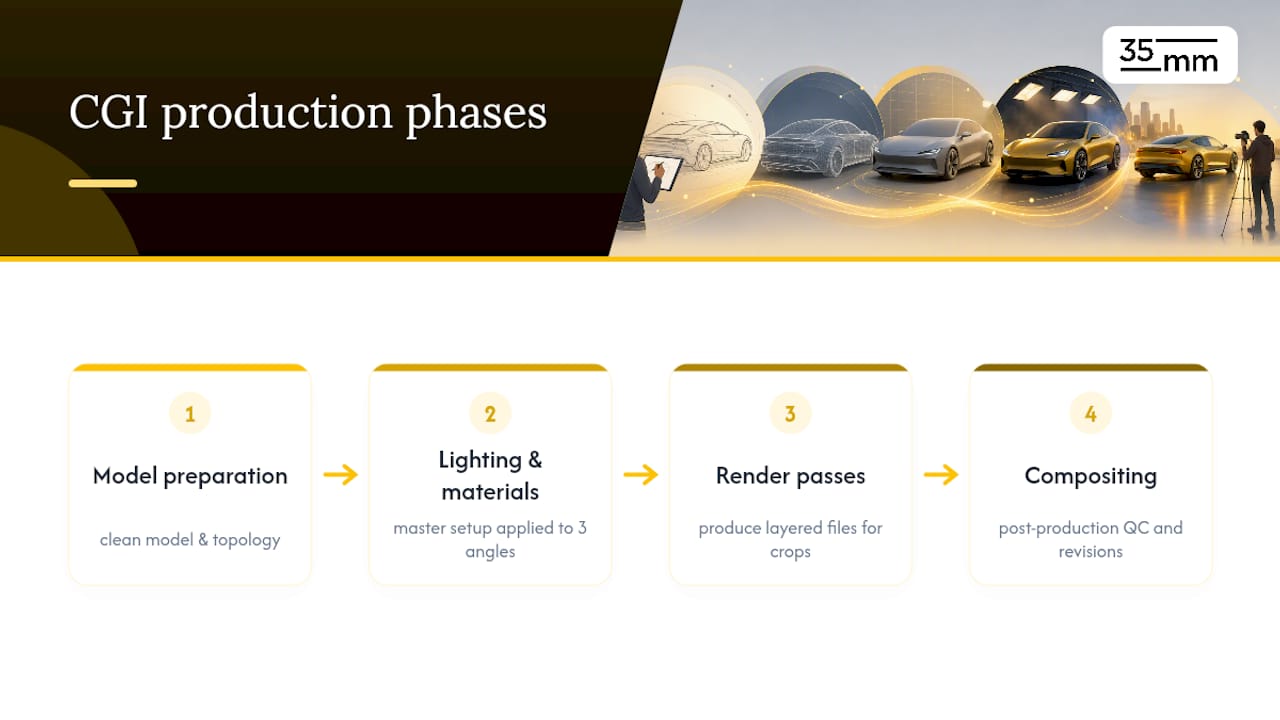
A representative example: a brand needing three hero angles of a supplied vehicle model, delivered as layered files for both print and social crops, is scoped as one lighting and shader setup applied across three angles rather than three separate builds, which keeps the per-angle cost down after the first is finished. For readers who want the mechanics behind this, 35milimetre's posts on render cost brackets and reusing one master asset across stills, film, and configurators go deeper into process than a single article can.
Why Most CGI Budgets Go Wrong Before the First Render
Most automotive CGI budgets fail for a boring reason: the brief was vague, not because the studio overcharged.
The conventional advice, "get three quotes and compare," undersells the actual problem. Three quotes against three different interpretations of the same vague brief just produce three unrelated numbers. The fix isn't more quotes, it's a tighter brief: lock model status, resolution, camera count, and usage rights before you ask anyone to price anything.
If there's one place to spend the extra hour before you email a studio, it's writing down exactly what "done" looks like. Studios don't inflate quotes out of habit; they price in the risk of an undefined scope, and that risk premium disappears the moment your brief removes the ambiguity. Prioritize clarity over speed at the briefing stage, and the pricing conversation that follows gets dramatically simpler.
— 35mm
Get a Quote From 35milimetre for Your Automotive CGI Project
Skipping the guessing game on automotive CGI cost starts with sending a brief a studio can actually price accurately, and that's exactly what 35milimetre is built to work from. Rather than a generic agency retainer, the studio prices per deliverable, using systems that blend AI-assisted imagery with hands-on modeling and compositing.
For automotive CGI specifically, the relevant services are 3D Modeling, 3D Render, and photo compositing for finishing and retouching once the render is complete. Published starting points include 3D Modeling from $175 one-off and 3D Render at $80 to $175 one-off, both listed on the pricing page. When you reach out, send your reference images, any existing model files or CAD data, your intended camera angles, and where the final imagery will run, since usage scope changes the quote. A short discovery call from there covers deliverable formats, revision rounds, and a realistic timeline before any work begins. Request a quote to see where your project lands.
Sources
For broader pricing context beyond this article, see the CGI Artist Pricing Guide for hourly rate benchmarks and RENDERCAD's automotive customization overview for configurator-specific cost factors. For process detail, 35milimetre's posts on CGI workflows and choosing CGI versus photography expand on decisions covered here. Marketers weighing budget allocation for visuals generally may also find research on visual content's impact on engagement useful context.
FAQ
How Much Does CGI Cost for a Car?
Automotive CGI typically ranges from $150 to $800 for a basic catalog still, $800 to $2,500 for a marketing-grade still, and $2,500 to $7,000 or more for a photoreal advertising still. Animation and configurator work generally starts around $3,000 and can climb past $20,000 depending on length and realism.
What Is the $3,000 Rule for Cars?
This isn't a recognized industry pricing standard for automotive CGI. It's more commonly referenced in car-buying and depreciation contexts than in visual production, so treat any "$3,000 rule" claim in this space with caution rather than as an established benchmark.
How Much Does a Car Salesman Make Off a $20,000 Car?
This question relates to auto sales commissions, not CGI production, and isn't something this article's research covers. Dealership commission structures vary widely by state and dealership, so it's outside the scope of a CGI budgeting guide.
What Is a "Poor Man's Supercar"?
This is an automotive enthusiast term for a car that delivers supercar-level performance or looks at a fraction of the price, not a CGI or production term. It has no bearing on rendering or CGI pricing.
Does 35milimetre Offer 3D Rendering for Automotive Projects?
Yes. 35milimetre offers 3D Modeling starting at $175 one-off and 3D Render priced at $80 to $175 one-off, alongside compositing and retouching to finish the final image. Current pricing for related services is listed on the studio's site.