
When an image model updates, the details worth capturing are the model name, exact version or checkpoint, and its license and indemnity terms, plus a provenance record for every generated file. Commercial teams should pause public deployment of new outputs until those three things are confirmed. The A Checklist for When a New Model Drops walks through the sequence to run before anything ships.
TL;DR:
- Confirm the model name, version, license tier, and provenance record before deploying new outputs to ensure legal and technical readiness.
- Verify that new features like object consistency and text rendering meet brand fidelity and production needs at scale.
- Restrict assets to internal testing without enterprise indemnity for high-risk, brand-sensitive use cases such as packaging or hero images.
- Maintain detailed provenance logs including prompts, seed, model version, and human edits to defend legal rights and AI-generated asset authenticity.
- Run rapid, controlled tests on new models using actual briefs and secure client approval with proof of provenance before full deployment.
Table of Contents
- What Does an AI Model Release Actually Change?
- How Do License and Indemnity Terms Change After a Release?
- What Training Data Signals Should You Watch in Release Notes?
- Building a Provenance Record Your Legal Team Can Actually Use
- A Checklist for When a New Model Drops
- How 35milimetre Evaluates New Image Models
- Ready to Bring a New Model Into Your Production Pipeline?
- Sources
What Does an AI Model Release Actually Change?
A release note rarely tells you everything that matters. The headline is usually the model name, but the details that affect your production timeline sit a layer deeper: exact version or checkpoint, release date, and availability status, whether it is in preview, gated API access, or an open-weight download anyone can run locally.
Technical shifts inside a release change what you can actually deliver. A new sampling method or solver alters how fine detail resolves. An upgraded upsampler changes how much retouching a hero image still needs. Better inpainting means fewer manual fixes on product edges. Object consistency and in-image text rendering are the two changes worth watching most closely. When a model finally renders legible packaging text or keeps a sneaker's logo consistent across ten variations, that is hours of post-production disappearing from your schedule.
Product-level signals matter just as much as visual ones. Pricing per image, batch throughput, and latency determine whether a model fits a 500-asset social campaign or only a handful of concept boards. Microsoft's release of MAI-Image-2.5-Pro into public preview is a useful example: the announcement leaned heavily on production-oriented editing precision and tiered pricing built for volume, not just fidelity, which tells you the vendor expects agencies to use it at scale.
How Do License and Indemnity Terms Change After a Release?
The output looking right is not the same as the output being safe to run. Most vendors structure rights in tiers: free, consumer-paid, and enterprise, and each tier can carry a different indemnity posture. A revenue threshold in the terms can even change your rights to assets you already generated, so a campaign that scales past a certain size might quietly shift what you are legally allowed to do with images made under an earlier plan.
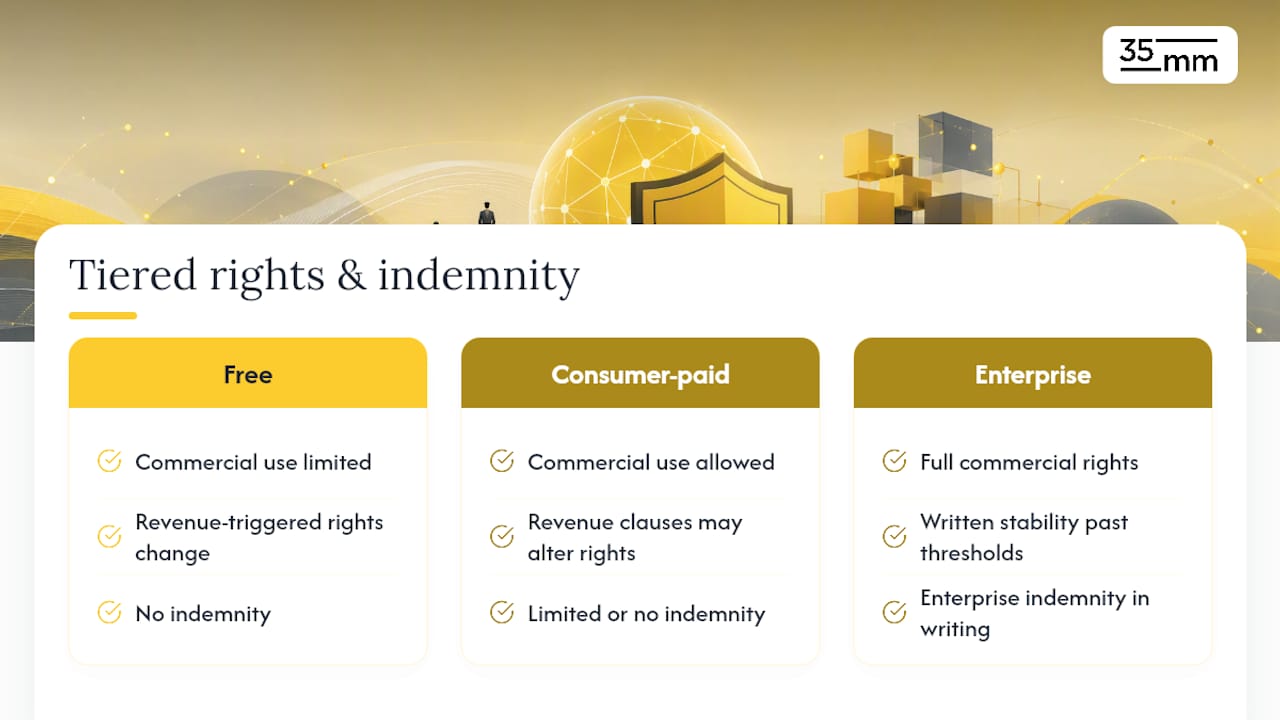
Indemnity coverage varies just as widely. Some platforms extend enterprise indemnity that covers you if a generated image triggers a copyright claim. Others, especially open-weight models, offer none at all. The Terms lays out exactly how these tiers and revenue-gating clauses work in practice, and it is worth reading before you brief a campaign built on a new model version.
Legal precedent adds another layer. Rulings on human authorship affect whether a purely AI-generated image can be copyrighted at all, which matters if you need exclusive rights to defend a campaign asset. Litigation like the Getty Images case against Stability AI has already pushed some vendors toward licensed, indemnified offerings, while open-weight alternatives remain cheaper but legally exposed.
Decision rule: if an asset is destined for paid media, packaging, or a hero product shot, restrict it to internal testing until you have enterprise indemnity in writing. If it is a quick social variation with no packaging or SKU accuracy at stake, the risk tolerance can be lower. Our AI image copyright guide breaks this down further for photographers and designers weighing the same call.
What Training Data Signals Should You Watch in Release Notes?
Release notes that name their training sources are rare, and that rarity is itself useful information. A model page that discloses licensed datasets, partnership agreements, or opt-in contributor pools gives you something to point to if a client's legal team asks where the pixels came from. A model page that says nothing gives you nothing to defend.
Treat non-disclosure as a risk signal, not an oversight to ignore. Analysts covering output licensing across generators recommend exactly this: when a vendor stays silent on training data, assume higher exposure and act accordingly. Watch, too, for mentions of third-party libraries bundled into a release, pending takedown notices, or active litigation tied to the model family. Any of those should slow you down.
A rough three-tier system works well in practice. Low risk covers internal concepting, mood boards, and pitch decks that never reach the public. Medium risk covers social and lifestyle content where a brand is comfortable with some ambiguity. High risk covers packaging, packshots, and anything tied to a specific SKU or trademark, the category where enterprise-grade models with explicit indemnities become the only sensible choice. When a release sits in that high-risk band and the client's exposure is real money, loop in legal counsel before the asset goes anywhere near a deck.
Building a Provenance Record Your Legal Team Can Actually Use
A provenance record is the single habit that separates a defensible campaign asset from a liability. An ArXiv paper on provenance best practices recommends logging a structured file for every generated image, and the fields are straightforward enough to automate at generation time:
- Model name, version, and checkpoint used
- The exact prompt text submitted
- Seed value, when the platform exposes one
- Account ID that generated the asset
- Generation date and license tier active at that moment
- A record of any human edits applied afterward
Capture this at the point of generation, not after the fact. Once the metadata is gone, reconstructing it from memory is close to impossible, and that gap is exactly where a legal dispute gets uncomfortable. The handoff matters too: generation logs the file, review confirms it matches brief and license requirements, client sign-off references the same record, and archiving stores it permanently alongside the final asset. Assign one owner per stage so nothing falls through.
A folder convention as simple as campaign_model_version_date_seed keeps files traceable without extra software. For anything requiring exclusive rights, pair that machine metadata with proof of human authorship, selection decisions, substantial retouching, or layered PSD work, since current copyright reasoning leans heavily on demonstrable human contribution.

Pro Tip: Keep a short screen recording or a before/after PSD layer stack showing exactly which edits a human made after generation. It is the fastest way to prove authorship if a client or legal team ever asks.
A Checklist for When a New Model Drops
Most agencies waste days deciding whether a release matters. Running this sequence in order compresses that into an afternoon.
- Triage. Ask whether the release touches an active brief or simply offers a production efficiency worth testing later. Run a small A/B batch against an existing brief before committing wider budget.
- Test. Generate a controlled set of images against your actual spec, not a generic prompt, and log full provenance for every file, model, version, prompt, seed, account, and date.
- Check fidelity against the brief. Compare object consistency, in-image text accuracy, and color match to brand guidelines. A model that nails typography but drifts on product color is not ready for packaging.
- Confirm licensing. Verify the license tier, indemnity coverage, and any revenue-gating clause tied to the account generating the assets. Escalate to legal if the outputs are headed for packaging, packshots, or hero campaign imagery.
- Client sign-off. Present a short approval package that includes provenance proof and the human-edit log alongside the creative. Do not skip this step for internal-only assets that might later get repurposed publicly.
- Deploy and archive. Finalize the decision, ship the asset, and store its provenance record permanently with the final file, not in a separate system that might get lost.
This sequence works for a single hero image or a five-hundred-asset social batch. The only thing that changes is how much you automate steps two and six.
How 35milimetre Evaluates New Image Models
We treat every model release the same way: as a tool to test before it becomes a habit. Rapid pre-production concepting is where new releases earn their keep fastest, generating a dozen visual directions for a pitch in the time it used to take to storyboard one. Social creative volume is the next natural fit, and account after account confirms clients accept AI-generated lifestyle assets when nobody is inspecting stitch lines or logo placement. A commercial photographer writing for PetaPixel made this same case: AI earns its place in concepting and lower-scrutiny lifestyle work, while product accuracy for hero shots still calls for CGI or photography.
We still lean on photography and CGI whenever product fidelity or brand integrity is non-negotiable, packaging, packshots, automotive detail work. Every AI-assisted deliverable we hand off carries a provenance record, so clients know exactly what generated it and what a human changed afterward.
— 35mm
Ready to Bring a New Model Into Your Production Pipeline?
Testing a new release without a provenance system in place is how agencies end up with images they cannot legally defend six months later. 35milimetre works alongside ad agencies, brands, and photographers to evaluate which model releases actually fit a brief, capture the provenance record that protects the asset, and finish the retouching that gets it campaign ready.
A typical engagement starts with a scoped call about your upcoming campaign, moves into concepting or AI-assisted retouching against your brief, and wraps with final assets delivered alongside their full provenance files, usually within a timeline set at the outset rather than billed hourly. Our guide to how AI is changing image editing covers more of what that process looks like day to day. If a new release has your team wondering whether it belongs in the next campaign, request a scope estimate from 35milimetre and get a straight answer before you brief the work.
Sources
The claims above draw on legal analysis, vendor documentation, and studio-tested provenance practice. Worth bookmarking: