
Hire a human-led studio for AI-assisted ad imagery when a campaign demands consistency, control, and imagery you can legally defend, not when you need bulk creative churned out from a prompt box. This route suits agencies, brands, and photographers commissioning campaign-level assets, not solo operators looking for a fast DIY batch. The tradeoff for that quality is a workflow with locked identity references, documented human authorship, and disclosure practices already built in.
TL;DR:
- AI-assisted ad imagery from a studio is suited for impossible scenes, future product visuals, and rapid variant exploration, not for authentic human performance.
- Studios ensure consistency through identity locking, seed-based reproduction, manual retouching, and bias QA, with human oversight remaining crucial.
- Contracts must specify human creative input, AI disclosure, provenance metadata, and talent clearance, especially when using synthetic or real likenesses.
- Deliverables should include high-resolution masters, layered exports, provenance logs, seed notes, and channel-specific formats, with a documented, repeatable process.
- Evaluation criteria for tools involve subject consistency, resolution quality, reproducibility, and smooth integration with compositing to maintain production control.
Table of Contents
- What Is AI Image Generation for Ads, and When Should You Use a Studio for It?
- What Are the Benefits and Limits of AI-Generated Ad Imagery?
- What Legal and Contract Terms Should You Require?
- What Deliverables Should a Production-Grade Studio Provide?
- How Do You Brief and Vet a Studio Before Signing?
- Which AI Image Generation Tools Fit an Advertising Studio's Workflow?
- How Do AI Images Work with Copy, Video, and Interactive Ad Formats?
- How Should You Test and Optimize AI-Generated Ad Imagery?
- How 35milimetre Runs Studio-Led AI Campaigns
- Ready to Commission Studio-Delivered AI Ad Imagery?
- Where to Verify the Standards Cited in This Guide
- Sources
- FAQ
What Is AI Image Generation for Ads, and When Should You Use a Studio for It?
Studio-delivered AI image generation for ads means a trained creative team uses AI models as one tool inside a bespoke production pipeline, not as the whole pipeline. A photographer or retoucher steers the output, locks visual identity across variants, and finishes every frame by hand. That's a different animal from prompt-to-image apps built for marketers to self-serve at volume.
The decision comes down to what your brief actually needs.
- Impossible environments. A car suspended midair over a canyon, a product shot inside a storm cloud. R/GA's work with Google's Veo model showed AI can pull off scenes no physical shoot could stage, though the team still had to steer continuity by hand.
- Speculative or future-facing concepts. Product visualization for launches months out, before tooling exists.
- Rapid multi-variant exploration. Generating packshot variants or DCO creative sets for A/B testing at a pace no shoot day allows.
- Authentic human performance. A real actor's expression, tightly choreographed physical product interaction, or anything where audience trust depends on knowing it's real. Traditional production still wins here.
If your brief lives in the first three categories, studio-AI is worth a scope call. If it lives in the fourth, book a shoot.
What Are the Benefits and Limits of AI-Generated Ad Imagery?
The upside is real: faster iteration cycles, the ability to generate dozens of packshot or scene variants from a single locked reference, and cost efficiencies on assets that would otherwise require multiple shoot days. Agencies adopting AI into creative operations report meaningful productivity gains and stronger returns when the tool is layered into an existing workflow rather than used to replace it.
The limits are just as real. Raw model output still struggles with character continuity across frames, produces occasional artifacts (extra fingers, warped text, inconsistent lighting), and behaves unpredictably at the edges, especially with skin tones, hands, and reflective surfaces. That unpredictability is exactly why the finishing layer matters more than the generation layer.
A studio mitigates this through several concrete controls:
- Identity locking or brand-aware conditioning to keep a product's exact geometry and a model's face consistent across every variant.
- Seed-based generation so a specific look can be reproduced or refined later without starting over.
- Layered compositing and manual retouch to eliminate artifacts before delivery.
- Demographic and bias QA on any output involving people, checked against brand guidelines before approval.
Creative leaders increasingly frame this correctly: AI works as a creative accelerant under human oversight, not a replacement for the eye that catches what the model got wrong.
Pro Tip: Ask any studio candidate to show you a single campaign's "identity lock" reference sheet. If they can't produce one, they're not running a repeatable process. They're generating one-offs and hoping for consistency.
What Legal and Contract Terms Should You Require?
Copyright protection for AI-assisted imagery isn't automatic, and that single fact should shape every contract you sign. The U.S. Copyright Office has concluded that generative-AI outputs qualify for copyright only where a human has made sufficiently creative choices in arranging, selecting, or modifying the result. That means your studio needs to document its human contribution at every stage, from creative direction through final retouch, and disclose AI involvement during any registration.
If a campaign uses a real likeness, celebrity double, or synthetic performer, talent clearance gets more complicated than a standard model release. SAG-AFTRA's Commercials Contract now recognizes Digital Replica and Synthetic Performer categories, and infrastructure providers like XR have built systems to classify and pay AI performers under those rules. Many early disputes over AI-generated ads have actually turned on whether existing model releases already cover the AI use case, which is exactly why release language needs a fresh read before, not after, a campaign runs.
Disclosure has its own set of expectations. The FTC enforces deceptive-practices rules on a case-by-case basis. It can treat an undisclosed synthetic persona or AI testimonial as deceptive even without a blanket federal labeling mandate. Build these into every contract:
- AI usage logs tied to each deliverable
- Training-data warranties from the studio
- Explicit assignment of finished deliverables and working files
- Indemnity and limitation-of-liability clauses covering AI-specific risk
Clients are already pushing for this. Agencies report a rise in requests for contractual AI transparency clauses in creator and vendor agreements, and that trend is not slowing down. For a deeper walkthrough of what to put in writing, see 35milimetre's guide to AI image copyright and contract language.
What Deliverables Should a Production-Grade Studio Provide?
A studio worth hiring runs a documented pipeline, not an improvised one. The stages look roughly like this:
- Brief and reference collection. Creative intent, brand guidelines, and any existing photography or CGI assets that anchor the look.
- Concept and reference pass. Mood boards or rough composites that establish direction before any AI generation starts.
- Identity lock. The product, model, or scene "DNA" gets fixed using conditioning and seeded generation so every later variant matches lighting, grade, and character.
- AI generation passes. Multiple variants produced against the locked reference.
- Compositing and retouch. Manual finishing to remove artifacts, blend layers, and correct anything the model got wrong.
- Color grading. Consistency across the full asset set, calibrated to the destination channel.
- QA and delivery. Final review against brand and legal requirements before handoff.
Your deliverables checklist should specify:
- High-resolution masters in TIFF or DPX for print and out-of-home
- Layered PSD or PNG exports for future edits
- Compressed web and social masters sized per platform
- C2PA provenance metadata and AI usage logs attached to each file
- Seed and recipe notes so any variant can be reproduced later
- A consistent file-naming and versioning convention across every channel export
Print, social, and paid placements each carry different color and resolution demands, and a studio that treats them identically is cutting corners. For a fuller breakdown of channel specs, 35milimetre's guide to preparing campaign images covers the format-by-format detail.
How Do You Brief and Vet a Studio Before Signing?
The gap between a studio that delivers and one that improvises shows up fast once you ask the right questions. Before signing anything, request evidence of reproducible consistency across a past campaign, ask for documentation of human authorship on sample deliverables, and get references from clients in a comparable sector, not just a generic portfolio.
Your brief itself should specify:
- The creative intent and mood, not just a list of assets
- Exact deliverables and file formats needed per channel
- Disclosure requirements for the campaign's markets
- Approval gates and what counts as acceptance at each stage
Watch for red flags before you commit. A studio that can't show provenance metadata, hesitates to sign IP assignment or usage-rights language, keeps its toolchain opaque, or can't confirm it can hit your channel specs is telling you something about how the rest of the project will go.
Your contract should lock down IP assignment of final files, restrictions on how your reference images get used in the studio's training or promotional material, indemnity for AI-specific claims, and audit rights over provenance metadata for every asset delivered.
Pro Tip: Ask to see one full identity-lock reference sheet plus its finished output set, side by side. A studio confident in its process will show you the "before" as readily as the "after."
Which AI Image Generation Tools Fit an Advertising Studio's Workflow?
No single AI model handles an entire ad campaign end to end, and that's by design. Studios typically run a stack: one model for base generation, a separate upscaling or inpainting tool for detail work, and traditional compositing software for the finishing layer where a human retoucher takes over.
The real differentiator between tools isn't raw image quality. Most current-generation models can produce a strong single frame. What separates production-grade platforms from consumer apps is control: reference-image conditioning that locks a product's exact shape, seed reproducibility so a look can be revisited weeks later, and resolution output that survives a billboard crop rather than just a social feed.
Evaluation criteria worth applying to any tool in the stack:
- Can it hold a fixed subject (a product, a face) consistent across dozens of variants?
- Does it output at resolutions usable for print, not just screen?
- Can a specific result be reproduced later using seed or recipe data?
- Does it integrate cleanly with layered compositing software for the human finishing pass?
This is exactly why studios blend tools rather than picking one platform and calling it done. A model good at speculative environments might be poor at product fidelity, and a studio's job is knowing which tool earns a place in which stage of the pipeline. Buyers should judge a studio by that toolchain logic, not by which single brand name it mentions in a pitch deck.
How Do AI Images Work with Copy, Video, and Interactive Ad Formats?
An AI-generated hero image rarely ships alone. It has to sit next to headline copy, animate into a video cutdown, or serve as the base layer for an interactive unit, and a studio's output needs to survive all three without looking like three different projects stitched together.
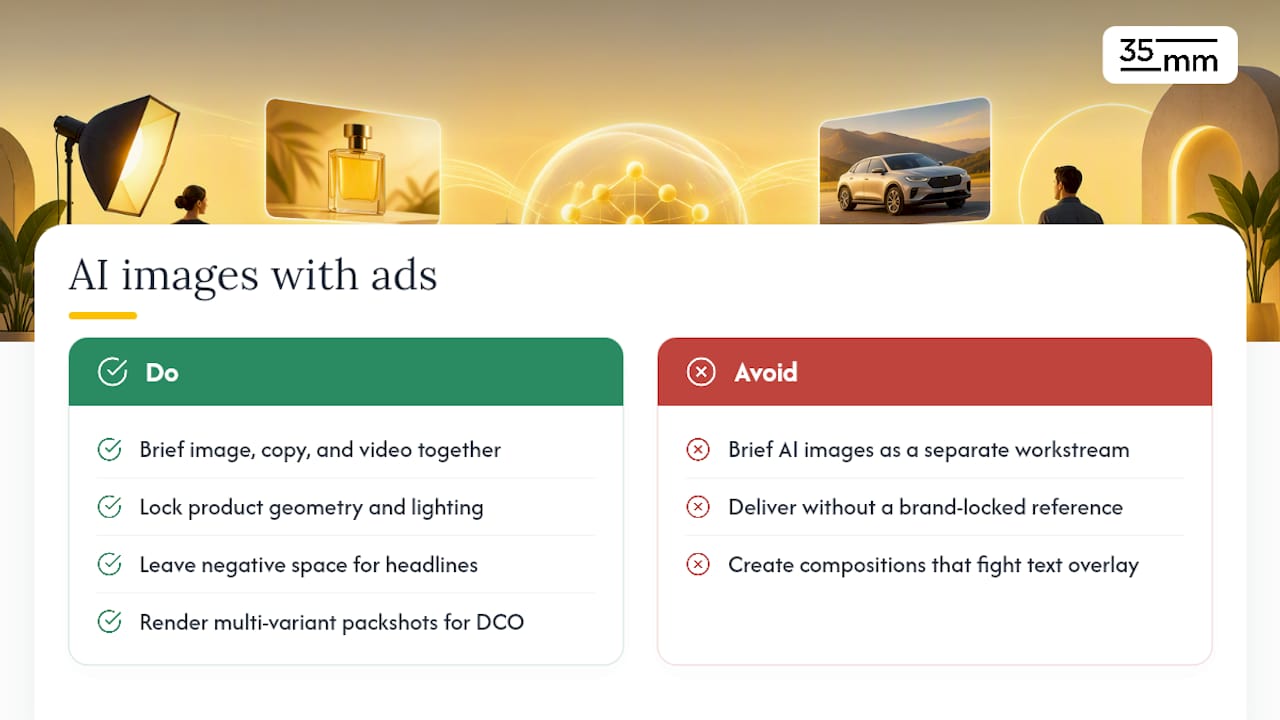
The practical issue is grading and layout consistency. A still built for a static banner needs negative space that a copywriter can actually use for a headline, not a composition that fights the text overlay. When the same asset becomes a video keyframe, the identity-locked reference used during generation earns its keep. Locking a product's geometry and lighting during the AI pass means the video team can animate from that still without a visible seam between frame one and frame two.
For interactive or dynamic creative optimization units, the packshot and scene variants generated during a studio's multi-variant pass double as the raw material for DCO testing. A single locked identity, rendered across a dozen backgrounds or angles during production, gives a media team enough variation to run real tests without commissioning a second shoot.
The failure mode to avoid is treating AI image generation as a separate workstream from copy and video, briefed and delivered on its own timeline. The strongest results come from briefing all three simultaneously, so the visual composition, the headline length, and the video crop all get designed against the same brand-locked reference from day one.
How Should You Test and Optimize AI-Generated Ad Imagery?
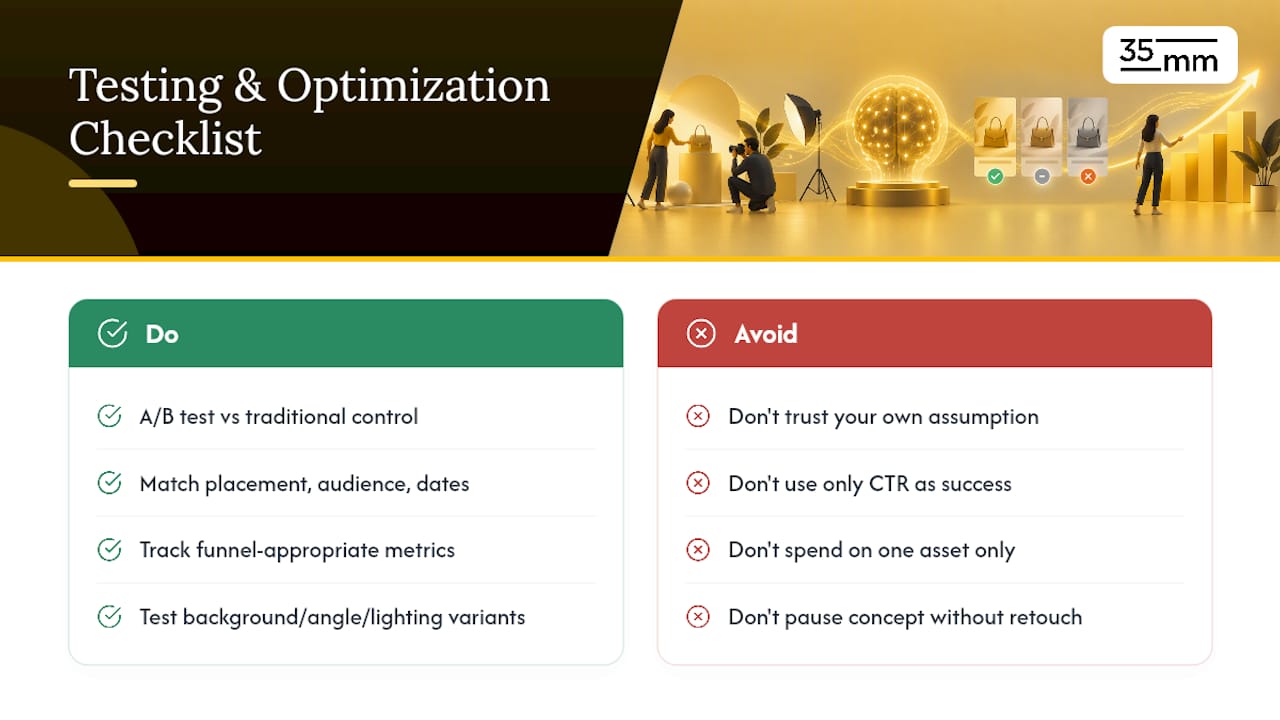
Treat AI-generated imagery the same way you'd treat any other creative variable: test it against a real baseline, not against your own assumption that it looks good. Run A/B tests comparing an AI-assisted composite against a traditionally shot control, using the same placement, audience, and flight dates, so the only variable that changes is the image itself.
Track engagement metrics that actually reflect campaign goals, not just click-through rate. Scroll-stop rate and time-on-creative matter more for upper-funnel awareness plays, while conversion rate and cost-per-acquisition matter more for direct-response placements. An AI-generated packshot that wins on click-through but underperforms on conversion is telling you something about trust, not creative quality.
Because studio-delivered AI workflows can produce multiple locked-identity variants from a single production pass, use that volume deliberately. Test background, angle, and lighting variants against each other before committing media spend to just one, rather than running a single AI asset and calling the test complete.
Watch for one failure pattern specific to AI imagery: audiences sometimes disengage from visuals that read as slightly uncanny, even when they can't articulate why. If engagement metrics dip without an obvious creative reason, check whether the asset has subtle continuity or texture artifacts a quick glance might miss. That's a signal to route the asset back through human retouch before pausing the whole creative concept.
How 35milimetre Runs Studio-Led AI Campaigns
35milimetre has spent more than two decades in image manipulation, compositing, and visual storytelling for brands across technology and automotive sectors. The studio runs lean by design: a post-production artist, a graphic designer, and a 3D artist, with senior oversight on every project and the flexibility to bring in specialists when a brief demands it.
That structure is what makes brand-aware conditioning and human-in-the-loop prompt engineering actually work in practice. Every AI pass gets steered by someone who understands the brand's visual language first, then layered with retouch, color grading, and provenance logging so the final asset holds up to legal and creative scrutiny. For a look at how identity consistency gets maintained across a multi-asset campaign, see 35milimetre's guide to AI image consistency. A scope call is the fastest way to find out whether your brief fits this process.
— 35mm
Ready to Commission Studio-Delivered AI Ad Imagery?
If your campaign needs bespoke visuals that hold up under legal review and still look like nothing else in the feed, that's precisely where 35milimetre's AI-assisted workflow earns its keep over a generic prompt tool or a template generator. You get a senior team locking identity and grading by hand, not a queue of unreviewed outputs.
35milimetre's relevant services for this exact brief include AI product compositing, AI portraiture, and photo compositing and retouching for finishing any AI-assisted asset into a channel-ready master. When you reach out, come with your campaign goal, intended usage rights, a handful of reference images, your timeline, and the specific deliverables you need. That's enough for the studio to return a scope and estimate rather than a generic quote. Start the conversation through the AI product compositing page and expect a scope call as the first response.
Where to Verify the Standards Cited in This Guide
These are the primary sources behind the legal and disclosure guidance above, worth bookmarking if your team handles AI contracts regularly.
- U.S. Copyright Office: Copyright and Artificial Intelligence, Part 2 — human authorship requirements for copyright protection.
- IAB: AI Transparency and Disclosure Framework — disclosure and C2PA provenance standards.
- XR: expanded infrastructure for AI performer payments — SAG-AFTRA-aligned talent categories.
Sources
- Copyright Office: Copyright and Artificial Intelligence, Part 2 (Copyrightability report)
- IAB: AI transparency and disclosure framework (January 2026)
- Adweek wire: XR expands celebrity payments to support AI performers in advertising
FAQ
Can AI-generated ad images be copyrighted?
Only the parts reflecting genuine human creative choices are eligible. The U.S. Copyright Office requires applicants to disclose AI-generated portions and describe the human contribution during registration.
Do I need to disclose AI use in my ad creative?
Disclosure depends on whether the AI element could mislead a consumer about what they're seeing. The FTC enforces this on a deceptive-practices basis rather than a fixed labeling rule, and the IAB recommends pairing consumer-facing labels with C2PA provenance metadata for auditability.
How long does a studio-delivered AI ad campaign take?
Timelines vary by scope, from a single-week turnaround for a handful of packshot variants to several weeks for a full multi-channel campaign with identity locking, compositing, and QA. A scope call with a studio like 35milimetre is the fastest way to get a project-specific timeline.
What does 35milimetre charge for AI-assisted ad imagery?
Pricing depends on the deliverable, service, and complexity, and current rates are listed on 35milimetre's Amazon retouching and compositing page and its Upwork service page for other formats. Services like AI product compositing and AI portraiture don't carry a published flat rate and are quoted after a scope call.
Do I need a model release if a real performer's likeness is used in an AI ad?
Yes, and it needs specific AI-use language, not just a standard release. SAG-AFTRA's Commercials Contract now defines Digital Replica and Synthetic Performer categories, and existing model releases don't always automatically cover AI-generated use without that language added.