
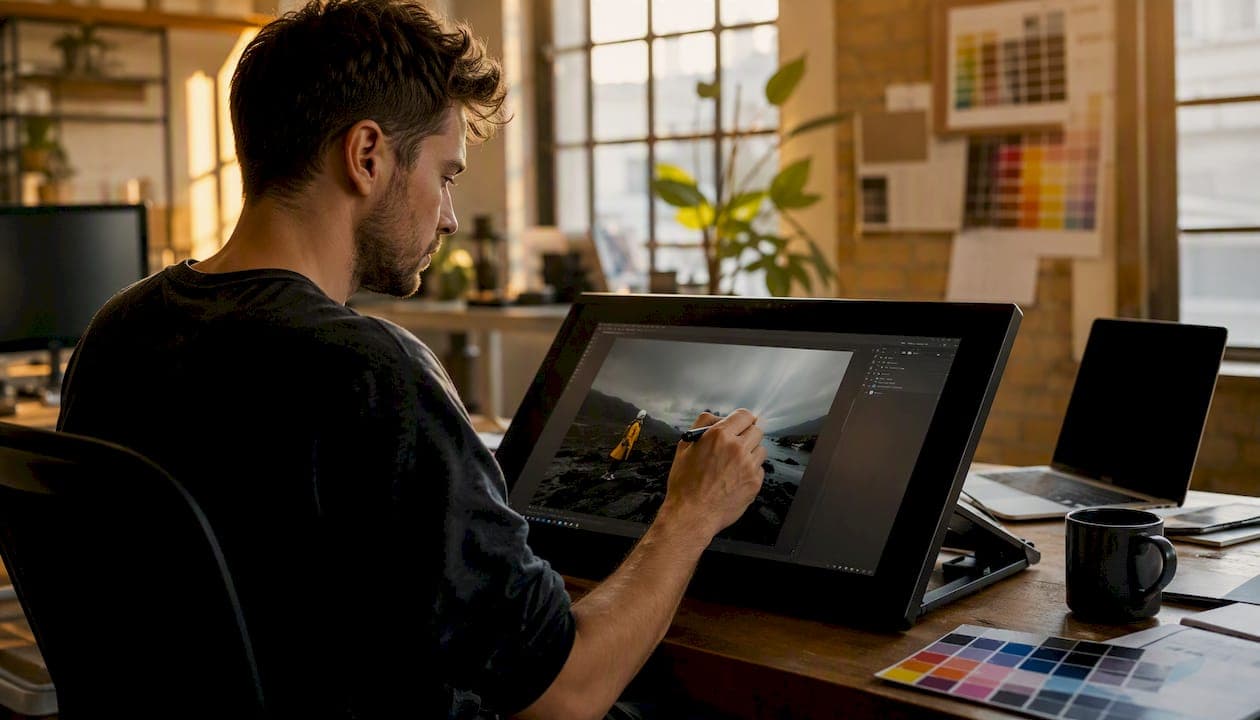
Purely AI-generated images cannot be copyrighted in the United States right now. If a human contributes real creative expression to the final piece, the resulting work often can qualify, but the AI-generated portions alone still fall outside protection. The controlling standard, laid out in the Copyright Office's guidance, turns on what the Office calls the "extent of human control" over expressive choices, not just whether a person clicked a button or typed a prompt.
A federal appeals court reinforced this in 2025, affirming the Office's refusal to register a work its own creator described as autonomously generated by a machine.
What this means day to day:
- Commercial platforms like OpenAI's DALL·E, Midjourney, and Stability AI's tools may grant you a license to use images commercially, but that license is not the same as owning a copyright.
- If you never touch the output beyond a short prompt, you likely have no exclusive rights to stop someone else from using an identical image.
- Documentation of your creative process, not just the final image, is what separates a registrable work from an unprotectable one.
Key Takeaways
AI-generated images gain copyright protection only when a human contributes genuine expressive choices, not merely a prompt, and documenting that contribution is what makes registration and ownership claims defensible.
| Point | Details |
|---|---|
| Human authorship is required | Purely AI-generated output isn't copyrightable; meaningful human editing or arrangement can qualify. |
| Prompts alone rarely count | The Copyright Office and courts have not treated text prompts by themselves as sufficient authorship. |
| Disclosure is mandatory | Registrations must flag AI-generated material beyond a de minimis amount and describe human contribution. |
| Training data creates infringement exposure | Access plus substantial similarity can trigger liability for users and platforms alike. |
| Documentation protects your position | 35milimetre builds prompt logs, layered files, and edit records into its production workflow to support client ownership claims. |
Primary Sources and Further Reading
- U.S. Copyright Office AI Initiative: official guidance and registration policy.
- Copyright and Artificial Intelligence Part 2 report: detailed copyrightability analysis.
- USF library guide: consolidated case summaries and practical pointers.
Can AI images be copyrighted at all? Only the human-authored portions. A fully autonomous AI output, with no meaningful human creative control, cannot be registered under current Copyright Office practice.
Can you use AI images commercially without owning the copyright? Yes, in many cases. Platform terms from tools like Midjourney or DALL·E often grant commercial-use licenses even when no exclusive copyright exists, but that license doesn't stop others from generating similar images.
Does editing an AI image make it copyrightable? Often, yes, if the editing involves real creative decisions, compositing, retouching, or selective arrangement rather than trivial adjustments like resizing or color filters.
What about AI image copyright outside the United States? Rules vary significantly. The UK's Computer-Generated Works provision offers limited protection unavailable in the U.S., while the EU and other jurisdictions are still developing their own frameworks, so international use requires separate legal review per market.
Do I need a lawyer to register a work containing AI elements? Not always, but legal review helps for high-value commercial projects where ownership certainty affects licensing revenue or resale rights.
This article is general information, not a substitute for advice from a qualified lawyer. Consult a qualified legal professional about your own circumstances before acting on anything here.
Table of Contents
- Legal Basis for AI Image Copyright: Human Authorship and Copyright Office Guidance
- When Can an AI-Generated Image Be Copyrighted?
- Infringement and Training Data Risks in AI-Generated Art
- How to Register Copyright for Works With AI-Generated Content
- Practical Best Practices for AI Image Copyright Protection
- Sources
Legal Basis for AI Image Copyright: Human Authorship and Copyright Office Guidance
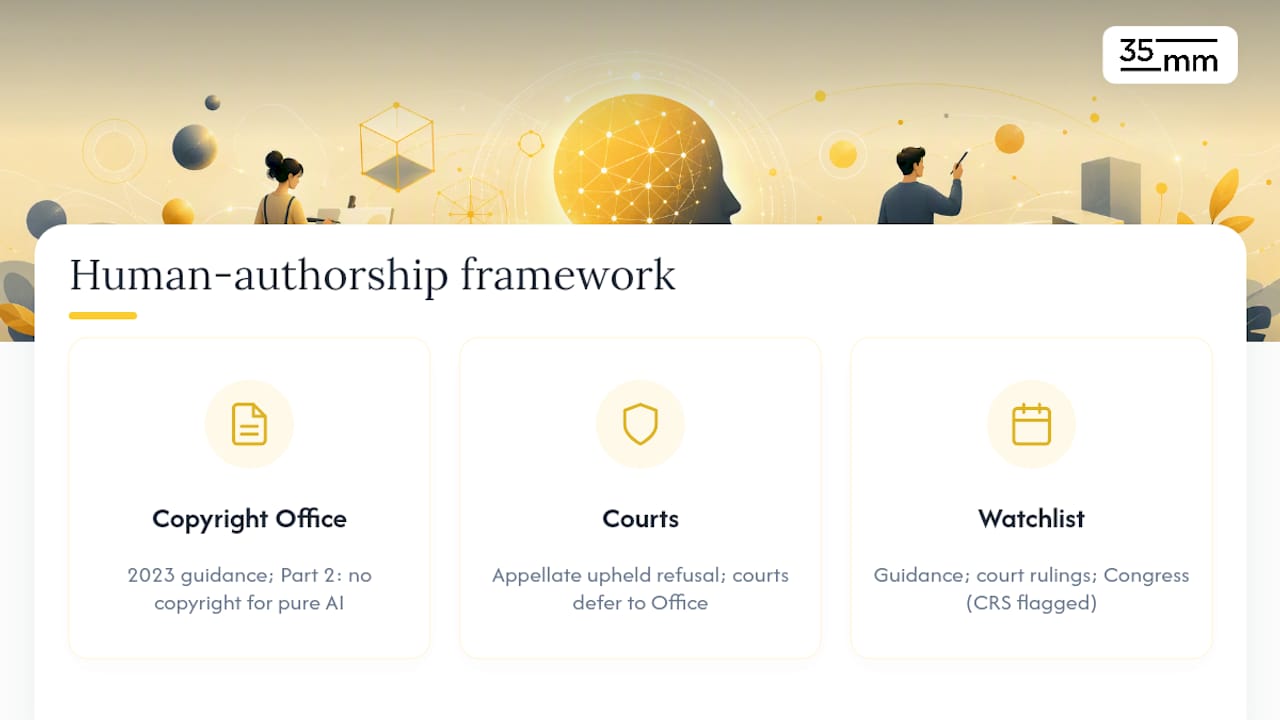
The Copyright Act has always protected "original works of authorship," and the Copyright Office has consistently read that phrase to require a human author. Its AI Initiative formalized this in a two-part project: registration guidance issued in the Federal Register in March 2023, followed by a deeper analytical report.
The Office's Part 2 report states plainly that copyright does not extend to purely AI-generated material, and that every determination is fact-specific rather than governed by a bright-line rule. That single sentence has shaped how attorneys advise clients across the industry.
Courts have backed this reading. The appellate decision on autonomously created art didn't just uphold a single registration refusal. It signaled that judges will defer to the Office's human-authorship framework rather than carve out new AI-specific exceptions from the bench. Creators should watch three sources going forward: the Copyright Office's published guidance and Federal Register notices, ongoing district and appellate court rulings interpreting AI-assisted works, and Congressional activity, since the Congressional Research Service has already flagged this as an area where Congress may eventually legislate rather than leave the issue entirely to case law.
When Can an AI-Generated Image Be Copyrighted?
The Copyright Office breaks human contribution into three buckets, and understanding them changes how you work, not just how you file paperwork.
- Prompts and instructions. Text prompts alone, even long and detailed ones, generally do not establish the kind of control the Office requires. The Congressional Research Service notes that neither courts nor the Office have accepted prompting by itself as sufficient authorship, because the AI system, not the person, still determines the specific expressive output.
- Perceptible expressive inputs. If you feed the model your own photograph, sketch, or existing artwork as a base image, that human-created input can carry its own protection and may support a stronger claim over the composite result.
- Modifications and arrangement. Manually editing, compositing, retouching, or selectively arranging AI outputs into a finished piece is where most defensible claims actually live. A single short prompt with no follow-up editing rarely clears the bar. Iterative prompting followed by deliberate selection, cropping, color correction, and compositing usually does.
Pro Tip: Keep your prompt history, save intermediate renders before final edits, and work in layered files (PSD or equivalent) rather than flattening immediately. That version trail is often the difference between a registrable claim and a rejected one.
Infringement and Training Data Risks in AI-Generated Art
Copyright issues with AI art run in two directions. Beyond whether your output qualifies for protection, there's a separate question: does it infringe someone else's existing copyright? Courts analyze this the same way they've always analyzed copying claims, through a two-step test.
- Access. Did the AI model train on the copyrighted work in question? Training datasets for tools like Stable Diffusion have scraped billions of images, so access is often easy to establish for well-known works.
- Substantial similarity. Even with access proven, a plaintiff must show the output is substantially similar to the original, not just similar in general style or subject matter.
Fair use arguments around training data remain unresolved, and litigation is ongoing over whether scraping copyrighted images to train a model qualifies as transformative use or market substitution. One study cited by the Congressional Research Service found copying in fewer than 2% of images generated by Stable Diffusion in the sample tested, though the researchers cautioned that figure likely understates the true rate given methodology limits. Liability can attach at multiple points: the user who wrote the prompt, and potentially the platform or developer under vicarious or contributory infringement theories, depending on how the output was generated and used.
How to Register Copyright for Works With AI-Generated Content
The Office requires you to disclose AI-generated material that makes up more than a de minimis portion of your submission, and to describe your own human contribution in plain terms.
- Identify the human-authored elements separately from anything the AI generated wholesale.
- Write a concise author's statement describing your selection, arrangement, or editing decisions.
- Submit deposit copies that make your human edits visible, not just the polished final render.
- Pay the standard filing fee and expect Federal Register processing timelines similar to any other application. Registration, when granted, protects only the human-authored portions, not the underlying AI-generated elements.
Practical Best Practices for AI Image Copyright Protection
Treat documentation as part of the creative process, not paperwork you do afterward.
- Keep prompt logs and edit histories for every project, timestamped where possible.
- Save native layered files (PSD, native 3D scene files) rather than only flattened exports.
- Record your selection and curation decisions, especially when generating multiple variants before picking one.
- Version-control your outputs so you can show the progression from raw generation to finished asset.
- Put licensing terms in writing with every freelancer or AI-platform provider you work with, including warranties against known infringement and clear scope of use.
For agencies and studios, this means building AI provenance into your workflow itself, not bolting it on later. Label AI-assisted assets internally, require an approval checklist before delivery, and negotiate indemnity language into vendor contracts so liability doesn't land solely on your studio if a training-data dispute surfaces down the line. Our guide to industry terms in image editing is a useful reference when drafting these contract clauses, since terms like "derivative work" and "layered master" carry specific legal weight.
What a Documented AI Workflow Actually Looks Like
A defensible workflow generally follows one path: prompt iterations, a selection log with timestamps, manual edits or compositing in layered master files, then a final output paired with metadata and a short README describing the human decisions made along the way.
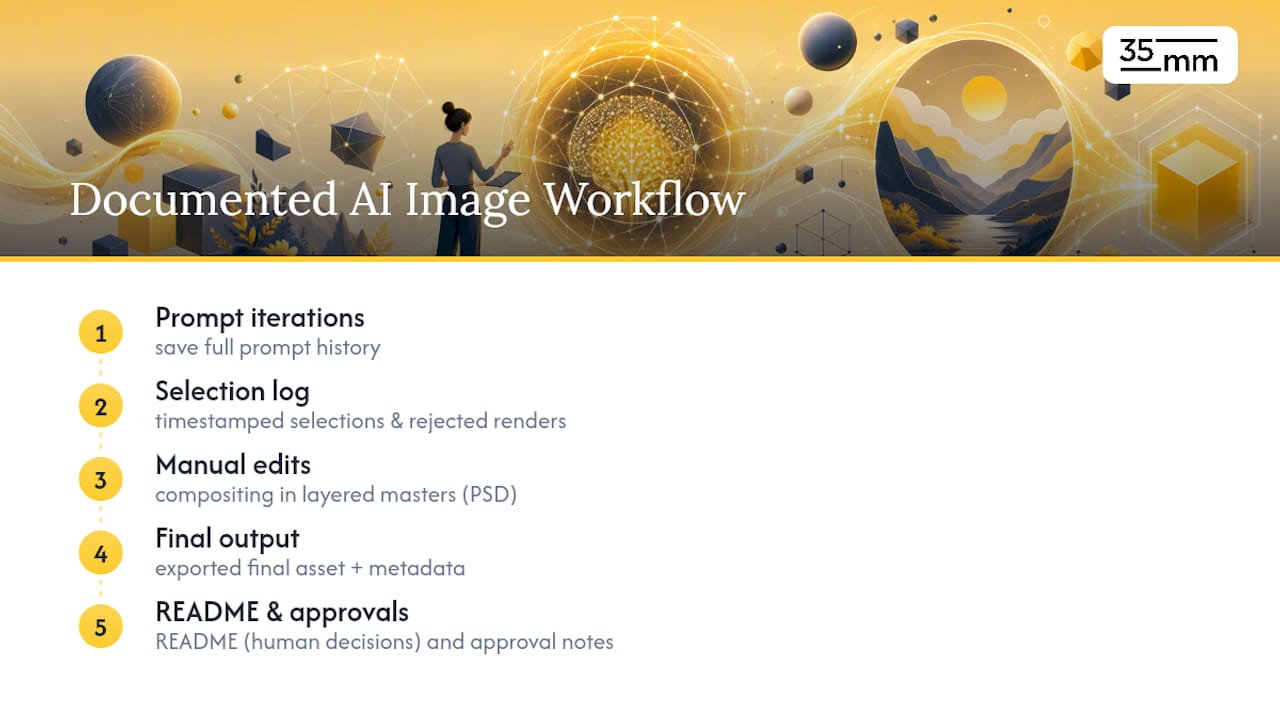
The file artifacts worth keeping: full prompt history, intermediate renders you rejected along the way, PSD or equivalent layered masters, exported metadata, and any client approval notes tied to specific revisions. This is exactly the kind of AI-enhanced imagery workflow that maps directly onto what the Copyright Office wants to see in a registration file, and it's also what commercial clients expect when they need to know an asset is contractually clean.
Why Documentation Matters More Than Certainty
Nobody should assume today's rules are permanent. Courts and the Copyright Office are still working through fact patterns none of us anticipated three years ago, so the safest posture is treating every project's paper trail as evidence you might need later, not paperwork you can skip.
Post-Production Support for Commercially Safe AI Imagery
Ad agencies and brands don't need to guess at this alone. 35milimetre builds documentation into the production process itself, layering manual compositing, retouching, and creative direction on top of AI-generated base images so the final deliverable reflects real human authorship, not just a prompt and an export button.
That matters most for teams commissioning campaign visuals where ownership clarity affects licensing, resale, or long-term brand use. Our studio's approach to AI in image editing keeps prompt logs, layered source files, and selection records as standard practice on every project, and agencies looking to scale AI-assisted production without losing control over pricing and scope can find useful groundwork in how agencies price AI services. This article explains general principles and isn't legal advice for your specific situation. If your brand needs campaign-ready imagery with a documented creative process behind it, visit 35milimetre's services page to talk through your next project.