

Striking visuals alone don't win campaigns. Many marketing teams operate under the assumption that bold, beautiful imagery is all it takes to capture attention and move audiences down the funnel, but the data consistently tells a different story. Visual storytelling in advertising is a precise discipline, not an aesthetic exercise. The real competitive edge lies in knowing which visual choices align with specific campaign objectives, audience psychology, and funnel stages. This article cuts through the noise and gives you a framework grounded in research, production experience, and measurable outcomes.
Table of Contents
- What ad campaign imagery really means
- Core mechanics and frameworks for effective ad imagery
- AI, human, and hybrid imagery: What the data really shows
- Translating imagery into business results: Practical applications
- Why the best ad imagery isn't always the prettiest—here's what really works
- Work with ad imagery specialists for your next campaign
- Frequently asked questions
Key Takeaways
| Point | Details |
|---|---|
| Strategic imagery matters | Effective ad imagery requires deliberate choices, not just visual appeal. |
| Test for performance | Iterative testing of visuals is proven to boost campaign results over instincts alone. |
| Align with brand story | Imagery must fit narrative, evoke emotions, and match funnel stages for maximum results. |
| Choose the right creator | AI, photography, and illustration each have specific strengths for conversions and engagement. |
| Prep for rapid iteration | Adopting modular and hybrid workflows lets you adapt imagery at scale for higher ROI. |
What ad campaign imagery really means
Before you can optimize imagery, you need a clear picture of what it actually encompasses. Ad campaign imagery refers to the visual elements used in advertising, including photography, illustrations, graphics, and video, all deployed to convey brand messages, evoke emotion, and support storytelling. It's not a single asset. It's a system of visual decisions that work together to shape how an audience perceives your brand in the fraction of a second before they decide to engage or scroll past.
Imagery serves three core functions in any campaign. First, it acts as an attention anchor, interrupting habitual scroll behavior long enough to hold a viewer's gaze. Second, it establishes narrative context, immediately signaling what kind of brand, product, or promise is being offered. Third, it sets audience expectations, preparing them for what the landing page, product, or offer will deliver. When these three functions are aligned, imagery stops being decorative and starts being strategic.
"The most effective ad imagery doesn't just look good. It communicates something specific before the headline is even read."
Understanding the role of storytelling in marketing helps clarify why this matters so deeply. Audiences don't process ads logically. They respond emotionally first, rationally second. An image that triggers the right emotional cue, whether it's trust, aspiration, urgency, or warmth, primes the viewer to receive your message more favorably. The craft of key visual strategies lies in making that emotional trigger intentional, not accidental.
This is why investing in strong visual content creation strategies from the start of a campaign builds a more reliable foundation than treating imagery as an afterthought. Every visual element, the composition, color palette, subject matter, and texture, carries meaning. The question is whether that meaning is intentional or left to chance.
Core mechanics and frameworks for effective ad imagery
With a solid definition in place, it's time to dissect the mechanics that make imagery perform. The best practices for ad images consistently point to several key components: a clear focal point, strategic use of color psychology, minimal overlaid text, high technical quality, and congruence between the image, the ad copy, and the landing page. These aren't aesthetic preferences. They are performance variables backed by testing at scale.
A clear focal point directs the viewer's eye and prevents cognitive overload. When everything in an image competes for attention, nothing wins. One strong subject, whether a product, a face, or a scene, gives the brain an immediate anchor and reduces the mental effort required to process the ad. This matters especially in mobile environments where attention windows are narrow.
Color psychology is equally significant. Red creates a sense of urgency and excitement, which is why it dominates clearance sale visuals. Blue communicates trust and reliability, making it a staple for financial services and technology brands. Green signals health, growth, and environmental responsibility. These are not arbitrary conventions. They are deeply conditioned associations that influence emotion and decision-making before the conscious mind registers them.
- Define your single focal subject before any other design decision.
- Choose your primary color based on the emotional state you want to trigger.
- Limit overlaid text to 3 to 7 words maximum to preserve visual breathing room.
- Use sharp, well-lit imagery without heavy compositing artifacts that reduce credibility.
- Match the visual style to both the ad copy tone and the landing page experience.
- Run at least two image variants in every campaign and let performance data pick the winner.
Pro Tip: When testing imagery, change only one visual variable at a time. Swapping both the color treatment and the subject simultaneously makes it impossible to identify what actually drove the performance shift.
"Congruence between ad image and landing page is one of the most underrated conversion levers in digital advertising."
Understanding design-driven impact in modern advertising requires accepting that creative quality isn't purely subjective. Studies measuring outdoor imagery impact on brand recall show that structured, intentional visual design consistently outperforms clever but chaotic compositions. The same principle applies to digital ads. Structure and intentionality translate directly to results.
AI, human, and hybrid imagery: What the data really shows
Marketers today face a genuine choice about how to produce imagery. AI-generated visuals, traditional photography, hand-crafted illustrations, and hybrid approaches each carry real performance implications. The data now available on this question is compelling, and it challenges some widely held assumptions.
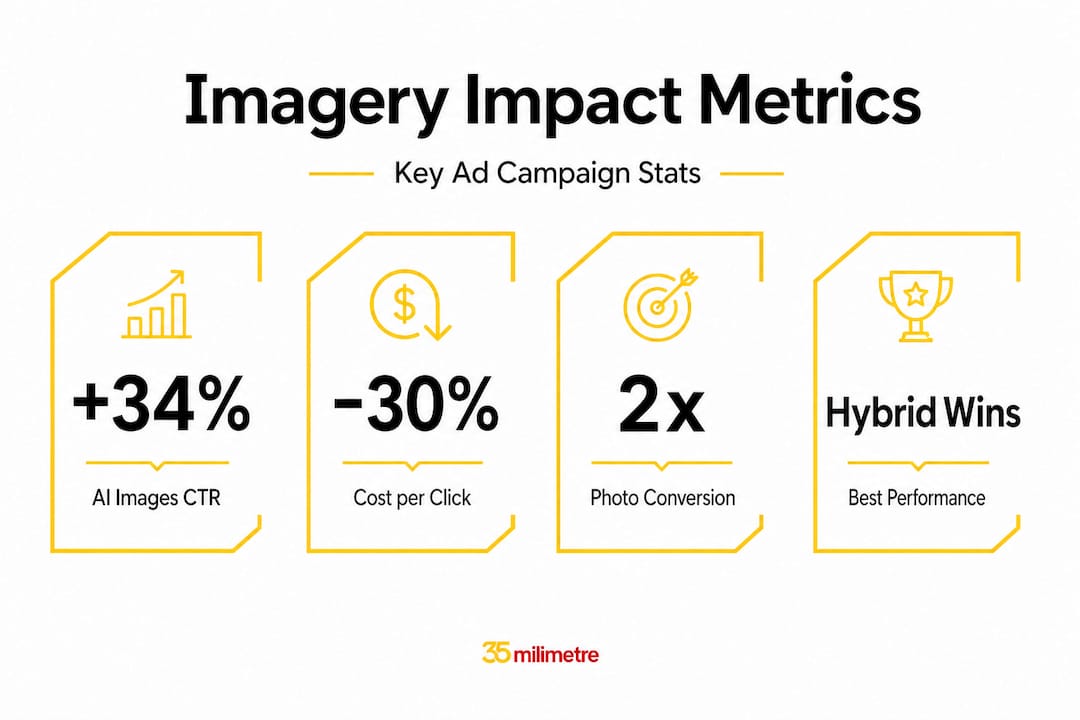
Fully AI-generated ads boost CTR by 19% compared to human-produced equivalents in controlled tests, and creative quality linked to AI tools drives up to a 49% lift in sales performance. AI product images specifically show a 34% increase in CTR and a 30% reduction in cost per click. These are not marginal improvements. They represent a meaningful shift in how production efficiency connects to campaign economics.

However, the AI advertising paradox research from NYU reveals a critical counterpoint. Photography still outperforms illustrations and AI images for conversion and trust, delivering up to a 95% lift in conversion rates when photographic credibility is present. When AI creation is disclosed to audiences, CTR drops by 31.5%. This suggests that the performance gains from AI imagery depend heavily on context, category, and how the production method is communicated, or not.
| Imagery type | CTR impact | Conversion strength | Best use case |
|---|---|---|---|
| AI-generated | +19 to +34% | Moderate | Awareness and top-of-funnel |
| Photography | Baseline | Highest (up to 95% lift) | Conversion and trust-building |
| Illustration | Variable | Lower for direct sales | Storytelling and brand engagement |
| Human-AI hybrid | High | Strong across funnel | Nuanced campaigns needing both scale and depth |
For agencies managing large campaign volumes, AI imagery performance data points toward a clear hybrid strategy. Use AI-assisted production to generate volume and variation at the top of the funnel, where CTR and reach matter most. Bring in high-quality photography or retouched composites for mid and bottom-funnel touchpoints where trust and emotional depth drive conversions. Illustrations, used strategically, add personality and narrative texture to brand campaigns that need to stand out through stylistic differentiation.
Choosing between illustration styles for agencies is also not a trivial decision. A flat graphic style communicates efficiency and modernity. A painterly, textured illustration style evokes craft and authenticity. Each carries a different set of audience associations, and matching style to brand personality is as important as matching subject matter to product category.
Translating imagery into business results: Practical applications
Having the research is one thing. Building a repeatable workflow that turns visual choices into measurable campaign outcomes is where most teams lose momentum. The path from insight to execution requires four clearly defined steps.
First, define the business outcome before selecting any imagery. Awareness campaigns, engagement campaigns, conversion campaigns, and lifetime value campaigns each require a different visual approach. A campaign designed to maximize reach on social platforms needs imagery that stops the scroll in under two seconds. A campaign designed to drive direct purchases needs imagery that builds trust and clearly communicates the product benefit.
Second, choose imagery that fits both the funnel stage and the intended emotional outcome. AI product images deliver +34% CTR and reduce CPC by 30%, making them strong candidates for awareness-stage paid social. Photography converts at significantly higher rates for retargeting and bottom-of-funnel campaigns where purchase intent is already present.
Third, build a rapid testing and iteration process into the production workflow. Visual storytelling in advertising at scale demands modular asset systems, meaning imagery designed so that individual elements like background, subject, and color treatment can be swapped independently without rebuilding the entire visual. This is where AI-assisted production earns its keep, not by replacing creative judgment but by dramatically accelerating the variant generation process.
Fourth, track KPIs at the asset level and attribute performance wins back to specific visual choices. A structured ad agency visual workflow makes this attribution possible by keeping asset versions organized, tagged, and tied to performance data. Without this infrastructure, you end up repeating the same guesswork campaign after campaign.
Pro Tip: Build a simple asset naming convention that includes the visual variable being tested (for example, "blue-background-hero" vs. "white-background-hero") so your analytics team can pull performance data without needing to re-examine every creative manually.
Understanding the real impact of photographers in campaigns is also worth noting here. Even in an era of AI production capabilities, professional photographers bring location intelligence, lighting expertise, and authentic subject relationships that no generative model has fully replicated. For brands in lifestyle, travel, and food categories especially, that authenticity translates directly to audience trust and purchase behavior.
| Funnel stage | Recommended imagery | Primary KPI | Testing priority |
|---|---|---|---|
| Awareness | AI-generated or bold illustration | CTR, reach | Color and composition |
| Consideration | Hybrid photography and graphic | Engagement rate | Subject and context |
| Conversion | High-quality photography | Conversion rate | Trust signals and clarity |
| Retention and LTV | Brand-consistent composites | Repeat purchase rate | Emotional tone and familiarity |
The most effective campaigns we've worked on over the years share one consistent trait: the visual decisions were made before the brief was finalized, not after. Imagery treated as a strategic variable from day one produces fundamentally different results than imagery chosen to fit a budget leftover after copy and media have been allocated.
Why the best ad imagery isn't always the prettiest—here's what really works
Here's an uncomfortable truth the industry doesn't talk about enough. Gorgeous, award-caliber imagery loses A/B tests to simple, context-anchored visuals with surprising regularity. We've seen it happen repeatedly in campaigns across both the technology and automotive sectors. A meticulously retouched hero shot, technically flawless, loses to a straightforward product-in-use photo because the latter creates an immediate, recognizable context that the audience can project themselves into.
The reason is relatability, not quality. Audiences aren't evaluating ads the way judges evaluate portfolio work. They're scanning for relevance. An image that signals "this is for someone like me, in a situation I recognize" will outperform a visually superior image that reads as aspirational but distant. This is why emotional resonance and clarity of message consistently outperform visual flair in performance testing.
The other factor most agencies undervalue is landing page congruence. When the imagery in an ad closely mirrors the imagery on the destination page, there's a visual continuity that reduces the cognitive friction of the click. The viewer feels they arrived in the right place. When there's a mismatch, even a subtle one in color treatment or visual tone, the transition creates doubt. That doubt costs conversions.
Our editorial view, shaped by years of production experience and close collaboration with agencies on live campaigns, is that relentless iteration in context beats one-time creative perfection every time. The brands that win consistently aren't the ones with the most beautiful assets. They're the ones testing the most variables with the most discipline. The guide to boosting engagement with visuals we've developed reflects this philosophy directly: build for testing, not just for admiration.
Work with ad imagery specialists for your next campaign
When the stakes are high, creative quality and strategic alignment need to work together seamlessly. That's the kind of work we do at 35milimetre every day, from high-end retouching and compositing to AI-enhanced imagery and CGI production for agencies and brands that need visuals built to perform, not just to impress.
We've spent over two decades working across technology and automotive campaigns, and we understand the difference between imagery that looks polished and imagery that drives measurable results. Whether you need a modular asset system built for rapid A/B testing, a hybrid AI and photography workflow, or a single hero visual with the depth and precision to anchor a major campaign, our team brings both the technical capability and the strategic perspective to deliver it. If your next campaign demands imagery that earns its place in the funnel, let's talk.
Frequently asked questions
What types of imagery perform best in ad campaigns?
Photography typically converts best for trust-driven and bottom-of-funnel campaigns, while illustrations drive engagement and AI-generated visuals boost CTR most effectively at the top of the funnel.
How does AI-generated imagery affect campaign results?
AI imagery boosts CTR by up to 34% and lowers cost per click by 30%, but disclosing AI creation to audiences can reduce CTR by 31.5%, so context and transparency matter.
Why does color psychology matter in ad imagery?
Colors directly influence how audiences feel before they consciously process your message, and strategic color choices like red for urgency or blue for trust shape emotional response and purchase behavior.
What's the most important tip for choosing imagery?
Test multiple image variants and rely on performance data rather than intuition. Prioritizing testing over guesswork consistently produces better results than selecting images based on subjective preference alone.