

Most marketing professionals know that visuals matter. But treating them as decoration rather than infrastructure is one of the most expensive mistakes a campaign can make. A strong key visual is not just a pretty image placed alongside copy — it is the structural core that holds every campaign touchpoint together, from billboard to banner ad. Understanding what separates an effective key visual from a generic one, how to measure its performance, and when to deploy AI versus human craft is where campaigns are won or lost. This guide covers all of it, with particular focus on the demands of technology and automotive advertising, where precision and consistency are non-negotiable.
Table of Contents
- Defining ad agency visuals: What are 'key visuals'?
- How visuals drive campaign performance: Metrics that matter
- The creative process: Frameworks and expert methodologies
- AI vs human vs hybrid visuals: Strategic choices and industry nuances
- Perspective: Beyond the visual — What most ad pros overlook
- Transform campaign results with expert visual production
- Frequently asked questions
Key Takeaways
| Point | Details |
|---|---|
| Key visuals unify campaigns | A strong key visual ensures consistency and drives recognition across all channels. |
| AI and human visuals complement | Hybridizing AI speed with human creativity maximizes both efficiency and emotional impact. |
| Metrics guide strategy | Use CTR, ROAS, and conversion data to select and refine visuals for optimal campaign performance. |
| Frameworks boost repeatability | Models like ABC and A/B testing help agencies design visuals that reliably perform. |
| Sector-specific needs matter | Automotive and technology campaigns require specialized visuals and workflow expertise. |
Defining ad agency visuals: What are 'key visuals'?
Before optimizing visuals, it helps to agree on what we mean by them. In agency practice, a key visual is the unifying image or design element that defines a campaign's visual identity and carries consistent messaging across every channel. Think of it as the visual anchor — the one image that, when seen without any headline or logo, still communicates the brand and the campaign's emotional direction.
Key visuals appear across print, digital display, out-of-home placements, social media, and video. Their primary job is to create immediate recognition and continuity regardless of platform or format. A campaign might run on billboards, Instagram stories, and a website hero section simultaneously. Each of those formats has different dimensions and technical requirements, but the key visual ensures they all feel like one cohesive brand experience. That kind of design's impact on advertising is measurable and significant.
What makes a key visual genuinely effective comes down to several core qualities:
- Immediate clarity: The viewer understands the message within two seconds, without needing to read anything.
- Brand alignment: Color palette, typography direction, and mood match the brand's established identity.
- Scalability: The visual works at a highway billboard scale and at a 300x250 pixel banner without losing its impact.
- Emotional resonance: It triggers a feeling, not just a recognition.
- Platform adaptability: The core composition translates across vertical, horizontal, and square crops.
Different campaign types draw on different visual formats. Here is how they typically map across sectors:
| Visual type | Primary use case | Sector fit |
|---|---|---|
| Hero product render | Launch campaigns | Automotive, Tech |
| Lifestyle composite | Brand storytelling | Retail, Automotive |
| Animation/motion loop | Social and digital display | Tech, Consumer goods |
| Illustrated concept | Awareness and OOH | Any |
| AI-generated variant | Testing and personalization | Tech, E-commerce |
The understanding of what key visuals are has shifted considerably over the past decade. Creative teams no longer produce a single hero image and adapt it manually. Instead, they build visual systems — sets of rules, templates, and components that allow a key visual to scale intelligently. This shift has changed what agencies actually need from designers and production partners.
"Designers have evolved from executors of isolated briefs to systems thinkers managing visual consistency across an increasingly fragmented media landscape. A key visual is no longer a file — it is a framework."
For agencies managing essential agency design assets, this systems mindset is now a baseline expectation, not a bonus capability.
With visual strategy set as the foundation, the next step is understanding how impact is measured and optimized.
How visuals drive campaign performance: Metrics that matter
Knowing what a key visual is does not automatically explain why investing in one well is worth the budget. The performance data does that job clearly.

Recent benchmarking across AI-generated, human-designed, and hybrid ad visuals shows meaningful differences in how each approach performs across critical campaign metrics. According to AI Ad Creative Benchmark 2026, AI-generated visuals consistently outperform human-made ones on click-through rate in lower-funnel and retargeting contexts, while human and hybrid visuals hold stronger positions in high-AOV (average order value) conversion and brand recall.
| Visual type | Avg. CTR lift | ROAS performance | Conversion rate (high-AOV) |
|---|---|---|---|
| AI-generated | +18% vs. baseline | Parity for low-value | Below human baseline |
| Human-designed | Baseline | Strong for premium | Best for high-AOV |
| Hybrid (AI + human) | +12% vs. baseline | Above baseline | Near-human performance |
The automotive and technology sectors offer some of the clearest proof of what visuals can do to design impact in campaigns. Nissan's shift to AI-assisted creative generated a 49% CTR lift in targeted digital campaigns. Kia Spain's visual overhaul resulted in 3x ad traffic growth compared to the prior campaign period. These are not marginal gains — they represent fundamental changes in campaign efficiency driven by visual decisions.
To consistently achieve results like these, agencies rely on a structured approach to visual testing:
- Establish a visual baseline using your brand's current top-performing creative as the control.
- Test one variable at a time — color palette, background style, or product angle — before compounding changes.
- Introduce human elements in variants when testing for premium or emotional-category products, as human faces significantly affect engagement rates.
- Iterate on CTA placement and style specifically, since data shows CTA-focused tests carry a 35% win rate in determining ad effectiveness.
- Segment testing by platform, since what lifts CTR on Meta may behave differently on display networks or automotive-specific digital publishers.
For technology campaigns specifically, rapid creative cycling and volume-based testing tend to outperform single-hero approaches. For automotive, precision in rendering and emotional staging consistently drives better outcomes at the lower funnel.
After understanding the tangible impact, it's essential to explore the creative processes and frameworks agencies use for consistent results.
The creative process: Frameworks and expert methodologies
Consistently producing high-performing key visuals is not a matter of talent alone — it requires a repeatable framework that moves from ambiguity to precision at each stage. The creative workflow that produces reliable results follows a clear sequence:
- Brief: Define the campaign goal, target audience, platform mix, and the single emotional or rational message the visual must carry.
- Concept: Develop two to three distinct visual directions. These are not finished images — they are directional moodboards or rough composites.
- Prototype: Produce working versions of each concept at key formats (at minimum, a social square and a horizontal display unit).
- Test: Run the prototypes in controlled A/B environments, measuring CTR, engagement, and conversion as applicable.
- Refine: Apply the test learnings. This is where the real craft happens — adjusting color temperature, compositional weight, or human element placement based on real data.
One of the most useful evaluation tools in this process is the ABC model, which structures visual review around three criteria: Attention, Branding, and Communication. The model, referenced in modern ad visual frameworks, gives teams a shared language for critiquing work that moves beyond subjective preference and into structured effectiveness assessment.
Pro Tip: Apply the ABC checklist at the prototype stage, before any production spend is committed. Ask: Does this stop a scroll (Attention)? Is the brand unmistakably present (Branding)? Is the intended message clear without reading the copy (Communication)? If any answer is uncertain, revise before testing.
In automotive contexts, iteration is especially critical because CAD-derived renders and material specifications must be reviewed for accuracy alongside creative effectiveness. A headlight reflection rendered incorrectly can undermine an otherwise strong composition. In tech campaigns, the iteration pace is faster but equally rigorous — A/B testing methodology confirms that CTA-specific tests deliver the highest win rates, making that element a priority in each test cycle.
For creative production in ad visuals, aligning these process steps with client approval workflows is equally important. The framework only works when stakeholders understand that refinement is part of the plan, not a signal that the first concept failed.
"The agencies producing the most consistent visual results are not those with the most talented individual designers — they are the ones who have built frameworks that make quality reproducible."
Armed with solid creative processes, professionals next face the decision of when and how to use AI, human, or hybrid visuals for maximum effect.
AI vs human vs hybrid visuals: Strategic choices and industry nuances
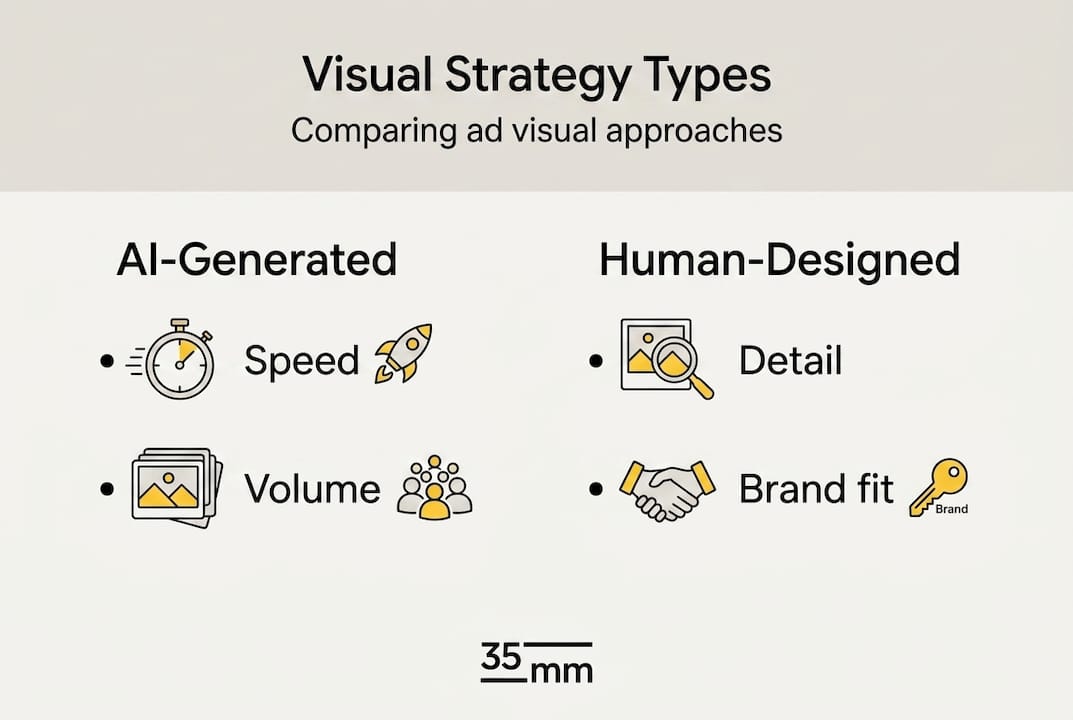
The choice between AI-generated, human-designed, and hybrid visuals is increasingly one of strategic fit rather than capability. All three approaches produce campaign-ready imagery. The question is which approach serves your specific goals, timeline, and sector requirements.
| Criteria | AI-generated | Human-designed | Hybrid |
|---|---|---|---|
| Production speed | Very fast | Moderate to slow | Moderate |
| Cost at volume | Low | High | Medium |
| Emotional depth | Limited | High | Strong |
| CTR performance | High for low-AOV | Baseline | Above baseline |
| Automotive rendering accuracy | Insufficient alone | Excellent | Best practice |
| Tech campaign iteration | Excellent | Limited by speed | Very strong |
The AI Ad Creative Benchmark 2026 data is clear: AI visuals lead on volume and click-through rate, particularly for lower-consideration products and retargeting contexts, but they consistently underperform human-designed work in high-AOV conversion scenarios where emotional resonance and product accuracy are decisive.
Pro Tip: Use AI for variant generation and volume testing in tech campaigns where you need to cycle through multiple audience segments quickly. Reserve human and hybrid production for your core hero visual, your launch-day campaign imagery, and anything that requires precise material rendering or strong emotional staging.
Automotive advertising sits in a particularly demanding space. Vehicle renders must accurately reflect real-world material properties, including paint finish, lighting behavior, and interior texture. A composited scene that misrepresents a vehicle's actual appearance creates legal and brand credibility risks. This is why automotive brands consistently invest in expert-led production for their primary key visuals, using AI-assisted tools for localization and variant work rather than core campaign imagery.
Tech sector campaigns, by contrast, benefit enormously from AI-generated volume. Consumer electronics, software products, and app campaigns often require dozens of ad variants across multiple platforms, audience segments, and languages. AI accelerates that process significantly, and brand storytelling with visuals at the core level still benefits from human curation and creative direction even when execution is AI-assisted.
With a strategic understanding of visual options, let's recap the key actions marketing professionals can take to boost campaign visuals going forward.
Perspective: Beyond the visual — What most ad pros overlook
After two decades of working on campaigns across technology and automotive, we have seen a consistent pattern: visual strategy gets planned last and cut first when budgets tighten. This is backwards, and the consequences show up in campaign performance every time.
The campaigns that genuinely move numbers treat the key visual as the first strategic decision, not the last production task. In technology and automotive particularly, the complexity involved — CAD-sourced assets, cross-platform variant management, precise material rendering — means that visual production must lead the timeline, not trail the media buy.
There is also a real organizational issue here. Visual strategy meetings tend to happen after messaging frameworks and media plans are already set. By that point, the visual is being asked to fit constraints rather than shape strategy. The most effective campaigns we have seen do it in reverse. They define the visual direction early and let it inform everything else, from copy tone to channel mix.
"In automotive, the right key visual isn't a file — it's an infrastructure for every message to follow."
If you want to know where your design's campaign impact is currently being lost, look at when visual decisions enter your planning process.
Pro Tip: Prioritize visual strategy meetings at the start of campaign planning, not after messaging and media are locked. The visual should shape the brief, not respond to it.
Transform campaign results with expert visual production
Understanding key visual strategy is one thing. Executing it at a level that actually moves campaign metrics is another. At 35milimetre, we work directly with ad agencies and brand teams to produce the kind of imagery that performs — not just visually, but commercially. From high-precision automotive compositing to rapid AI-assisted variant production for tech campaigns, our work is built around the performance outcomes that matter to your clients.

Whether you need a single hero image for a product launch or a full visual system for a multi-market campaign, we bring over two decades of post-production and design expertise to every brief. If you are ready to make your key visuals do more of the strategic heavy lifting, explore what our visual post production services can deliver for your next campaign.
Frequently asked questions
What is a 'key visual' in advertising?
A key visual is the main image or design element that unifies a campaign's look and message across all platforms and formats, from digital to out-of-home.
How do AI-generated visuals compare to human-made visuals in campaign performance?
AI visuals typically boost click-through rates, especially for lower-consideration products, but hybrid approaches outperform on emotional connection and high-value conversions where brand credibility and rendering accuracy matter most.
Which elements should agencies test in their ad visuals?
Agencies should prioritize A/B testing color palette, compositional layout, human elements, and CTA style, since CTA-focused tests consistently show the highest win rates at around 35% across campaign types.
Why are visuals especially complex in technology and automotive advertising?
Both sectors require a level of precision — from accurate automotive rendering sourced from CAD data to rapid tech variant management — that demands structured production workflows and experienced creative oversight rather than off-the-shelf solutions.