
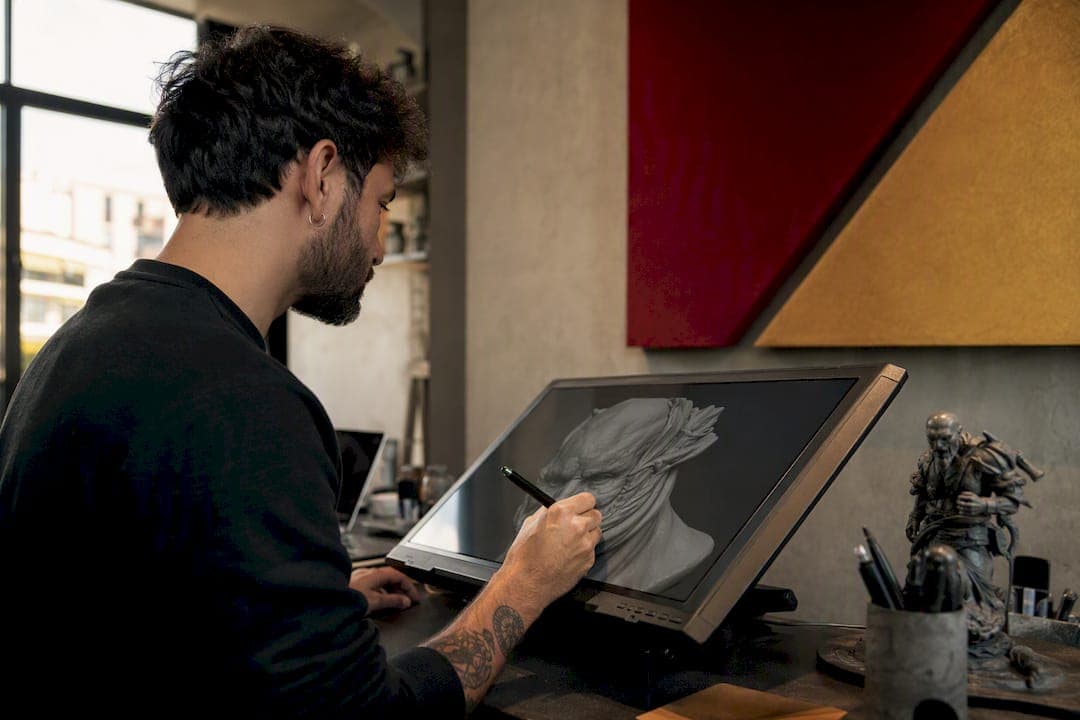
Most 3D modeling work typically falls within a moderate price range per deliverable, with simple product stills at the lower end and character models or animation pushing the cost higher. A basic product still generally costs a moderate amount. Mid-complexity product renders and architectural stills each fall into higher, but still moderate, cost bands, while character models and animations are priced according to their complexity and duration.
Most studios quote by project instead of hourly, typically including a few rounds of revisions within that price. Promises of unlimited revisions may indicate an undefined project scope.
- Simple product still: in a moderate price range
- Mid-complexity product: in a higher moderate price range
- Architectural still: in a higher moderate price range
- Character model: costs increase substantially with complexity
- Animation: priced per second, varying widely depending on complexity
Before you request quotes, gather your references, target file formats, and a rough sense of how many views or variants you need. That single step will make every quote you receive genuinely comparable.
Key Takeaways
Accurate 3D modeling budgets depend on matching deliverable complexity, revision rounds, and pricing model to a properly scoped brief, not on a single universal price.
| Point | Details |
|---|---|
| Budget by complexity | Simple stills run $150–$600; architectural and character work often exceeds $2,000. |
| Fixed pricing dominates | Most vendors quote by project, with 2–3 revision rounds included in that price. |
| Cost drivers are controllable | Model complexity, texture detail, variant count, and rush timelines each shift the price independently. |
| Outsourcing beats in-house at low volume | Full-time modeler packages often exceed $70,000 a year, well above most project-based budgets. |
| Get itemized quotes | 35milimetre breaks quotes into modeling, texturing, lighting, and rendering with revisions built in. |
Table of Contents
- How Much Does 3D Modeling Cost by Complexity?
- What Actually Drives the Price of a 3D Model?
- Hourly, Fixed, or Hybrid: Which 3D Modeling Pricing Model Fits Your Project?
- How Do You Write a Brief That Gets You an Accurate Quote?
- What Do Real 3D Modeling Budgets Look Like?
- What Studio Practitioners Actually Do to Keep Quotes Accurate
- How Does the Software You Choose Affect 3D Modeling Cost?
- Should You Outsource 3D Modeling or Hire In-House?
- When Should You Choose a Studio, a Freelancer, or AI Rendering?
- Get an Itemized 3D Modeling Quote From 35milimetre
- Benchmarks to Check Your Estimate
- Sources
How Much Does 3D Modeling Cost by Complexity?
The price tag on any 3D model depends almost entirely on how much geometry, texture detail, and unique output the job requires. Sketchfab's complexity tiers map neatly to hours worked, which is why a "simple" model can run under a few hundred dollars while high-complexity work moves into the thousands. Here's how that breaks down by deliverable type.
- Simple product still (a single hero shot, minimal materials): $150–$600
- Mid-level product render (multiple materials, moderate detail): $600–$1,500
- Product with complex materials (glass, reflective metal, fabric weave): $1,500–$3,000
- Architectural interior: $800–$2,500 per still
- Architectural exterior: $1,000–$3,000, depending on landscaping and lighting complexity
- Character model: $500 for stylized/low-poly, $2,000 to $8,000+ for realistic, rigged characters
- Animation: often $100 to $500 per second, depending on rigging complexity and frame rate
Freelancers commonly charge hourly rates in a moderate range, while studios generally charge higher hourly rates reflecting additional services such as project management and specialized skills.
Additionally, 2026 industry guides indicate professional still images usually fall within a moderate price range, influenced mostly by scene complexity and revisions. Thumbtack 360 Render guide
What Actually Drives the Price of a 3D Model?
Two quotes for what looks like the same product can differ by a factor of three, and it's rarely because one vendor is padding the invoice. Six variables account for almost all of that spread.
- Model complexity. A geometric primitive with flat surfaces takes an hour. A hand-sculpted character with anatomical detail can take days.
- Texturing and materials. PBR (physically based rendering) materials, meaning textures that react realistically to light, cost more to build than flat color maps because they require multiple texture layers, roughness maps, and normal maps.
- Animation and rigging. A still image is one render. A 10-second animation at 30 frames per second is effectively 300 renders, each one needing to look consistent with the last.
- Number of views or variants. Every additional camera angle or color variant adds cost, though usually at a discount once you order in batches.
- Revision rounds. Minor tweaks (color, lighting) are cheap. A pose change or a full model rebuild counts as a change of scope, and most vendors bill that separately.
- Timeline and licensing. Rush jobs and exclusive usage rights both add to the base price.
Pro Tip: Lock your references and target platform (Amazon listing, print catalog, web AR) before requesting quotes. Changing the target output after modeling starts is the single most common cause of scope creep.
Hourly, Fixed, or Hybrid: Which 3D Modeling Pricing Model Fits Your Project?
Vendors price work differently depending on how well-defined your project is, and picking the wrong model for your situation is how budgets balloon.
- Hourly pricing works best for exploratory or R&D-style projects where the end result isn't fully specified yet. Freelancer rates commonly sit at $25 to $55 an hour, while studio hourly rates run higher to cover project management and quality control.
- Fixed/project pricing is the standard for defined deliverables: a set number of product views, a specific architectural still, a known animation length. This is where most quotes in the $150 to $3,000 range you saw above come from.
- Hybrid pricing combines a fixed base fee (the core model) with per-unit charges for each additional image or second of animation. This is common for animation work, where the base rig is fixed-priced and each additional second is billed separately.
- Package and volume pricing applies to catalog work: e-commerce brands ordering 50 product variants will typically negotiate a per-unit discount well below the single-item rate, since batching views and locking variant counts up front is one of the most reliable ways to bring per-model cost down.
How Do You Write a Brief That Gets You an Accurate Quote?
Vague briefs produce vague quotes, and vague quotes are how a $600 job turns into a $2,000 invoice halfway through production. Include these details before you ask anyone for a number.
- References, ideally 3 to 5 images showing the exact look, lighting, and material finish you want.
- Target realism level, stylized versus photorealistic, since this changes the modeling approach entirely.
- File deliverables, whether you need OBJ, FBX, GLB for web/AR, or a rendered image sequence.
- Texture resolution, 2K versus 4K, which materially affects render time and file size.
- Polygon or LOD targets, especially for anything going into a real-time engine or AR viewer.
- Animation length in frames or seconds, not just "a short clip."
- Variant count, colors, angles, configurations, stated up front so the vendor can quote batch pricing.
Once you send that brief, ask for an itemized quote broken out by modeling, texturing, lighting, rendering, and revisions. Studios that separate these line items let you reuse a finished model for a cheaper re-render later, instead of paying for modeling twice.
Pro Tip: Ask directly how many revision rounds are included and what counts as a "major" change versus a tweak. A vague answer here is the biggest red flag in any quote. Fiverr's cost guidance notes that 2 to 3 rounds is standard; anything billed as unlimited usually means undefined scope, not generosity.
What Do Real 3D Modeling Budgets Look Like?
Numbers on a price list only mean so much until you see them applied to an actual job. Here are three representative budgets.
- Single product hero still, simple: modeling $150, texturing $100, lighting/render $150, two revisions included. Total: roughly $400.
- Same product, complex materials (brushed metal, glass): modeling $400, texturing $500, lighting/render $400, two revisions included. Total: roughly $1,300.
- Architectural interior, single still versus 5-image package: a single still runs $800 to $1,500. A 5-image package often drops to $500 to $900 per image once the base scene is built, since the room geometry and lighting rig carry over.
- Character model plus 10-second animation: character build $2,000, rigging $500, animation at roughly $150 per second ($1,500 for 10 seconds), lighting/render $600. Total: roughly $4,600.
Build in a 15 to 20% contingency on any of these for unexpected revisions, and ask about bulk discounts if you're ordering multiple variants. Per-category calculators show that adding a variant to an existing model typically costs $20 to $80, far less than modeling from scratch.
What Studio Practitioners Actually Do to Keep Quotes Accurate
Studios that quote well tend to structure pricing the same way every time: modeling, texturing, lighting, and rendering as separate line items, with two to three revision rounds built into the base price rather than treated as an upsell. That structure is what lets a client come back six months later for a re-render without paying for the model twice.
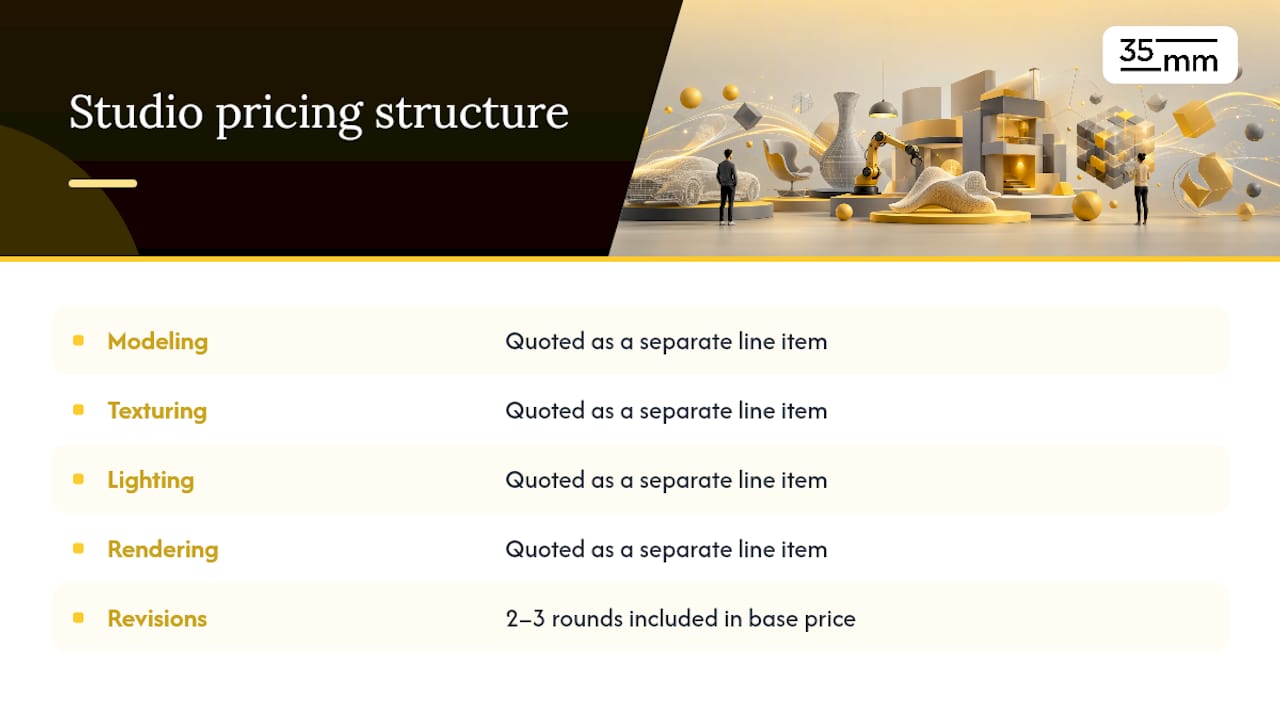
A few habits consistently keep costs down on our end. Clients who provide CAD files or manufacturer spec sheets up front skip a modeling step entirely. Batching product shots into a single order, rather than commissioning them one at a time, usually earns a better per-unit rate. And locking references before work begins is the single biggest lever against scope creep, since a "just try a different angle" request after modeling starts almost always counts as new work, not a revision.
How Does the Software You Choose Affect 3D Modeling Cost?
The software a modeler uses shapes labor cost more than most buyers expect, mainly through licensing overhead and speed. Blender is free and open source, which is one reason freelancers using it can sometimes quote lower than studios running licensed pipelines. That doesn't automatically mean lower quality, but it does mean the modeler is absorbing zero software cost, which shows up in their hourly rate.
Industry-standard paid tools (used heavily in film, product visualization, and architectural rendering) carry monthly or annual license fees that studios factor into their overhead, and by extension, into their rates. A studio running a full pipeline, modeling in one application, texturing in a second, rendering in a third, is paying for several licenses per artist, which is part of why studio quotes often run higher than a single freelancer working entirely in Blender.
Real-time engines used for AR and web-based 3D viewers add another variable: optimizing a model to run smoothly in a browser or AR app takes extra passes that a static render never needs, since the geometry has to stay light enough for real-time performance while still looking convincing from every angle. If your end use case is an interactive product viewer rather than a static image, expect that to add to the quote, not because the modeling software costs more, but because the deliverable itself requires more engineering.
Rendering engine choice also matters. Physically accurate render engines that simulate real light behavior generally take longer to render at high quality than faster, more stylized engines, and that render time gets priced into the final invoice whether you see it broken out or not.
Should You Outsource 3D Modeling or Hire In-House?
The math on in-house hiring rarely favors it until your volume is genuinely high. A dedicated 3D artist needs a capable workstation, licensed software, and a salary, and studio-level estimates put the full package, hardware, software, and pay, at $70,000 or more per year. That number only starts to make financial sense if you have consistent, ongoing modeling needs, not occasional projects.
For most brands, outsourcing wins on flexibility alone. You pay for the work you need, when you need it, without carrying a salary through slow months. An outside studio also brings a team, not one person's skill ceiling, meaning texturing, lighting, and rendering are each handled by someone who specializes in that step rather than one generalist juggling all of them.
The trade-off is coordination. In-house modelers sit in your Slack channel and can turn around a same-day tweak. Outsourced work runs on a quote-and-revision cycle, which is fast but not instant. For companies producing a handful of campaigns or product lines a year, that trade-off almost always favors outsourcing, since the break-even point on a full-time hire simply never arrives. For companies producing new visuals every week, in-house or a long-term studio retainer starts to make more sense, provided the volume is real and not just anticipated.
When Should You Choose a Studio, a Freelancer, or AI Rendering?
Freelancers suit single, well-defined deliverables. Studios earn their higher rate on complex or brand-critical work where consistency across dozens of assets actually matters. AI-assisted rendering is closing gaps on speed, but it still needs a trained eye to catch what looks almost right. For most brands commissioning campaign-grade visuals, a studio remains the safer bet.
Get an Itemized 3D Modeling Quote From 35milimetre
35milimetre gives you something a freelance marketplace listing can't: a full post-production team, a post-production artist, a graphic designer, and a 3D artist, working from one brief instead of three separate hires you'd have to coordinate yourself. That matters most when a project needs CGI, retouching, and compositing to land as one cohesive image rather than three mismatched pieces stitched together.
The studio has spent over two decades building visuals for technology and automotive brands, which means the quote you get back is already scoped by people who have priced this exact kind of complexity before. A typical starting conversation covers your references, target realism, deliverable format, and expected revision rounds, so the number you receive is itemized by modeling, texturing, and rendering rather than a single opaque figure. If you're weighing 3D rendering against traditional photography for an upcoming campaign, that same conversation can help you figure out which route actually saves money for your specific catalog size.
Ready to see a real number against your project? Request a quote from 35milimetre and bring your references, target format, and variant count to get an itemized breakdown back fast.
Benchmarks to Check Your Estimate
- Eyedex's 3D model cost calculator for per-category price ranges
- Thumbtack's 3D modeling price guide for national averages